

The Quote
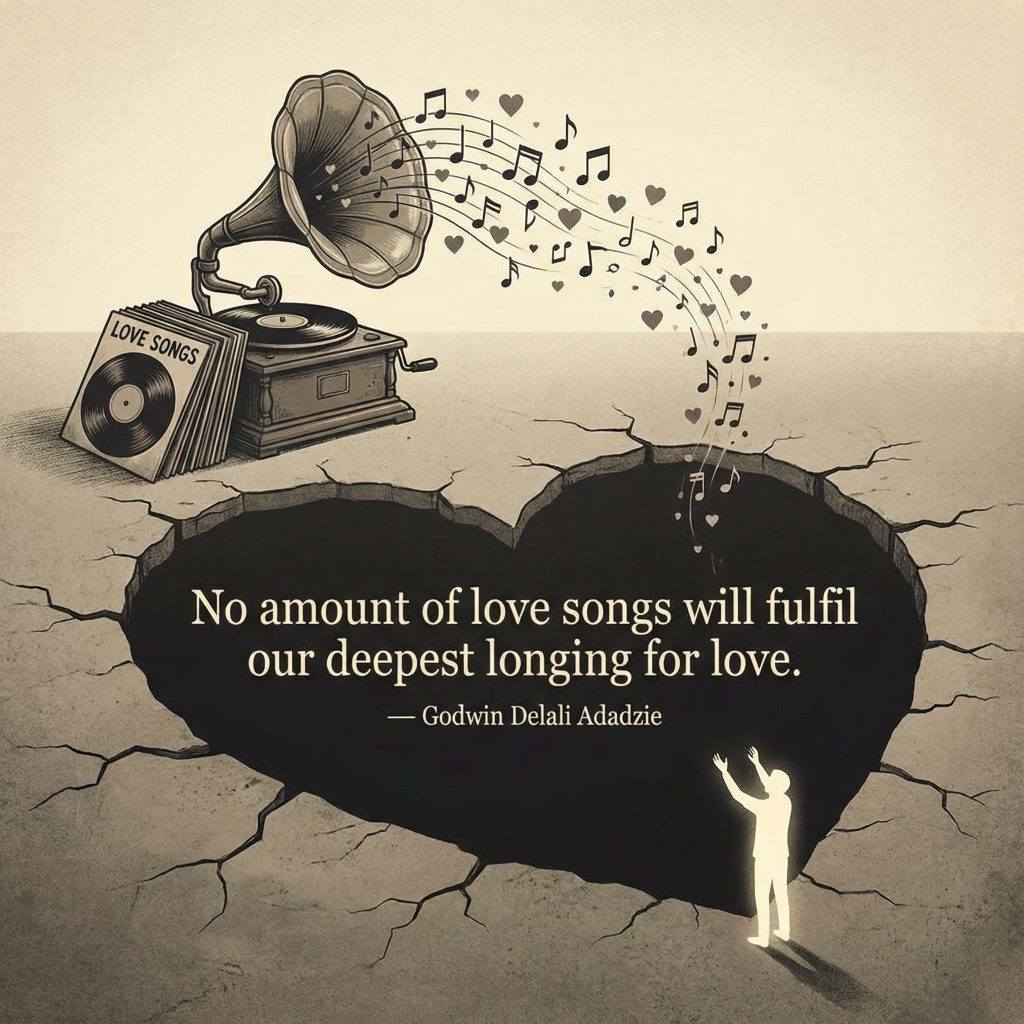
“No amount of love songs will fulfil our deepest longing for love.”
— Godwin Delali Adadzie
Context and Inspiration
This reflection addresses a pattern of substitution that marks modern life: replacing what we truly need with representations, simulations, or lesser versions of it. The observation uses love songs as an example—beautiful expressions about love that can stir emotions and provide temporary satisfaction, but ultimately cannot replace actual love. People can listen to thousands of songs about love, watch countless movies depicting romance, read endless books describing relationships, and still feel the ache of unloved loneliness because these are descriptions of love, not love itself. The pattern extends beyond romance. No amount of food shows satisfies hunger. No amount of travel documentaries replaces actual travel. No amount of sermons about God replaces knowing God. Substitutes provide the illusion of satisfaction while leaving the deepest hunger unfed. Understanding this helps people stop consuming endless substitutes and start pursuing what they actually need—not more content about love, but love itself; not more teaching about God, but God Himself; not more descriptions of life, but actually living.
The Universal Longing for Love
Every human being longs for love—to be known, valued, cherished, and connected:
Created for Relationship: “The Lord God said, ‘It is not good for the man to be alone'” (Genesis 2:18). God created humans for relationship, not isolation.
This longing for connection is built into human nature. It’s not weakness—it’s design.
Longing Testifies to Reality: C.S. Lewis wrote: “If I find in myself desires which nothing in this world can satisfy, the only logical explanation is that I was made for another world.”
Our longing for perfect love that human relationships can’t fully satisfy points to God—the source of perfect love.
The Heart’s Restlessness: Augustine prayed: “You have made us for yourself, O Lord, and our heart is restless until it finds rest in you.”
The deepest longing isn’t just for human love—it’s for God’s love. Human love, wonderful as it is, never completely satisfies because it’s not ultimate.
Love as Greatest Need: Jesus identified the greatest commandment as loving God and loving others (Matthew 22:37-39). Love is central to human existence and fulfillment.
Why Substitutes Don’t Satisfy
Love songs—and all substitutes for real love—fail to satisfy for clear reasons:
Substitutes Are About Love, Not Love Itself: Hearing about a delicious meal doesn’t feed you. Reading about water doesn’t quench thirst. Listening to love songs doesn’t provide the experience of being loved.
Information, description, or representation of something isn’t the thing itself.
Substitutes Are Passive; Love Is Active: Listening to music is passive consumption. Real love is active participation—giving, receiving, risking, connecting.
Substitutes Are Safe; Love Is Vulnerable: You can’t be hurt by a song. But real love requires vulnerability. The safety of substitutes is also their limitation—they offer no risk and no real connection.
Substitutes Are Controllable; Love Isn’t: You control when to play a song, pause it, or turn it off. Real relationships can’t be controlled. The messiness is part of the reality.
Substitutes Require No Response; Love Does: A song doesn’t demand anything from you. Real love requires response—sacrifice, commitment, faithfulness, forgiveness.
Substitutes Are Temporary; Love Endures: A song ends. The feeling it creates fades. Real love, though it has ups and downs, persists through time and challenge.
Modern Substitution Patterns
Contemporary culture is filled with substitutes replacing reality:
Entertainment Replacing Experience: People watch shows about adventure rather than having adventures. They consume content about relationships rather than building actual relationships.
Social Media Replacing Community: Online connections replace face-to-face relationships. Likes and comments substitute for actual conversation and presence.
Pornography Replacing Intimacy: This is perhaps the most destructive substitution—sexual images replacing actual intimate relationship, creating addiction while increasing isolation.
Religious Activity Replacing Relationship with God: Church attendance, Bible knowledge, theological debates—these can become substitutes for actually knowing and walking with God.
Jesus condemned the Pharisees for exactly this: “These people honor me with their lips, but their hearts are far from me” (Matthew 15:8). They had the form without the reality.
Information Replacing Wisdom: People collect facts, quotes, and concepts without applying them or being transformed by them.
Self-Help Replacing Actual Help: Reading about change substitutes for the hard work of actually changing. Consuming content about growth replaces actual growth.
Why People Choose Substitutes
If substitutes don’t satisfy, why do people consume them endlessly?
Substitutes Are Easier: Real love is hard. It requires vulnerability, sacrifice, and persistence. Love songs require only pressing play.
Substitutes Are Available: You can access substitutes immediately—streaming services, social media, entertainment on demand. Real relationships take time to build.
Substitutes Don’t Reject: A song won’t reject you. A movie won’t abandon you. Real people might. Substitutes feel safer even while leaving you empty.
Substitutes Create Illusion of Satisfaction: They provide temporary emotional response that feels like satisfaction. This tricks people into consuming more substitutes rather than pursuing reality.
Substitutes Don’t Demand Change: Real love transforms you. It calls you to grow, confront your issues, and become better. Substitutes let you stay exactly as you are.
Substitutes Are Socially Acceptable: Admitting you’re desperately lonely is stigmatized. Saying you love certain music is not. Substitutes hide need under acceptable behavior.
Substitutes Numb Pain: While they don’t satisfy the longing, they temporarily distract from it. This is addiction’s pattern—using something that doesn’t fulfill to avoid facing emptiness.
Biblical Examples of Longing and Fulfillment
The Woman at the Well (John 4:1-26): Jesus told her: “Everyone who drinks this water will be thirsty again, but whoever drinks the water I give them will never thirst. Indeed, the water I give them will become in them a spring of water welling up to eternal life.”
She was looking for love in wrong places—five husbands and now living with a man not her husband. Jesus offered what she truly needed—relationship with God.
The Prodigal Son (Luke 15:11-32): He tried to satisfy his longings with parties, pleasure, and wild living. But these substitutes left him empty, feeding pigs and starving.
Only returning to his father satisfied his deepest need—to be loved and accepted as a son.
David’s Psalms: David repeatedly expressed deep longing for God:
- “As the deer pants for streams of water, so my soul pants for you, my God” (Psalm 42:1)
- “My soul yearns, even faints, for the courts of the Lord” (Psalm 84:2)
- “O God, you are my God, earnestly I seek you; I thirst for you, my whole being longs for you” (Psalm 63:1)
David recognized that his deepest longing was for God, not for substitutes.
Solomon’s Search (Ecclesiastes): Solomon had everything—wisdom, wealth, pleasure, accomplishments, women. Yet he concluded: “Meaningless! Meaningless!… Everything is meaningless” (Ecclesiastes 1:2).
All the substitutes the world offers couldn’t satisfy. Only God satisfies.
What Actually Satisfies the Longing
If substitutes don’t work, what does?
God’s Love: “We love because he first loved us” (1 John 4:19). God’s perfect love is the foundation that satisfies our deepest longing.
No human love is perfect. All human love has limits, failures, and ends (at least in death). Only God’s love is perfect, unconditional, and eternal.
Real Human Relationships: Not substitutes for relationships, but actual presence, vulnerability, commitment, and connection with real people.
“Two are better than one, because they have a good return for their labor: If either of them falls down, one can help the other up” (Ecclesiastes 4:9-10).
Giving Love, Not Just Seeking It: “It is more blessed to give than to receive” (Acts 20:35). When you focus only on receiving love, you remain empty. When you give love, you find fulfillment.
Community: “And let us consider how we may spur one another on toward love and good deeds, not giving up meeting together, as some are in the habit of doing, but encouraging one another” (Hebrews 10:24-25).
Actual gathered community satisfies in ways isolated content consumption never can.
Purpose Beyond Self: Living for something greater than yourself provides meaning that self-focused pursuits can’t offer.
“For whoever wants to save their life will lose it, but whoever loses their life for me will find it” (Matthew 16:25).
Presence, Not Presentation: Being fully present with God and others, not performing or consuming content about them.
Moving from Substitutes to Reality
How do you stop consuming substitutes and pursue what actually satisfies?
Recognize the Pattern: Notice when you’re consuming content about love rather than giving or receiving actual love. Awareness is the first step.
Limit Consumption: Set boundaries on entertainment, social media, and other substitutes that create illusion without substance.
Risk Vulnerability: Real relationships require risk. You might get hurt. But staying safe with substitutes guarantees emptiness.
Invest Time: Real relationships take time. You can’t microwave genuine connection. Commit time to people.
Pursue God Directly: Don’t just consume content about God. Pray. Worship. Sit in silence with Him. Let Him speak to you through Scripture.
Serve Others: Get out of consumption mode into giving mode. Serve, help, love, give.
Accept Imperfection: Real relationships are messy. People fail. You fail. But imperfect reality beats perfect fantasy.
Create, Don’t Just Consume: Instead of endlessly consuming others’ expressions of love, create your own—write to someone, make something for them, express love actively.
The Danger of Perpetual Substitution
Living on substitutes creates serious problems:
Increasing Emptiness: Substitutes never satisfy, so you consume more and more while feeling emptier and emptier.
Relational Atrophy: Skills for real relationships deteriorate when you live in substitute world. You become less capable of actual connection.
Addiction Patterns: Substitutes can become addictive—you need increasing amounts to get the same temporary satisfaction.
Lost Time: Years can pass consuming substitutes that produce nothing lasting while opportunities for real relationships slip away.
Self-Deception: You can convince yourself that consuming content about love means you’re dealing with your loneliness. You’re not—you’re avoiding it.
Isolation: The more you consume substitutes, the more isolated you become, which increases longing, which drives more substitute consumption. It’s a destructive cycle.
For Those Who Feel Unloved
If you’re consuming substitutes because you feel unloved:
God Loves You: This isn’t trite—it’s foundational. “See what great love the Father has lavished on us, that we should be called children of God!” (1 John 3:1).
Your Longing Is Valid: Don’t shame yourself for wanting to be loved. That desire is God-given and good.
Substitutes Won’t Help: They’ll temporarily distract but ultimately deepen your pain. Stop the cycle.
Take Initiative: Don’t wait for others to reach out to you. Reach out to them. Join communities. Serve. Connect.
Address Barriers: If past hurt makes vulnerability difficult, address it through counseling, prayer, or trusted friends. Don’t let past wounds prevent future connection.
Give What You Seek: Want to be loved? Start loving others. This seems backwards but works.
Be Patient: Building real relationships takes time. Don’t give up when it’s not instant.
The Ultimate Love Song
Ironically, Scripture does contain love songs—the Psalms are full of them. But these aren’t substitutes for relationship with God—they express actual relationship.
David’s psalms weren’t about longing for God from a distance. They came from someone who knew God and expressed that relationship through song.
The difference: singing about God as someone you know versus singing about love you’re imagining.
One expresses reality. The other substitutes for it.
Song of Solomon celebrates human romantic love within covenant relationship. It’s not teaching about love from outside—it’s expressing love from inside.
This is the proper role of art, music, and expression—to express and celebrate reality, not to replace it.
Reflection Questions
- What substitutes are you consuming instead of pursuing real relationships?
- Are you spending more time consuming content about love than giving or receiving actual love?
- What makes substitutes feel safer than real relationships for you?
- When was the last time you took a real risk in relationship—with God or people?
- What would it look like to pursue actual love rather than representations of it?
- Is your loneliness driving you toward substitutes or toward God and real community?
Related Quotes
- “When the party is over, everyone leaves for their homes. This is the reality of life. You are left alone after all the merrymaking is over.”
- “God is not a genie. A genie God grants unlimited wishes unlike a genie with only 3 wishes.”
- “Truth is a bitter medicine. That’s why many can’t take it.”
Want to move from substitutes to real love and connection? Explore my books on faith and relationships, discover more quotes and reflections, or read more articles on finding genuine connection.
Disclaimer: Adadzie.com is the personal website of Godwin Delali Adadzie. Content represents personal views and does not constitute official Catholic teaching, pastoral counseling, or professional advice. Quotes and reflections are shared for inspiration and reflection. For personal guidance, consult appropriate professionals. Questions? Email delali@adadzie.com | Read Full Disclaimer