
The Quote
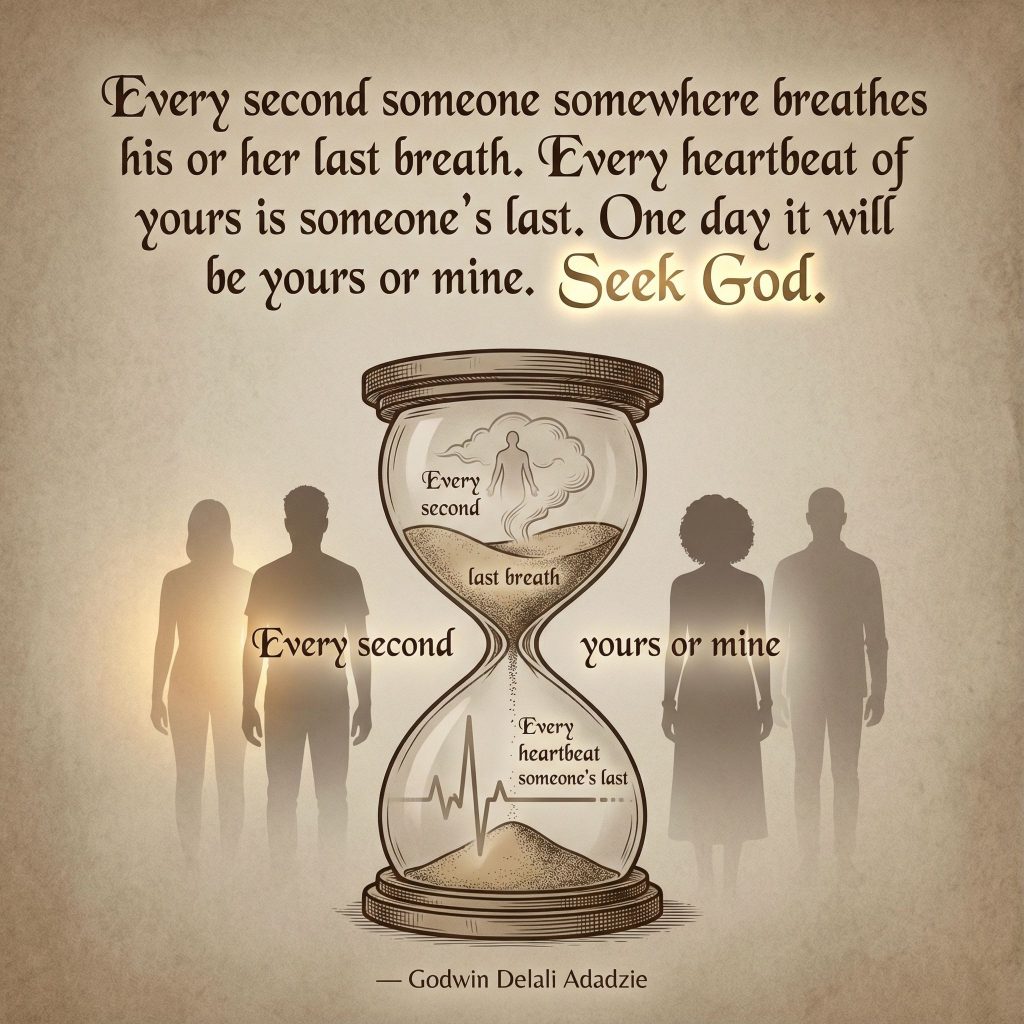
“Every second someone somewhere breathes his or her last breath. Every heartbeat of yours is someone’s last. One day it will be yours or mine. Seek God.”
— Godwin Delali Adadzie
Context and Inspiration
This reflection confronts a reality most people avoid thinking about: death is happening constantly, all around us, and will eventually happen to us. The observation creates visceral awareness of mortality by connecting your current moment—this heartbeat, this breath—to someone else’s final moment somewhere in the world. While you read these words, someone’s heart is stopping. While you continue your daily routine, countless people are experiencing their last seconds of earthly life. This isn’t morbid fascination with death—it’s sober recognition that should change how we live. Most people live as if they have unlimited time, postponing important decisions, delaying spiritual matters, assuming tomorrow will come. But death doesn’t wait for convenience. It comes to the prepared and unprepared, the young and old, the healthy and sick. Understanding that any heartbeat could be your last creates appropriate urgency not about panicking but about priorities—specifically, the priority of seeking God while you still have time. Because one day, your time will run out, and how you’ve responded to God will matter eternally.
The Reality of Constant Death
Death happens continuously, not occasionally:
Global Death Rate: Approximately 150,000-160,000 people die each day worldwide. That’s about 1.8 deaths per second.
Every second you exist, nearly two people somewhere are dying. Your heartbeat—someone’s last. Your breath—someone’s final one.
Job 14:1-2: “Mortals, born of woman, are of few days and full of trouble. They spring up like flowers and wither away; like fleeting shadows, they do not endure.”
Life is brief. Death is constant.
Psalm 90:10: “Our days may come to seventy years, or eighty, if our strength endures; yet the best of them are but trouble and sorrow, for they quickly pass, and we fly away.”
Even long life is short. It passes quickly. Then we “fly away”—a poetic description of death.
James 4:14: “Why, you do not even know what will happen tomorrow. What is your life? You are a mist that appears for a little while and then vanishes.”
Life is mist—here briefly, then gone. This isn’t pessimism—it’s reality.
Biblical Perspective on Mortality
Scripture consistently reminds us of death’s certainty:
Hebrews 9:27: “Just as people are destined to die once, and after that to face judgment.”
Death is appointment, not possibility. Everyone has this appointment. No exceptions.
Psalm 89:48: “Who can live and not see death, or who can escape the power of the grave?”
Rhetorical question with obvious answer: nobody. Death comes to all.
Ecclesiastes 3:2: “A time to be born and a time to die.”
Birth and death bookend life. The first happened without your choice. The second will happen regardless of your wishes.
Ecclesiastes 8:8: “No one has power over the wind to contain it; so no one has power over the day of their death.”
You control many things. Your death date isn’t one of them.
Psalm 39:4-5: “Show me, Lord, my life’s end and the number of my days; let me know how fleeting my life is. You have made my days a mere handbreadth; the span of my years is as nothing before you. Everyone is but a breath, even those who seem secure.”
David asked God to help him grasp his mortality. Recognizing life’s brevity matters spiritually.
Death Comes Without Warning
Death doesn’t announce itself:
Luke 12:16-21: Jesus told a parable about a rich man who had great harvest and planned to build bigger barns and enjoy many years of ease. “But God said to him, ‘You fool! This very night your life will be demanded from you.'”
He had plans. Death had other timing. His plans didn’t matter.
Proverbs 27:1: “Do not boast about tomorrow, for you do not know what a day may bring.”
Tomorrow isn’t guaranteed. Assuming it is creates false security.
Acts 12:21-23: King Herod gave a speech. People praised him as a god. “Immediately, because Herod did not give praise to God, an angel of the Lord struck him down, and he was eaten by worms and died.”
Healthy enough to give public address. Dead immediately. No warning.
Rich Young Ruler (Matthew 19:16-22): He asked about eternal life. Jesus told him what to do. He went away sad, choosing wealth over following Jesus.
Did he expect to have more time to decide? We never hear of him returning. What if he died that week, having made his choice?
Why People Ignore Mortality
If death is certain, why do people live as if it’s not?
Death Seems Distant: Young people especially feel immortal. Death happens to others, old people, sick people—not them.
But cemeteries are full of people who thought they had more time.
Modern Culture Denies Death: Society hides death—in hospitals, funeral homes, euphemisms. “Passed away,” “lost,” “departed”—anything but “died.”
This creates illusion that death isn’t that common or serious.
Fear Creates Avoidance: Thinking about death creates fear. People avoid thinking about what frightens them.
But avoiding thinking about death doesn’t prevent dying.
Busyness Distracts: Daily life’s demands keep people too busy to contemplate mortality.
This is sometimes intentional—staying busy avoids existential questions.
Pride Suggests Control: People like feeling in control. Death is ultimate loss of control. Pride resists acknowledging this.
No Immediate Crisis: When health is good, death seems theoretical. Crisis makes mortality real, but by then it might be too late to prepare properly.
What Death Makes Urgent
Understanding mortality creates urgency about certain matters:
Relationship with God: “Seek the Lord while he may be found; call on him while he is near” (Isaiah 55:6).
There’s a time when He may be found. That time is now, while you’re alive. Death ends that opportunity.
Repentance: “In the past God overlooked such ignorance, but now he commands all people everywhere to repent” (Acts 17:30).
Repentance must happen this side of death. There’s no second chance after.
Faith in Christ: “I tell you, now is the time of God’s favor, now is the day of salvation” (2 Corinthians 6:2).
Today is the day for salvation. Tomorrow might not come.
Reconciliation: “Therefore, if you are offering your gift at the altar and there remember that your brother or sister has something against you, leave your gift there in front of the altar. First go and be reconciled to them” (Matthew 5:23-24).
Relationships need reconciliation now. Death makes reconciliation impossible.
Living for What Matters: If you could die any moment, how would you live differently? That urgency should govern life now.
Preparing for Eternity: “What good will it be for someone to gain the whole world, yet forfeit their soul?” (Matthew 16:26).
Eternity is longer than time. Preparation for eternity is most important preparation.
Seeking God: What It Means
The quote’s conclusion—”Seek God”—is the appropriate response to mortality:
Seeking Is Active: Seeking isn’t passive waiting or casual interest. It’s active pursuit with urgency and intention.
“You will seek me and find me when you seek me with all your heart” (Jeremiah 29:13).
Seeking Requires Humility: Seeking God means admitting you need Him, that you’re not self-sufficient, that you face death you cannot prevent.
Seeking Means Repenting: You can’t genuinely seek God while clinging to sin. Seeking involves turning from sin toward God.
Seeking Involves Faith: “And without faith it is impossible to please God, because anyone who comes to him must believe that he exists and that he rewards those who earnestly seek him” (Hebrews 11:6).
Seeking Results in Finding: God doesn’t hide from those who genuinely seek. “Ask and it will be given to you; seek and you will find” (Matthew 7:7).
Seeking Changes Everything: When you truly find God, everything changes—priorities, values, understanding, hope, purpose.
What Seeking God Before Death Accomplishes
Why does seeking God matter when facing mortality?
Eternal Life: “For God so loved the world that he gave his one and only Son, that whoever believes in him shall not perish but have eternal life” (John 3:16).
Physical death isn’t the end for those in Christ. Eternal life begins.
Peace with God: “Therefore, since we have been justified through faith, we have peace with God through our Lord Jesus Christ” (Romans 5:1).
Without seeking God, you face judgment. With Christ, you have peace.
Forgiveness: “If we confess our sins, he is faithful and just and will forgive us our sins and purify us from all unrighteousness” (1 John 1:9).
Death with unforgiven sin is terrifying. Death with forgiven sin through Christ is transition to presence of God.
Hope: “We believe that Jesus died and rose again, and so we believe that God will bring with Jesus those who have fallen asleep in him” (1 Thessalonians 4:14).
Death isn’t hopeless end—it’s doorway to resurrection life.
Purpose in Living: Knowing God gives meaning to life before death. Life isn’t just waiting to die—it’s living with eternal purpose.
Peace in Dying: Those who know God can face death with peace. “Even though I walk through the darkest valley, I will fear no evil, for you are with me” (Psalm 23:4).
The Danger of Delay
Many people plan to seek God later:
“I’ll Seek God When I’m Older”: But older might never come. Thousands die young daily.
“I’ll Get Right with God Before I Die”: But death often comes without warning. You won’t have time for deathbed conversion if heart attack, accident, or sudden illness takes you instantly.
“I Have Time”: You hope you have time. You don’t know you have time.
James 4:13-15 warns against presuming on tomorrow: “Now listen, you who say, ‘Today or tomorrow we will go to this or that city, spend a year there, carry on business and make money.’ Why, you do not even know what will happen tomorrow… Instead, you ought to say, ‘If it is the Lord’s will, we will live and do this or that.'”
Rich Fool’s Mistake (Luke 12:16-20): He planned for many years. He had that very night. His delay was fatal.
Felix and Paul (Acts 24:24-25): When Paul spoke about righteousness, self-control, and judgment, Felix was afraid and said, “That’s enough for now! You may leave. When I find it convenient, I will send for you.”
Did convenient time come? Scripture doesn’t say Felix ever responded to the Gospel. His delay may have been eternal tragedy.
How to Seek God Today
If mortality creates urgency to seek God, how do you do it?
Acknowledge Your Need: Admit you’re a sinner who needs God. “For all have sinned and fall short of the glory of God” (Romans 3:23).
Believe in Jesus: “If you declare with your mouth, ‘Jesus is Lord,’ and believe in your heart that God raised him from the dead, you will be saved” (Romans 10:9).
Repent: Turn from sin toward God. “Repent, then, and turn to God, so that your sins may be wiped out” (Acts 3:19).
Call on Him: “Everyone who calls on the name of the Lord will be saved” (Romans 10:13).
This isn’t complex ritual. It’s genuine turning to God through faith in Christ.
Then Live for Him: Seeking God isn’t one moment—it’s ongoing life orientation. Daily prayer, Scripture reading, obedience, worship, fellowship with believers.
Living with Mortality Awareness
How should awareness of mortality change daily life?
Prioritize What Matters: If you could die today, what would matter? Eternal things—relationship with God, loving others, living with purpose.
Temporary things—possessions, status, comfort—diminish in importance.
Reconcile Relationships: Don’t let conflicts fester. “Do not let the sun go down while you are still angry” (Ephesians 4:26).
Every goodbye could be final. Live accordingly.
Live with Urgency: Not frantic panic, but purposeful urgency. Your time is limited. Use it well.
“Be very careful, then, how you live—not as unwise but as wise, making the most of every opportunity” (Ephesians 5:15-16).
Share the Gospel: If people are dying constantly and eternity matters, sharing Christ becomes urgent.
Be Ready: Live in such a way that if death came today, you’d be ready. “Therefore keep watch, because you do not know the day or the hour” (Matthew 25:13).
Value Each Day: Every morning is gift. Every breath is grace. Live gratefully.
For Those Who’ve Sought God
If you’ve already sought and found God through Christ:
Your Death Is Different: “For to me, to live is Christ and to die is gain” (Philippians 1:21). Death isn’t end—it’s promotion to presence of Christ.
Help Others Seek: Your urgency should extend to helping others find God before their time runs out.
Live Faithfully: You don’t know how many heartbeats remain. Use them for His glory.
Face Death Without Fear: “Where, O death, is your victory? Where, O death, is your sting?” (1 Corinthians 15:55). Christ has defeated death.
Look Forward: “I desire to depart and be with Christ, which is better by far” (Philippians 1:23). Paul could say this because he knew Christ.
Reflection Questions
- When was the last time you seriously contemplated your own mortality?
- Are you living as if you have unlimited time? What would change if you acknowledged you might not?
- Have you sought God, or are you postponing it?
- If your last heartbeat came today, are you ready for what comes after?
- What relationships need reconciliation before it’s too late?
- Are you helping others seek God with the urgency mortality demands?
Related Quotes
- “Faith is a journey. Not a one day trip. It is a life’s journey.”
- “Once you are in this world, challenges will always come. Whether you are ready or not.”
- “Everything is expensive. You just pay for it now or later.”
Want to understand what it means to seek God and prepare for eternity? Explore my books on faith and salvation, discover more quotes and reflections, or read more articles on eternal perspective.
Disclaimer: Adadzie.com is the personal website of Godwin Delali Adadzie. Content represents personal views and does not constitute official Catholic teaching, pastoral counseling, or professional advice. Quotes and reflections are shared for inspiration and reflection. For personal guidance, consult appropriate professionals. Questions? Email delali@adadzie.com | Read Full Disclaimer