
The Quote
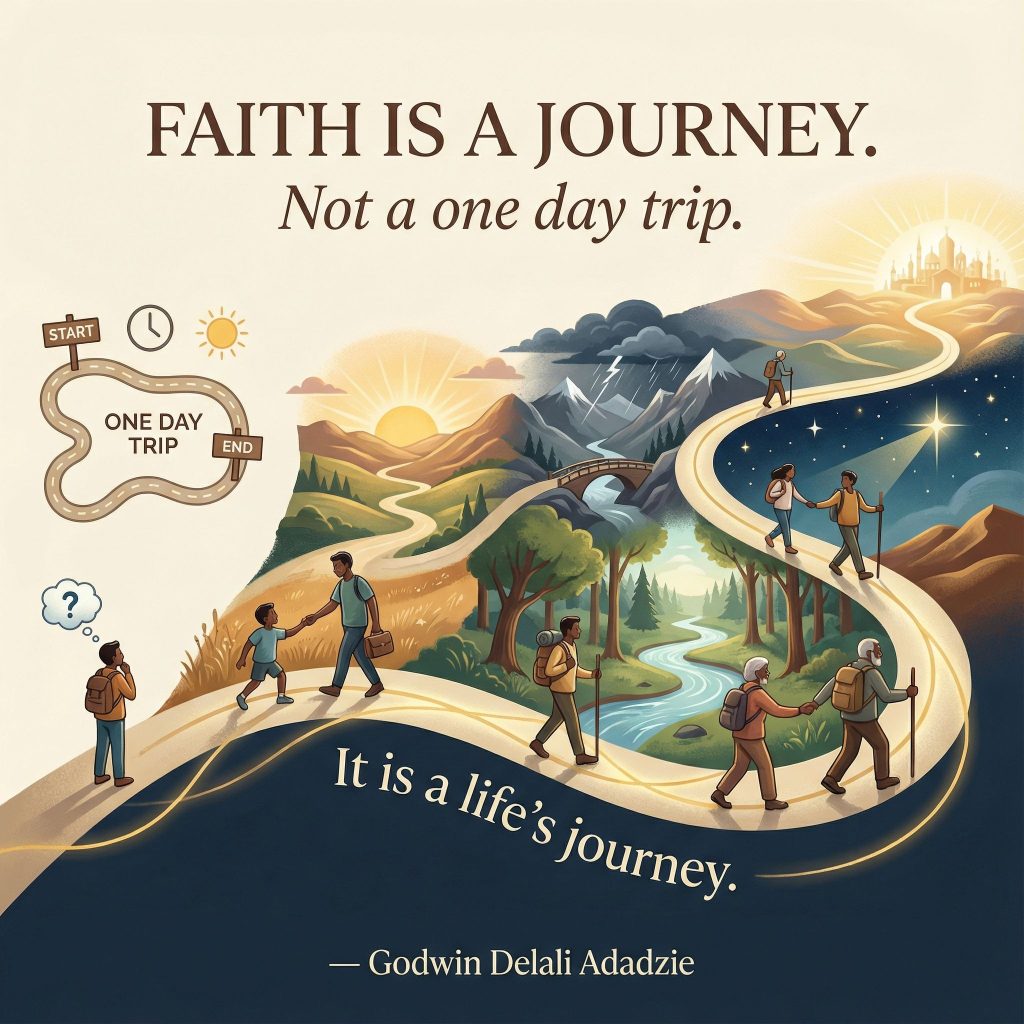
“Faith is a journey. Not a one day trip. It is a life’s journey.”
— Godwin Delali Adadzie
Context and Inspiration
This reflection addresses a common misunderstanding about faith: the belief that it’s primarily a single decision or moment rather than an ongoing process. The observation challenges both the “pray a prayer and you’re done” approach and the “crisis of faith means failure” mentality by repositioning faith as a lifelong journey with many stages, seasons, challenges, and growth opportunities. Many people treat faith like a destination—you arrive through conversion and that’s it. Others see faith as a one-time transaction—accept Jesus and collect your eternal life insurance. But biblical faith is portrayed as a walk, a race, a journey with beginning but no earthly end. This journey includes mountaintops and valleys, seasons of clarity and confusion, times of strength and weakness, periods of rapid growth and apparent stagnation. Understanding faith as a journey changes expectations, reduces shame when struggles come, creates patience for growth, and maintains hope through difficult seasons. You’re not failing because you haven’t arrived—you’re progressing because you’re still walking.
Biblical Language of Journey
Scripture consistently describes faith in journey terms:
Walk: “So I say, walk by the Spirit, and you will not gratify the desires of the flesh” (Galatians 5:16). Walking implies ongoing movement, not arrival.
“Enoch walked faithfully with God” (Genesis 5:24). His faith was described as continuous walking, not a single event.
Run: “Therefore, since we are surrounded by such a great cloud of witnesses, let us throw off everything that hinders and the sin that so easily entangles. And let us run with perseverance the race marked out for us” (Hebrews 12:1).
A race has stages. It requires perseverance. You don’t complete it in one step.
Path: “Trust in the Lord with all your heart and lean not on your own understanding; in all your ways submit to him, and he will make your paths straight” (Proverbs 3:5-6).
Paths are traveled over time, with twists and turns along the way.
Way: Jesus said, “I am the way and the truth and the life” (John 14:6). He’s not just the destination—He’s the path itself.
Pilgrimage: Abraham “made his home in the promised land like a stranger in a foreign country” (Hebrews 11:9). Faith made him a pilgrim, always journeying toward promises.
Following: Jesus called disciples to “follow me” (Matthew 4:19). Following is continuous action, not one-time decision.
This consistent journey language shows that faith is fundamentally about ongoing movement, not static arrival.
Why Faith Is a Journey, Not a One-Day Trip
Several realities make faith necessarily a lifelong journey:
Salvation Is Instant; Sanctification Is Process: You’re saved in a moment through faith in Christ. But becoming like Christ (sanctification) takes your entire life.
Paul wrote: “Therefore, my dear friends, as you have always obeyed—not only in my presence, but now much more in my absence—continue to work out your salvation with fear and trembling” (Philippians 2:12).
“Work out” doesn’t mean earn—it means live out, develop, apply. This takes time.
Human Capacity Is Limited: You can’t grasp all of God, all truth, or all spiritual reality in one day. Growth in understanding requires time and experience.
“Now we see only a reflection as in a mirror; then we shall see face to face. Now I know in part; then I shall know fully” (1 Corinthians 13:12).
Character Development Takes Time: Fruit of the Spirit—love, joy, peace, patience, kindness, goodness, faithfulness, gentleness, self-control—develop gradually through experiences, choices, and Spirit’s work.
Quick conversions happen. Quick character transformation doesn’t.
Life Brings Different Challenges: Faith adequate for your twenties needs deepening for your forties. Faith that sustains you single needs adjustment when married. Each life stage brings new challenges requiring faith growth.
God Reveals Progressively: God doesn’t show you everything at once. He reveals truth, calling, and understanding progressively as you’re ready.
Jesus told His disciples: “I have much more to say to you, more than you can now bear” (John 16:12). Progressive revelation requires journey.
Relationships Deepen Over Time: Faith is relationship with God, not just intellectual agreement. Relationships deepen through time, experience, communication, and shared history.
You don’t know someone deeply in one day. Growing intimacy with God takes lifetime.
Stages of the Faith Journey
Like any journey, faith has stages:
Beginning (Conversion): This is important—the journey starts somewhere. But it’s the beginning, not the whole journey.
Paul distinguished between spiritual infants and mature believers (1 Corinthians 3:1-2). You start as infant and grow toward maturity.
Early Enthusiasm: New believers often experience intense joy, passion, and spiritual highs. This stage is wonderful but not sustainable at that intensity.
Jesus’ parable of the sower describes those who receive the word with joy but have no root (Matthew 13:20-21). Early enthusiasm must develop depth.
Challenges and Doubts: Eventually, questions come. Doubts arise. Difficulties test faith. Some interpret this as faith failure. Actually, it’s normal stage of maturing faith.
John the Baptist, while imprisoned, sent disciples to ask Jesus, “Are you the one who is to come, or should we expect someone else?” (Matthew 11:3). Even strong faith faces doubt.
Deeper Learning: As you encounter questions and challenges, you dig deeper into Scripture, theology, and understanding. Your faith becomes less feeling-based and more truth-anchored.
Service and Purpose: Maturing faith moves from focusing on personal experience to serving others and fulfilling purpose.
Perseverance Through Difficulty: Long-term faith develops through sustained faithfulness during extended hardship.
Wisdom and Mentoring: Eventually, your journey experience enables you to guide others on theirs.
Not everyone experiences these in exact order, and you can revisit earlier stages. But the pattern generally moves toward greater depth, stability, and maturity.
Biblical Examples of Faith Journeys
Abraham: His journey spanned decades. Called at 75, received promised son at 100. Between the call and fulfillment were years of waiting, mistakes, and faith development.
Hebrews 11:8 says: “By faith Abraham, when called to go to a place he would later receive as his inheritance, obeyed and went, even though he did not know where he was going.”
That’s journey language—going without knowing the destination, trusting God step by step.
Moses: His faith journey had distinct stages: prince of Egypt, shepherd in wilderness, deliverer of Israel, wilderness wanderer, lawgiver. Each stage built on previous ones.
David: Shepherd, musician, warrior, fugitive, king. His Psalms show the journey—from confidence to despair to renewed trust, over and over.
Paul: Persecutor of church, dramatic conversion, years of preparation, missionary journeys, imprisonment, martyrdom. His faith deepened and matured through each phase.
Peter: Impulsive fisherman, bold disciple, denier of Christ, restored leader, church founder, martyr. His journey included spectacular failures and remarkable recovery.
In every case, faith was a journey with beginning, middle, and end—not instantaneous complete maturity.
What Changes Along the Journey
As you journey in faith, various things change:
Understanding Deepens: What you know about God, Scripture, theology, and spiritual truth grows exponentially from beginning to years later.
Relationship Becomes Real: Initial faith might be more about concepts. Over time, God becomes genuinely known, not just known about.
Character Transforms: You become genuinely different—more loving, patient, forgiving, humble. This happens gradually through Spirit’s work and your cooperation.
Priorities Shift: What matters to you changes. Early faith might focus on blessings. Mature faith focuses on God Himself and His purposes.
Doubt Changes: Doubt doesn’t disappear, but its nature changes. Early doubts: “Is any of this real?” Later doubts: “Why is God doing this?” The second assumes God’s reality while questioning specific circumstances.
Prayer Develops: Early prayers often resemble children asking parent for toys. Mature prayer becomes intimate conversation addressing God’s concerns, not just your wants.
Bible Reading Shifts: Initially, Scripture might feel disconnected or confusing. Over time, it becomes living, relevant, and personally applicable.
Trials Are Handled Differently: Early trials might devastate faith. Later trials, though still painful, don’t destroy faith because it’s deeper-rooted.
Common Journey Mistakes
Several misunderstandings about faith as journey cause problems:
Expecting Instant Maturity: Conversion is instant. Maturity is not. Expecting immediate deep understanding, perfect character, or complete transformation sets up disappointment.
Comparing Your Journey to Others’: Your journey is unique. Comparing your beginning to someone else’s middle creates false discouragement.
Interpreting Struggles as Failure: Struggles, doubts, and difficulties are normal journey features, not signs you’re doing it wrong.
Staying at the Start: Some people experience conversion but never move forward. They remain spiritual infants decades later because they stop walking.
Rushing the Journey: Some try to force rapid spiritual growth through intense activity. But depth comes through time and experience, not just effort.
Abandoning Journey During Hard Stages: Some quit when the journey gets difficult, not realizing hard stages are temporary and produce necessary growth.
Focusing on Destination Instead of Companion: The journey’s purpose isn’t just reaching heaven—it’s knowing God intimately. Focus on walking with Him, not just arriving somewhere.
Sustaining Faith Through the Journey
How do you keep walking over decades?
Remember It’s a Marathon, Not Sprint: Pace yourself. Sustainability matters more than intensity.
“Let us run with perseverance the race marked out for us” (Hebrews 12:1). Perseverance is key.
Stay Connected to God: Daily prayer, Scripture reading, worship—these maintain relationship that sustains journey.
Find Community: “And let us consider how we may spur one another on toward love and good deeds, not giving up meeting together” (Hebrews 10:24-25).
You need fellow travelers. Isolation kills perseverance.
Learn from All Seasons: Growth happens in both good and bad seasons. Don’t waste difficulties by only resenting them—learn from them.
Keep Perspective: Remember where you started and how far you’ve come. This creates gratitude and motivation.
Adjust Expectations: Different seasons require different approaches. Young parent’s faith walk looks different from retiree’s. Both are valid.
Celebrate Progress, Not Just Perfection: Acknowledge growth even when you’re not “there yet.” Progress matters.
Stay Humble: “So, if you think you are standing firm, be careful that you don’t fall!” (1 Corinthians 10:12). Pride precedes falls. Humility sustains journey.
Return After Falling: When you stumble, get back up. “Though the righteous fall seven times, they rise again” (Proverbs 24:16).
Falling doesn’t end journey—staying down does.
When the Journey Feels Too Long
Sometimes the journey exhausts you:
Remember the Destination: “I press on toward the goal to win the prize for which God has called me heavenward in Christ Jesus” (Philippians 3:14).
The destination is real and worth the journey.
Rest Along the Way: Even long journeys include rest stops. Jesus often withdrew to solitary places. Sabbath is built into journey rhythm.
Focus on Today: Don’t carry tomorrow’s journey today. “Therefore do not worry about tomorrow, for tomorrow will worry about itself” (Matthew 6:34).
Walk today’s portion. That’s enough.
Find Encouragement in Scripture: Read stories of others who completed their journey. Hebrews 11 recounts faithful journeyers. Their example encourages yours.
Look for Fellow Travelers: When discouraged, connecting with others on the journey reminds you that you’re not alone.
Remember God’s Faithfulness: He’s sustained you this far. He’ll sustain you the rest of the way. His faithfulness doesn’t expire mid-journey.
The Journey’s End
The faith journey ends only when life ends:
Earthly Journey Concludes at Death: Paul, facing death, said: “I have fought the good fight, I have finished the race, I have kept the faith” (2 Timothy 4:7).
He finished the race, but only when life ended.
Eternal Journey Begins: Death isn’t faith’s end—it’s transition to new phase. Faith becomes sight. Journey continues in perfection.
“Now we see only a reflection as in a mirror; then we shall see face to face” (1 Corinthians 13:12).
Finish Strong: The goal isn’t just starting well but finishing well. Many start the journey. Fewer finish faithfully.
Your Journey Impacts Others: How you walk affects those watching. Your faithful journey encourages others on theirs.
Reflection Questions
- What stage of the faith journey are you in currently?
- Are you treating faith as one-day trip or lifelong journey?
- What challenges in your current season are actually normal journey features, not failures?
- How has your faith changed from when you started?
- Are you comparing your journey to others’ in unhelpful ways?
- What helps you sustain faith over the long haul?
Related Quotes
- “Once you are in this world, challenges will always come. Whether you are ready or not.”
- “Life itself is the seesaw. It comprises of ups and downs.”
- “Before the storm, there is calm. After the storm, there is calm. This is the mystery of life.”
Want to walk faithfully through all seasons of the journey? Explore my books on faith and perseverance, discover more quotes and reflections, or read more articles on growing in faith.
Disclaimer: Adadzie.com is the personal website of Godwin Delali Adadzie. Content represents personal views and does not constitute official Catholic teaching, pastoral counseling, or professional advice. Quotes and reflections are shared for inspiration and reflection. For personal guidance, consult appropriate professionals. Questions? Email delali@adadzie.com | Read Full Disclaimer