
The Quote
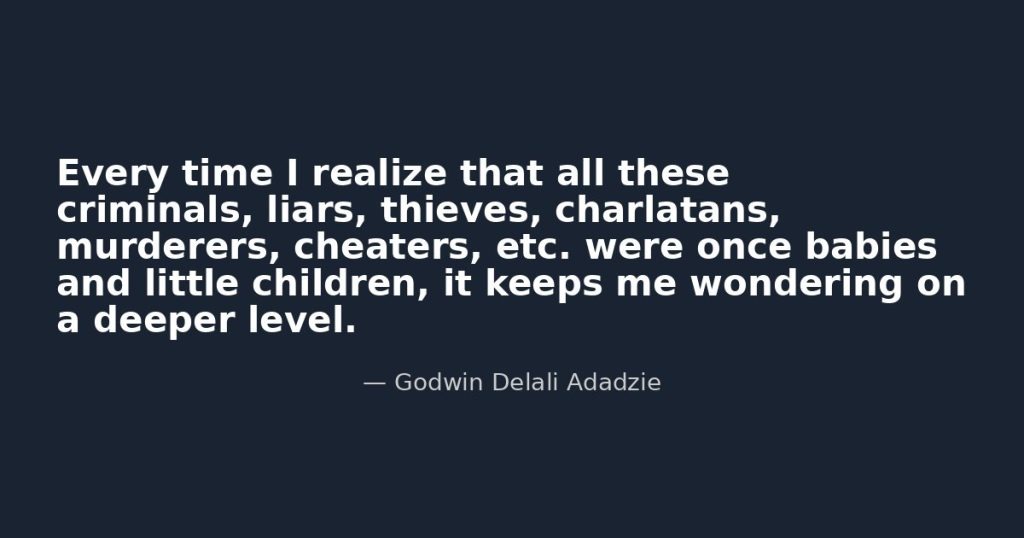
“Every time I realize that all these criminals, liars, thieves, charlatans, murderers, cheaters, etc. were once babies and little children, it keeps me wondering on a deeper level.”
— Godwin Delali Adadzie
Context and Inspiration
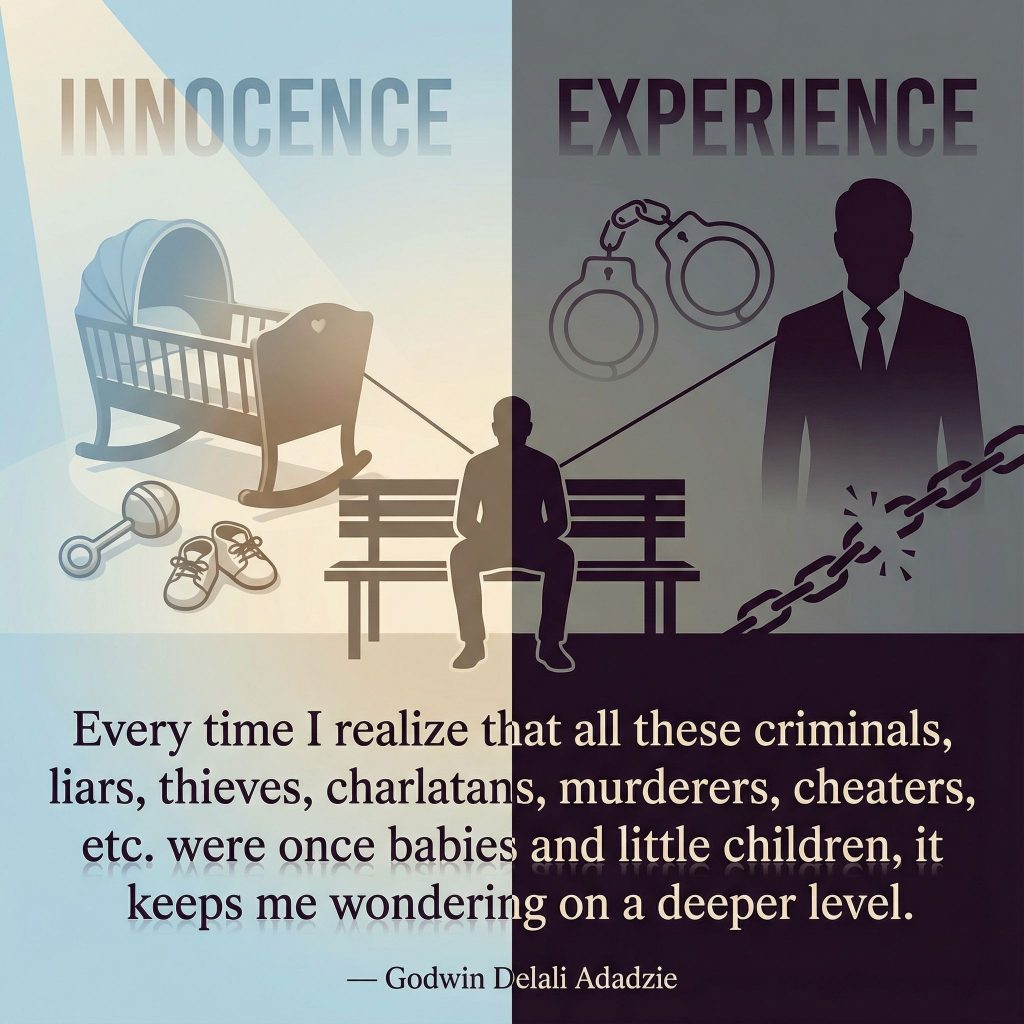
This reflection addresses one of the most troubling questions about human nature: how does an innocent child become someone who causes serious harm? The observation invites us to look beyond simple condemnation of wrongdoing and consider the complex journey from childhood innocence to adult corruption. Every person who commits terrible acts was once a baby held with tenderness, a toddler learning to walk, a child playing and laughing. This reality challenges us to think more carefully about moral development, personal responsibility, the effects of environment and choice, and the possibility of redemption. The question isn’t meant to excuse evil behavior, but rather to understand it more completely—recognizing that transformation from innocence to wrongdoing involves both external influences and internal choices that shape a person’s character over time.
The Universal Starting Point
No baby is born a criminal. No toddler plots theft or murder. No young child schemes to deceive and cheat others. Every human being begins life with a fundamental innocence, even if not with moral perfection.
The Scriptures affirm this reality. When Jesus wanted to illustrate the nature of His kingdom, He didn’t point to kings or warriors or scholars. He pointed to children: “Let the little children come to me, and do not hinder them, for the kingdom of heaven belongs to such as these” (Matthew 19:14).
Children possess a natural openness, trust, and simplicity that Jesus held up as the model for entering God’s kingdom. They haven’t yet built the complex layers of deception, pride, and self-justification that characterize much adult sin.
This doesn’t mean children are morally perfect. Catholic theology recognizes that even infants carry original sin—the wounded nature inherited from Adam and Eve (Romans 5:12). But original sin is different from actual sin. A baby hasn’t chosen evil. A toddler hasn’t deliberately rejected God. A young child hasn’t formed patterns of serious wrongdoing.
So the question becomes: What happens between that innocent beginning and the adult who commits terrible acts? How does the journey from childhood to criminality occur?
The Process of Moral Corruption
The transformation from innocent child to serious wrongdoer rarely happens overnight. It’s almost always a process—sometimes slow, sometimes accelerated by trauma, but always involving multiple factors that work together to shape a person’s moral direction.
Environment and Example: Children learn by watching. If a child grows up surrounded by violence, dishonesty, cruelty, and selfishness, those patterns become normalized. What should shock and disturb instead becomes familiar and acceptable.
Proverbs 22:6 says, “Train up a child in the way he should go; even when he is old he will not depart from it.” This works both ways. Train a child in goodness, and they tend toward goodness. Train a child—deliberately or accidentally—in evil, and they tend toward evil.
A child raised in a home where lying is normal learns to lie. A child exposed to violence learns that violence solves problems. A child taught that other people exist only to be used learns to manipulate and exploit.
Woundedness and Pain: Many people who commit serious evil have themselves been victims of serious evil. Abuse, abandonment, neglect, trauma—these experiences wound the soul deeply, especially in childhood when a person’s identity and moral framework are still forming.
This doesn’t excuse later wrongdoing. Adults must take responsibility for their choices regardless of their past. But it does help us understand how pain can twist a person’s development. Hurt people often hurt people.
The thief may have grown up in desperate poverty, learning that taking what you need is survival. The violent person may have been beaten as a child, internalizing the lesson that strength means dominating others through fear. The liar may have learned that truth brings punishment while deception brings safety.
Small Compromises Leading to Big Sins: Serious evil rarely starts with murder or major theft. It usually begins with small moral compromises that gradually expand.
A child tells a small lie to avoid punishment. It works. The lie gets bigger. The pattern strengthens. Years later, lying has become second nature—a reflexive response to any uncomfortable situation.
A teenager shoplifts something small for the thrill. The rush is exciting. The fear of getting caught fades. The theft escalates. Eventually, stealing becomes a regular pattern.
Jesus warned about this progression: “Whoever can be trusted with very little can also be trusted with much, and whoever is dishonest with very little will also be dishonest with much” (Luke 16:10). The inverse is also true: whoever is dishonest with very little will grow toward being dishonest with much.
The Hardening of Conscience: God gives every person a conscience—an internal sense of right and wrong (Romans 2:14-15). But conscience can be trained, either toward greater sensitivity or toward numbness.
When someone repeatedly ignores their conscience, it becomes quieter. When they consistently choose wrong while knowing it’s wrong, their moral sense dulls. Eventually, things that once bothered them no longer register as problematic.
Paul describes this process: people who “have lost all sensitivity” and “have given themselves over to sensuality so as to indulge in every kind of impurity” (Ephesians 4:19). The conscience hasn’t disappeared, but it’s been so thoroughly ignored that it no longer functions effectively.
Cultural and Social Influences: The broader culture also shapes moral development. A society that glorifies violence, greed, sexual exploitation, and dishonesty produces people who view these things as normal or even admirable.
When popular entertainment celebrates criminals as heroes, when business culture rewards deception, when political life normalizes corruption, when social media amplifies cruelty—these patterns influence how people think about right and wrong.
Young people especially are vulnerable to these influences as they’re forming their identity and values. If the culture around them says that success means stepping on others, that loyalty is for fools, that pleasure justifies any means—they’ll internalize those messages unless stronger counter-influences exist.
Spiritual Warfare: Finally, Catholic theology recognizes that moral corruption isn’t just a natural process. There’s a spiritual dimension. The devil is real, and he actively works to corrupt souls, especially during vulnerable periods like childhood and adolescence.
Scripture is clear about this: “Your enemy the devil prowls around like a roaring lion looking for someone to devour” (1 Peter 5:8). The evil one doesn’t wait until people are adults. He begins his work early, exploiting wounds, amplifying temptations, and encouraging small compromises that lead to bigger falls.
This doesn’t remove human responsibility. People still make real choices. But it does mean the battle for a person’s soul is more than just a matter of environment and psychology. It’s a spiritual battle.
The Role of Personal Choice
Understanding the factors that contribute to moral corruption is important. But we must be careful not to let explanation become excuse.
Yes, environment matters. Yes, trauma affects development. Yes, cultural influences shape thinking. Yes, spiritual warfare is real.
But at the end of the day, each person makes choices. And those choices matter.
The Bible presents human beings as morally responsible agents, not merely victims of circumstance. God holds people accountable for their actions because people genuinely choose their actions.
Two children can grow up in the same terrible environment—one becomes a criminal, the other becomes a saint. Two people can experience similar trauma—one uses it as an excuse for harming others, the other uses it as motivation to prevent others from being harmed.
Joseph’s brothers sold him into slavery, but Joseph didn’t become bitter and vengeful. He chose a different path (Genesis 50:20). David committed adultery and murder, but he took responsibility rather than blaming his circumstances (Psalm 51).
This is the tension we must hold: Environmental and personal factors genuinely influence moral development, AND people remain responsible for their choices. Both are true simultaneously.
When Does Innocence End?
This raises a challenging question: At what point does a person cross from innocent child to morally responsible adult?
Catholic theology recognizes that moral responsibility develops gradually. Very young children don’t have the capacity for serious sin because they lack sufficient knowledge and freedom. As they grow, that capacity increases.
The Church traditionally sets the “age of reason” around seven years old—the point at which a child can generally understand right from wrong and make deliberate moral choices. This is why children typically receive their First Confession around this age.
But even then, full moral responsibility continues to develop throughout childhood and adolescence. A seven-year-old understands some moral concepts but not others. A teenager has greater capacity but still lacks the full maturity of an adult.
This matters when we think about how people become wrongdoers. A child who steals at age eight is not the same as an adult who steals at age thirty. Both actions are wrong, but the level of moral responsibility differs significantly.
The gradual nature of moral development means that the journey from innocent baby to serious wrongdoer involves many small steps, many choices, many influences working together over years. It’s a process, not a single moment.
The Mystery of Human Freedom
Even with all this understanding, a mystery remains. Why do some people, given every advantage, choose evil? Why do others, given every disadvantage, choose good?
We can identify contributing factors, but we cannot fully explain individual choices. Human freedom is real, and freedom means genuine unpredictability. People can surprise us—for better or worse.
This is both sobering and hopeful. Sobering because it means no amount of good environment, education, or opportunity guarantees good character. Even people raised in loving Christian homes can choose destructive paths.
But it’s also hopeful because it means no amount of bad environment, trauma, or disadvantage makes evil inevitable. People can rise above their circumstances. Grace can work in the most unlikely places. Redemption is always possible.
The thief on the cross next to Jesus had lived a life of crime (Luke 23:39-43). Whatever his childhood was like, his adult choices led to crucifixion. But in his final moments, he turned to Jesus in faith—and Jesus promised him paradise.
That’s the mystery and beauty of human freedom. It’s never too late to choose differently.
What Prevents the Slide?
If we understand how people move from innocence to wrongdoing, we can also understand what helps prevent that slide. Several key factors make a significant difference:
Strong, loving relationships: Children who experience consistent love, care, and healthy attachment are far less likely to become serious wrongdoers. Love doesn’t guarantee goodness, but its absence creates serious vulnerability.
The security of knowing they’re valued, the experience of being treated with respect, the modeling of healthy relationships—these shape a child’s moral development powerfully.
Clear moral teaching: Children need to be taught right from wrong explicitly, not left to figure it out on their own. They need to understand that some actions are genuinely wrong regardless of consequences or feelings.
This includes both positive instruction (“This is good because…”) and appropriate consequences for wrongdoing. Discipline, when done with love and consistency, helps form conscience.
Spiritual formation: For Christian families, this means teaching children about God, prayer, Scripture, and the life of virtue. It means helping them develop a relationship with Jesus, understand the reality of sin and grace, and learn to rely on God’s help in moral struggles.
Regular participation in the sacraments—especially Confession and Eucharist—provides ongoing grace that strengthens moral resistance to evil.
Healing of wounds: When children experience trauma, abuse, or significant loss, they need help processing those experiences in healthy ways. Unhealed wounds often become sources of moral corruption.
This might involve professional counseling, spiritual direction, supportive community, or simply caring adults who listen and help the child make sense of difficult experiences.
Good examples: Children need to see adults living with integrity, honesty, kindness, and courage. They need heroes who embody virtue, not just celebrities who embody success or pleasure.
When a child watches their parents keep promises, tell the truth even when it’s costly, treat others with respect, and practice their faith consistently, powerful lessons are learned through observation.
Accountability and community: People are less likely to drift into serious wrongdoing when they’re part of a community that knows them, cares about them, and holds them accountable.
This is one reason why strong families, good friendships, and active church involvement matter so much. These relationships create natural guardrails against moral corruption.
Looking at Wrongdoers with New Eyes
When we truly grasp that every criminal, liar, thief, and murderer was once an innocent child, it changes how we view them.
It doesn’t mean we excuse their actions. Wrong is still wrong. Victims still deserve justice. Society still needs protection from those who cause harm.
But it does mean we can look at wrongdoers with more complexity—seeing both the evil they’ve done AND the wounded child still somewhere inside them.
This is how Jesus looked at people. He never excused sin, but He also never reduced people to their worst actions. He saw the tax collectors, prostitutes, and sinners as people capable of redemption—not just as their current roles.
When Jesus encountered the woman caught in adultery (John 8:1-11), He didn’t say, “Adultery is fine.” He said, “Go and sin no more.” He acknowledged the wrong while also affirming her dignity and her capacity to change.
This balanced view—condemning evil while loving the person—is what Christianity requires of us.
The Hope of Transformation
The most hopeful aspect of recognizing that wrongdoers were once innocent children is this: If transformation happened in one direction (from innocence to evil), it can also happen in the other direction (from evil back to goodness).
The Bible is full of dramatic transformations:
Moses was a murderer who fled to the desert in shame (Exodus 2:11-15). God met him there and called him to lead His people out of slavery.
David committed adultery and arranged a murder to cover it up (2 Samuel 11). Yet after genuine repentance, he was called “a man after God’s own heart” (Acts 13:22).
Paul persecuted Christians, approving of their executions (Acts 8:1-3). Jesus appeared to him, and he became the greatest missionary in Christian history.
Peter denied Jesus three times out of fear (Matthew 26:69-75). Jesus restored him and made him the leader of the early Church.
Mary Magdalene was possessed by seven demons (Luke 8:2). Jesus freed her, and she became one of His most devoted followers.
These weren’t just minor improvements in already-decent people. These were radical transformations of people who had done seriously wrong things.
The same power that transforms children into wrongdoers—slowly, through choices and influences—can work in reverse. God’s grace can heal wounds, renew conscience, break destructive patterns, and redirect a life toward goodness.
This is the message of the Gospel: No one is beyond redemption. No life is so corrupted that God cannot restore it. No amount of evil can exhaust God’s mercy for those who genuinely repent.
As Paul wrote: “Therefore, if anyone is in Christ, the new creation has come: The old has gone, the new is here!” (2 Corinthians 5:17).
Our Responsibility
Recognizing how people move from innocence to wrongdoing creates certain responsibilities for us:
Protect children: We must do everything possible to create safe environments for children where abuse, neglect, and trauma are prevented. This includes supporting families, strengthening communities, and creating systems that protect vulnerable children.
Teach virtue: We need to be intentional about moral education—at home, in schools, in churches. Children need clear teaching about right and wrong, not just vague encouragement to “be good.”
Model integrity: Adults must live with the integrity we want to see in the next generation. Our hypocrisy teaches more powerfully than our words.
Offer help, not just judgment: When we encounter people who’ve done wrong, we should ask: “What happened to this person? How can they be helped?” alongside the necessary question: “What should be the consequence for their actions?”
Support redemption: We must create paths for people to change. When someone genuinely repents and seeks to live differently, we should support that transformation rather than permanently defining them by their worst moments.
Pray: We should pray for children who are vulnerable, for families that are struggling, for people who are drifting toward evil, and for those who are already deep in wrongdoing. God’s grace can reach anyone, anywhere.
Never give up hope: Even when someone seems completely hardened in evil, we should never conclude they’re beyond redemption. Only God knows the full state of any soul. Our job is to pray, to offer truth with love, and to trust God’s ability to transform hearts.
The Deeper Wonder
The quote speaks of wondering “on a deeper level” when we realize that all wrongdoers were once innocent children. What is this deeper level of wondering?
Perhaps it’s wonder at the mystery of human freedom—that we can choose such radically different paths from similar beginnings.
Perhaps it’s wonder at the fragility of goodness—how easily innocence can be corrupted when the right (or wrong) influences align.
Perhaps it’s wonder at the power of environment and experience—how much our surroundings shape who we become.
Perhaps it’s wonder at God’s patience—that He continues to offer grace and mercy to people who repeatedly reject Him.
Perhaps it’s wonder at the possibility of redemption—that the journey from innocence to evil can be reversed through God’s transforming power.
Or perhaps it’s all of these things together—a deep contemplation of what it means to be human, to have moral agency, to be capable of both great evil and great good, and to live in a world where grace offers hope even to the worst of us.
A Personal Examination
This reflection should also turn us inward. Each of us was once an innocent child. Each of us has made choices—small and large—that have shaped our character. Each of us has been influenced by environment, relationships, and spiritual forces.
When we look at our own lives honestly, we can trace the journey from childhood innocence to our current moral state. We can identify the moments we chose well and the moments we chose poorly. We can recognize the people and experiences that shaped us for good or for ill.
This self-knowledge should humble us. We may not be criminals or murderers, but we’re also not morally perfect. We’ve all made compromises. We’ve all ignored our conscience at times. We’ve all failed to be the people we should be.
And yet God’s grace is available to us too. The same transforming power that can redeem the worst wrongdoer can also help us grow from where we are toward greater holiness.
The question is: Are we willing to honestly examine our own journey? To take responsibility for our choices? To seek God’s help in becoming better? To allow His grace to complete the good work He began in us (Philippians 1:6)?
Reflection Questions
- When you think about people who’ve done terrible things, does it change your perspective to remember they were once innocent children? How?
- Looking at your own life, what influences helped protect you from serious wrongdoing? What influences pushed you toward bad choices?
- Are there small moral compromises in your life right now that could lead to bigger problems if you don’t address them?
- How can you help protect children in your circle of influence from the factors that lead to moral corruption?
- Is there someone you’ve written off as beyond redemption? How might God be calling you to pray for them or see them differently?
- What wounds from your own past might still be affecting your moral choices? Have you sought healing for those wounds?
Related Quotes
- “The enemy is not your friend but your friend can be the enemy.”
- “Truth is a bitter medicine. That’s why many can’t take it.”
- “There are levels of ignorance… Be humble, and learn from those who truly know.”
Want to grow in understanding human nature and God’s grace? Explore my books on faith and moral wisdom, discover more quotes and reflections, or read more articles on spiritual growth and transformation.
Disclaimer: Adadzie.com is the personal website of Godwin Delali Adadzie. Content represents personal views and does not constitute official Catholic teaching, pastoral counseling, or professional advice. Quotes and reflections are shared for inspiration and reflection. For personal guidance, consult appropriate professionals. Questions? Email delali@adadzie.com | Read Full Disclaimer