
The Quote
“Life itself is the seesaw. It comprises of ups and downs.”
— Godwin Delali Adadzie
Context and Inspiration
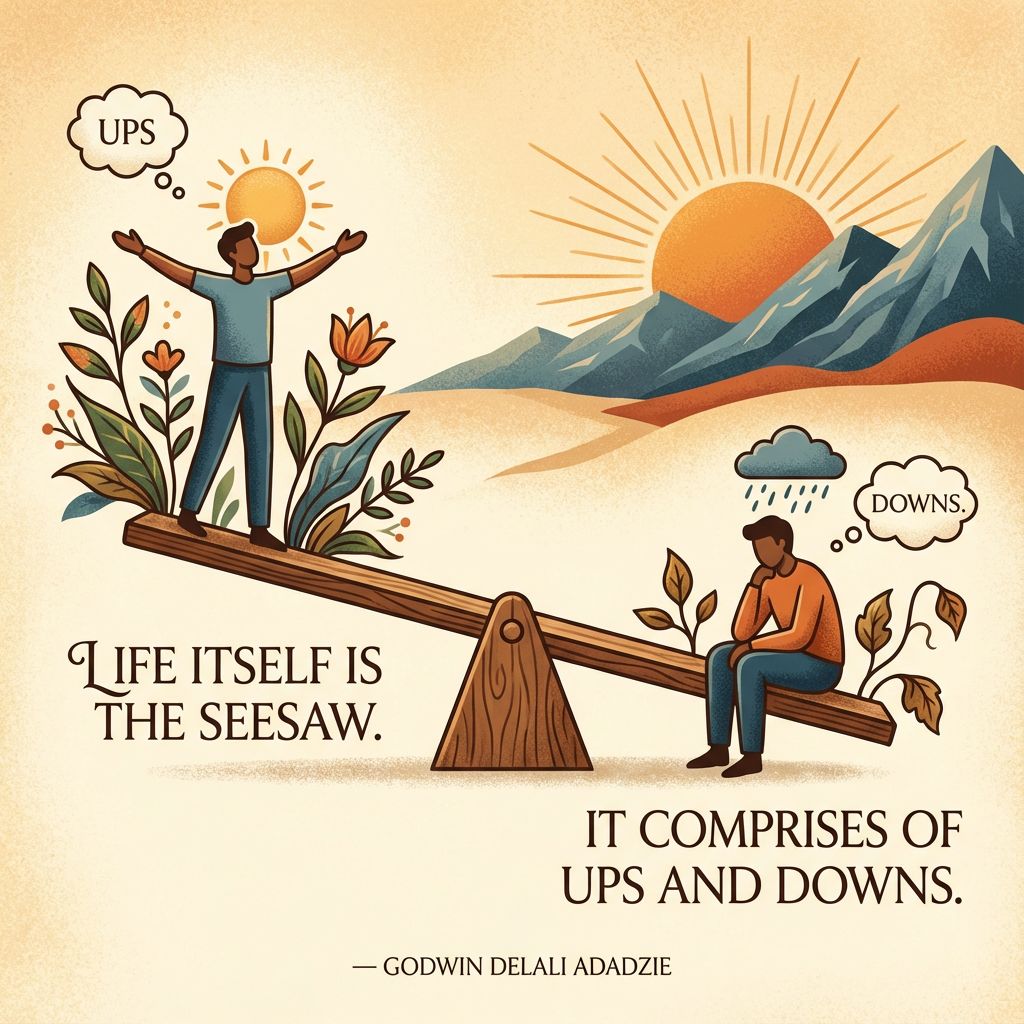
This reflection captures a fundamental reality about human existence that many people resist or fail to understand: life naturally fluctuates between high points and low points, success and setback, joy and sorrow, gain and loss. The image of a seesaw perfectly illustrates this pattern—when one side goes up, the other goes down, and the motion continues back and forth as long as the seesaw remains in use. Many people expect life to reach a stable high point and remain there permanently, becoming devastated when the inevitable down comes. Others experience a low point and assume they’ll be stuck there forever, unable to imagine the up that will eventually arrive. Understanding that life itself is this alternating pattern—not a malfunction when it happens but the normal rhythm—helps people navigate both seasons with greater peace, realistic expectations, and enduring hope. The question isn’t whether ups and downs will come, but how we respond when each phase arrives.
The Seesaw Image
A seesaw is a simple playground device with profound metaphorical power:
Constant Motion: A seesaw in use doesn’t stay still. It moves up and down, up and down. That’s its nature. Trying to stop it defeats its purpose.
Necessary Balance: Both sides matter. You can’t have only ups without downs. The down creates the momentum for the up. The up eventually yields to the down.
Depends on Weight and Force: Where you are on life’s seesaw partly depends on circumstances beyond your control (weight on each side) and partly on your responses (how you push off).
Temporary Positions: When you’re up, you won’t stay up forever. When you’re down, you won’t stay down forever. The motion continues.
The Pivot Point: In the middle is a fulcrum—a point of balance. Life has these pivot points too, brief moments between up and down where things feel stable before the next shift.
This image helps us understand that ups and downs aren’t evidence of something wrong—they’re evidence of being alive.
Biblical Affirmation of Life’s Ups and Downs
Scripture consistently acknowledges this pattern:
Ecclesiastes 3:1-8: “There is a time for everything, and a season for every activity under the heavens: a time to be born and a time to die, a time to plant and a time to uproot, a time to kill and a time to heal, a time to tear down and a time to build, a time to weep and a time to laugh, a time to mourn and a time to dance…”
Solomon lists fourteen pairs of opposites, showing that life contains both sides of each pair. You’ll experience both. That’s not abnormal—it’s life.
Psalm 30:5: “For his anger lasts only a moment, but his favor lasts a lifetime; weeping may stay for the night, but rejoicing comes in the morning.”
Notice the pattern: weeping then rejoicing. Night then morning. Down then up. But the up comes—morning follows night.
2 Corinthians 4:8-9: “We are hard pressed on every side, but not crushed; perplexed, but not in despair; persecuted, but not abandoned; struck down, but not destroyed.”
Paul experienced both sides repeatedly—hardship and deliverance, pressure and strength, trouble and survival. The Christian life isn’t exemption from downs but endurance through them.
Job’s Testimony: Job experienced the ultimate down—losing everything in a single day (Job 1:13-19). But later, God restored him with twice what he had before (Job 42:10-17). Down then up. That was his story.
Joseph’s Journey: Favored son (up), sold into slavery (down), promoted in Potiphar’s house (up), falsely accused and imprisoned (down), elevated to second in Egypt (up). His life was a seesaw, but ultimately God used all of it for good (Genesis 50:20).
David’s Cycles: Anointed as king (up), hunted by Saul (down), victorious warrior (up), scandal with Bathsheba (down), rebellion of Absalom (down), restoration (up). His psalms reflect this pattern—lament followed by praise, despair followed by hope.
Scripture doesn’t promise a life of only ups. It promises God’s presence through both ups and downs, and it shows that both seasons serve purposes in our development and in God’s plans.
The Downs: Low Points in Life
Let’s be honest about the downs—they’re painful and often feel unbearable:
Loss: Death of loved ones, end of relationships, loss of jobs, loss of health, loss of dreams. These downs cut deep and take time to process.
Failure: Business ventures that collapse, goals unmet, efforts that produce nothing. These shake confidence and question competence.
Betrayal: People you trusted turn against you. Friends abandon you. Those you helped forget you. These wounds strike at your ability to trust.
Illness: Physical sickness, chronic pain, mental health struggles. These affect everything and can feel endless.
Financial Hardship: Debt, unemployment, unexpected expenses. These create stress that touches every area of life.
Spiritual Dryness: Feeling distant from God, prayers seeming unanswered, faith tested. These make you question everything you believed.
Disappointment: Plans that don’t work out, expectations unmet, hopes deferred. These accumulate and weigh heavily.
The downs are real. They hurt. They’re not imaginary or insignificant. But they’re also not permanent, even when they feel that way.
The Ups: High Points in Life
The ups bring relief, joy, and celebration:
Achievement: Graduating, getting promoted, completing projects, reaching goals. These validate effort and build confidence.
Connection: Falling in love, making deep friendships, reconciliation after conflict, experiencing genuine community. These fill the heart.
Provision: Financial breakthrough, unexpected blessing, needs met abundantly. These reduce stress and enable generosity.
Health: Recovery from illness, strength returning, energy restored. These make everything else possible.
Spiritual Vitality: Experiencing God’s presence, answered prayers, growth in faith, clarity about calling. These anchor everything else.
Beauty: Moments of joy, laughter with loved ones, experiencing creation’s beauty, celebrations. These create memories that sustain during downs.
Purpose: Knowing you’re making a difference, using your gifts well, serving meaningfully. These give life significance.
The ups are wonderful. They’re gifts. But they’re also not permanent, even when we wish they were.
Why We Resist the Pattern
If ups and downs are normal, why do we fight this reality?
We Want Stability: Humans crave predictability and stability. The seesaw’s motion feels threatening because we can’t control it completely.
We Fear the Down: When we’re up, we dread falling. When we’re down, we fear staying down. This fear prevents us from enjoying the up or maintaining hope during the down.
We Compare to Others’ Highlight Reels: Social media shows everyone’s ups, not their downs. This creates the illusion that others live permanently up while we alone ride the seesaw.
We Misinterpret Downs as Punishment: Many people assume that downs mean they’ve done something wrong or God is angry. Sometimes that’s true, but often downs are just part of life’s rhythm, not divine judgment.
We Tie Identity to Current Position: When we’re up, we feel valuable. When we’re down, we feel worthless. But identity should be rooted in something more stable than current circumstances.
We Lack Perspective: In the moment, whatever we’re experiencing feels permanent. We can’t see that this too shall pass.
Cultural Messages Lie: Self-help culture promises you can eliminate downs through positive thinking, right techniques, or enough effort. This sets unrealistic expectations.
Wisdom for the Ups
When you’re experiencing an up, certain responses demonstrate wisdom:
Be Grateful: Acknowledge the blessing. Don’t take it for granted or assume it’s permanent.
Psalm 103:2 says: “Praise the Lord, my soul, and forget not all his benefits.” In good times, remember to thank God.
Prepare for the Inevitable Down: This isn’t pessimism—it’s wisdom. Save during abundance for scarcity. Build relationships during calm for support during crisis. Develop character during ease for strength during hardship.
Joseph stored grain during seven years of plenty to survive seven years of famine (Genesis 41:47-57). That’s wisdom, not negativity.
Stay Humble: Success can breed pride. But “God opposes the proud but shows favor to the humble” (James 4:6).
Remember that ups are often gifts, not just achievements. Stay teachable, grateful, and aware of your continued need for God.
Use the Up to Bless Others: When you’re experiencing abundance, health, or success, use it to help others.
2 Corinthians 1:4 says God “comforts us in all our troubles, so that we can comfort those in any trouble with the comfort we ourselves receive from God.”
Don’t Get Too Attached: Enjoy the up but hold it loosely. Everything earthly is temporary. Your security must be in God, not circumstances.
Build Spiritual Foundation: Use peaceful seasons to develop prayer life, study Scripture, and deepen relationship with God. These sustain you when downs come.
Wisdom for the Downs
When you’re experiencing a down, different wisdom applies:
Remember: This Is Temporary: Psalm 30:5 promises that “weeping may stay for the night, but rejoicing comes in the morning.” Morning comes. The down won’t last forever.
Don’t Make Permanent Decisions: Major life decisions made during lows often look foolish later. Survive the down, then decide.
Reach Out: Don’t isolate. Tell trusted people you’re struggling. Ask for help. Accept support.
Galatians 6:2 says: “Carry each other’s burdens, and in this way you will fulfill the law of Christ.”
Look for What God Is Teaching: Not every down is punishment, but every down offers lessons. What is this season revealing about your faith, your character, your priorities?
James 1:2-4 instructs: “Consider it pure joy, my brothers and sisters, whenever you face trials of many kinds, because you know that the testing of your faith produces perseverance.”
Hold Onto Hope: The up will come. You’ve survived previous downs. You’ll survive this one too.
Romans 5:3-5 says suffering produces perseverance, perseverance produces character, and character produces hope—”And hope does not put us to shame.”
Do Small Things: You can’t fix everything during a down. But you can do small things—get out of bed, take a shower, eat a meal, pray one sentence, take one step.
Something is better than nothing, even when you’re down.
Remember God’s Faithfulness: Look back at previous downs God brought you through. He was faithful then. He’ll be faithful now.
The Israelites built memorials to remember God’s past deliverance (Joshua 4:1-9). Your memory of past faithfulness sustains present faith.
The Pivot Points
Between ups and downs are brief moments of transition—pivot points where life feels balanced before tipping one direction or another.
These moments matter:
Recognize Them: Sometimes you’re neither clearly up nor clearly down—you’re in transition. Recognize this as its own season.
Make Choices: Pivot points offer opportunities for decisions that influence which direction you’ll go. Wise choices during transitions can extend ups or shorten downs.
Rest: Transitions are good times to rest, reflect, and recalibrate before the next up or down begins.
Stay Alert: Don’t sleepwalk through transition times. They’re often when important shifts happen.
Finding Stability in the Motion
If life is constant up and down motion, where do you find stability?
In God, Not Circumstances: Your circumstances will always fluctuate. But “Jesus Christ is the same yesterday and today and forever” (Hebrews 13:8).
When everything else moves, He remains constant. Anchor yourself to Him.
In Identity in Christ, Not Performance: Your worth isn’t determined by whether you’re up or down. It’s determined by Christ.
Romans 8:38-39 promises nothing can separate you from God’s love—not current circumstances, not future circumstances, nothing.
In Eternal Perspective, Not Temporary Reality: All ups and downs on earth are temporary. The eternal reality is unchanging.
2 Corinthians 4:17-18 says: “For our light and momentary troubles are achieving for us an eternal glory that far outweighs them all. So we fix our eyes not on what is seen, but on what is unseen, since what is seen is temporary, but what is unseen is eternal.”
In God’s Promises, Not Present Feelings: How you feel during an up or down is real but not ultimate. God’s promises remain true regardless of feelings.
In Community, Not Isolation: Relationships that endure through ups and downs provide stability the seesaw lacks. Build and maintain genuine community.
The Purpose of the Seesaw
Why does life work this way? Why not just stability?
Downs Develop Character: Hardship produces qualities that comfort never could—perseverance, compassion, humility, dependence on God, strength.
Ups Provide Rest and Encouragement: Good seasons restore you from hard seasons and give hope for enduring future hard seasons.
The Pattern Prevents Complacency: If life was always easy, we’d become soft, self-sufficient, and distant from God.
It Reflects Reality in a Fallen World: We live between Eden (perfection lost) and the New Heaven and Earth (perfection restored). The in-between is messy and fluctuating.
It Prepares Us for Eternity: Learning to trust God through ups and downs prepares us for eternal relationship with Him.
It Displays God’s Faithfulness: God’s unchanging faithfulness shows most clearly against the backdrop of our changing circumstances.
When One Side Seems Stuck
Sometimes people feel stuck on one side of the seesaw:
Stuck Down: Chronic illness, long-term unemployment, persistent depression, ongoing crisis. The down feels permanent.
If this is you, remember:
- Even small improvements are real movement
- God’s presence in suffering is real, even when circumstances don’t change
- Your value isn’t determined by your circumstances
- The ultimate “up” is eternal—even if earthly ups remain rare
Stuck Up: Some experience prolonged prosperity and ease. This has its own dangers—complacency, self-sufficiency, losing compassion for others, forgetting dependence on God.
If this is you, remember:
- Use abundance to bless others
- Stay humble and grateful
- Maintain spiritual disciplines even when life is easy
- Don’t identify with the up—it’s temporary too
Helping Others on the Seesaw
Understanding life’s ups and downs should change how you relate to others:
Celebrate with Those Up: Don’t minimize their joy or warn them about inevitable downs. Let them enjoy the season.
Romans 12:15 says: “Rejoice with those who rejoice.”
Comfort Those Down: Don’t offer trite fixes or suggest they caused their down. Just be present.
Romans 12:15 continues: “mourn with those who mourn.”
Share Your Own Seesaw Story: Let others know you’ve experienced both ups and downs. This normalizes the pattern and offers hope.
Don’t Judge Based on Current Position: Someone down isn’t necessarily foolish. Someone up isn’t necessarily wise. Circumstances fluctuate.
Offer Practical Help: When someone is down, offer tangible assistance, not just encouragement. When someone is up, let them bless you—receive their generosity gracefully.
The Eternal Perspective
The ultimate hope is that the seesaw is temporary. Revelation 21:4 promises: “He will wipe every tear from their eyes. There will be no more death or mourning or crying or pain, for the old order of things has passed away.”
In eternity, the ups and downs end. Permanent joy, permanent peace, permanent presence with God. The seesaw stops because we’ve reached perfection.
Until then, we ride the seesaw with faith, knowing:
- God is with us in both ups and downs
- Both seasons serve His purposes
- This pattern won’t last forever
- Our security is in Him, not circumstances
- We can help others through both their ups and their downs
Reflection Questions
- What season are you in right now—up, down, or transition? How is that affecting your perspective?
- When you’re up, do you prepare for downs or assume the up is permanent?
- When you’re down, can you maintain hope that the up will eventually come?
- Is your stability rooted in God or in your current circumstances?
- How well do you celebrate with others in their ups and comfort others in their downs?
- What have past downs taught you that ups never could?
Related Quotes
- “Before the storm, there is calm. After the storm, there is calm. This is the mystery of life.”
- “When the party is over, everyone leaves for their homes. This is the reality of life. You are left alone after all the merrymaking is over.”
- “If you don’t want to end up disappointed. Don’t get too excited too soon and don’t expect too much.”
Want to navigate life’s ups and downs with greater peace? Explore my books on faith and endurance, discover more quotes and reflections, or read more articles on finding stability in changing circumstances.
Disclaimer: Adadzie.com is the personal website of Godwin Delali Adadzie. Content represents personal views and does not constitute official Catholic teaching, pastoral counseling, or professional advice. Quotes and reflections are shared for inspiration and reflection. For personal guidance, consult appropriate professionals. Questions? Email delali@adadzie.com | Read Full Disclaimer