
The Quote
“If you don’t want to end up disappointed. Don’t get too excited too soon and don’t expect too much.”
— Godwin Delali Adadzie
Context and Inspiration
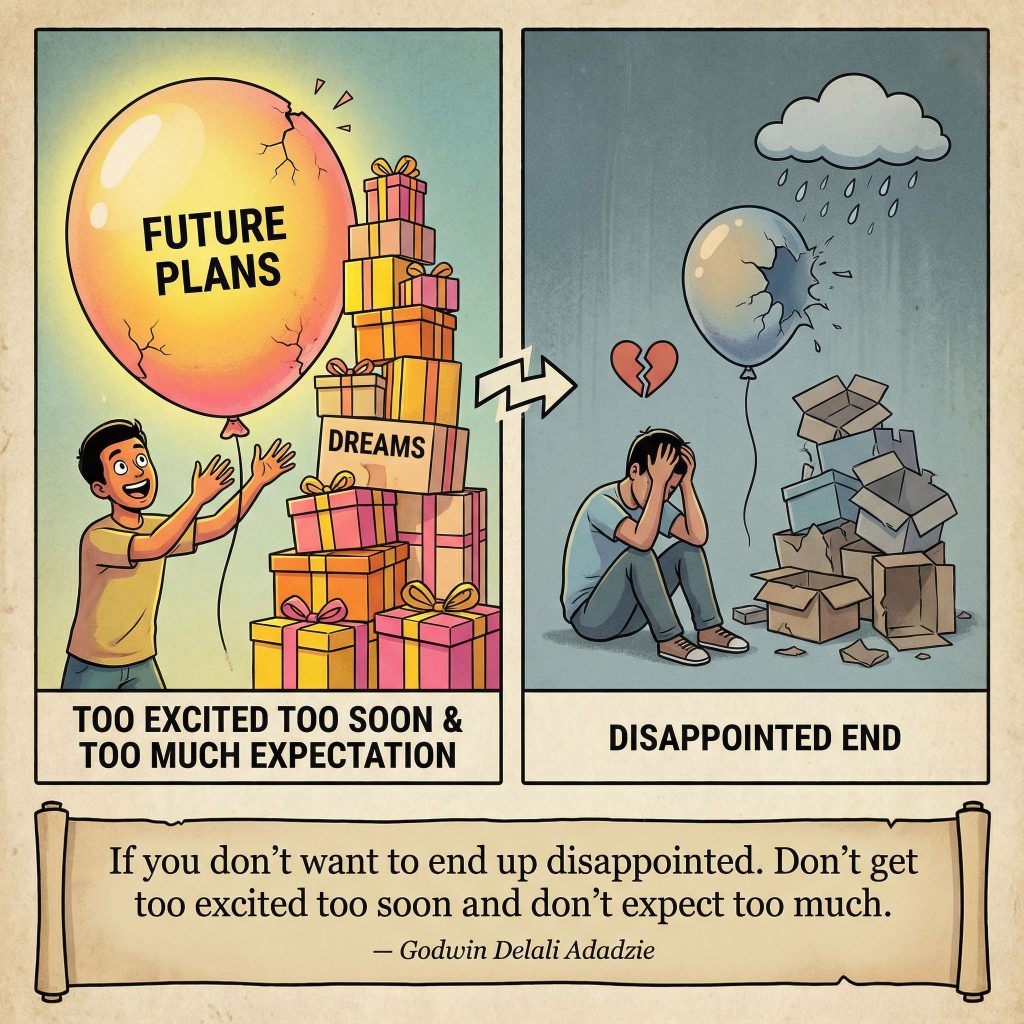
This reflection addresses a pattern observed across countless human experiences: the relationship between expectations and disappointment. The observation emerges from watching people set themselves up for emotional crashes by building elaborate mental pictures of how things will unfold before reality has a chance to develop. When someone receives a job interview, they immediately imagine themselves in the position, spending the salary, planning their new life—only to be crushed when they don’t get hired. When a relationship shows early promise, they mentally plan the wedding and name their future children—only to be devastated when things don’t work out. The principle isn’t an invitation to cynicism or the absence of hope, but rather a call to emotional wisdom that protects against unnecessary pain while still allowing for genuine joy when good things actually happen. Understanding this pattern helps people maintain steadier emotions, make better decisions, and experience less suffering from unrealized possibilities.
The Disappointment Equation
Disappointment has a simple formula:
Disappointment = Expectations – Reality
When your expectations exceed reality, you feel disappointed. The bigger the gap, the greater the disappointment.
This means there are two ways to reduce disappointment:
- Improve reality to meet your expectations
- Adjust your expectations to match likely reality
We often focus entirely on the first option—trying to make everything work out exactly as we hope. But we have limited control over reality. We have much more control over our expectations.
This doesn’t mean lowering your standards or settling for mediocrity. It means being realistic about what’s likely to happen, what’s actually promised, and what you can actually control.
The Bible speaks to this principle: “Hope deferred makes the heart sick, but a longing fulfilled is a tree of life” (Proverbs 13:12). Constantly hoping for things that don’t materialize creates sickness of heart. The solution isn’t to stop hoping, but to hope wisely.
The Problem with Getting Too Excited Too Soon
Early excitement feels wonderful. That rush of possibility, the mental planning, the imagining of how great things will be—it’s intoxicating.
But there are real costs to premature excitement:
You Invest Emotionally Before Things Are Certain: When you get extremely excited about something that might happen, you start emotionally investing as if it’s already happened. Your heart attaches to an outcome that’s still uncertain.
Then if it doesn’t happen, you don’t just lose a possibility—you lose something you’d already claimed emotionally. That hurts far more than if you’d stayed measured.
You Make Premature Decisions: Excessive early excitement can lead to poor choices. You quit your current job before the new one is confirmed. You tell everyone about the opportunity before it’s secured. You make financial commitments based on anticipated income that hasn’t materialized.
Proverbs 21:5 warns: “The plans of the diligent lead to profit as surely as haste leads to poverty.” Rushing ahead in excitement often leads to regret.
You Set Yourself Up for a Harder Fall: The higher you climb in imagination, the farther you fall when reality doesn’t match. If you kept your emotions measured, disappointment would be manageable. But when you’ve already lived out the whole scenario in your mind, the crash is brutal.
You Miss Present Realities: When you’re overly focused on an exciting possibility, you neglect what’s actually in front of you. You stop fully engaging with your current job because you’re already mentally in the new one. You stop appreciating what you have because you’re fixated on what you might get.
You Lose Objectivity: Extreme excitement clouds judgment. You stop seeing potential problems or red flags because you’re so caught up in how amazing this could be. This makes you vulnerable to deception, bad deals, and poor decisions.
You Exhaust Yourself Emotionally: Riding a constant roller coaster of high excitement followed by crushing disappointment is emotionally draining. Over time, this pattern can lead to cynicism, depression, or emotional numbness.
The Problem with Expecting Too Much
Expectations aren’t inherently bad. We should expect certain things—honesty, basic respect, people keeping their word. But unrealistic or excessive expectations create unnecessary suffering.
Expecting Perfection from Imperfect People: When you expect your spouse, friends, boss, or children to never disappoint you, always understand you, meet all your needs, or never make mistakes—you’re expecting something impossible.
Everyone is human. Everyone fails. Everyone has limitations. Expecting perfection guarantees disappointment.
As Paul wrote: “All have sinned and fall short of the glory of God” (Romans 3:23). If everyone falls short of God’s glory, they’ll certainly fall short of your expectations sometimes.
Expecting Outcomes You Can’t Control: When you expect specific results from situations where multiple factors are involved—many beyond your control—you’re setting yourself up for disappointment.
You can control your effort, preparation, and attitude. You can’t control whether you get hired, whether someone likes you back, whether your proposal is accepted, or whether circumstances align perfectly.
Expecting Others to Read Your Mind: When you expect people to know what you need without you telling them, or to understand your perspective without you explaining it, disappointment is inevitable.
Clear communication matters. Proverbs 18:2 says: “Fools find no pleasure in understanding but delight in airing their own opinions.” Wise people seek to understand and be understood, rather than just expecting others to figure them out.
Expecting Life to Be Fair: This is perhaps the most common source of disappointment. “I worked hard, so I should succeed.” “I’m a good person, so good things should happen to me.” “I did everything right, so it should work out.”
But life isn’t fair in the short term. Rain falls on the just and the unjust (Matthew 5:45). Good people suffer. Bad people sometimes prosper. Hardworking people face setbacks. Lazy people sometimes get lucky breaks.
God is just, and ultimate justice will prevail. But expecting immediate fairness in this broken world is unrealistic.
Expecting Instant Results: We live in an instant-gratification culture that has trained us to expect quick outcomes. But most things worth having take time—building character, developing skills, growing relationships, achieving significant goals.
When we expect instant results and they don’t come, we get discouraged and quit. Patience is a crucial virtue that protects against this particular form of disappointment.
Biblical Examples of Measured Hope
Scripture shows us what realistic, measured hope looks like:
Abraham’s Faith (Romans 4:18-21): Abraham “against all hope… in hope believed” that he would have a son, even though he and Sarah were far too old. His faith was strong, but notice the progression—it took 25 years from promise to fulfillment.
Abraham didn’t expect instant results. He kept believing, but he also lived his life during those waiting years. He didn’t put everything on hold in excessive excitement. He maintained measured hope across decades.
Mary’s Response (Luke 1:26-38): When the angel told Mary she would bear the Messiah, she didn’t immediately start planning the coronation. She asked practical questions, pondered things in her heart, and said “may it be to me as you have said.”
She believed, but she also remained grounded. She knew becoming the Messiah’s mother would involve difficulty, not just glory.
Paul’s Contentment (Philippians 4:11-13): Paul learned to be content “whatever the circumstances.” He could handle plenty or want, comfort or hardship. This wasn’t because he had no hopes or desires, but because he didn’t pin his peace on specific outcomes.
He hoped to visit churches, spread the gospel, and see believers grow. But he didn’t expect everything to go smoothly or get devastated when plans changed. His expectations were held loosely.
Job’s Steadiness (Job 1:20-22, 13:15): When Job lost everything, he grieved but didn’t curse God or claim God had violated some promise. His famous statement—”Though he slay me, yet will I hope in him”—shows hope without unrealistic expectations.
Job hoped in God’s character and ultimate justice, not in immediate comfort or explanation.
The Balance: Hope Without Naivety
The quote isn’t calling for hopelessness or pessimism. It’s calling for wisdom—hope tempered with realism.
Acknowledge Possibilities Without Claiming Them as Certainties: “This could work out well” is different from “This will definitely work out well.” The first leaves room for disappointment without being crushed by it. The second sets you up for a harder fall.
Prepare for Good Outcomes While Accepting Other Possibilities: Do what you can to make things succeed. Hope they will. But also have a plan B, emotional reserves, and acceptance that things might go differently than you hope.
James 4:13-15 models this: “Now listen, you who say, ‘Today or tomorrow we will go to this or that city, spend a year there, carry on business and make money.’ Why, you do not even know what will happen tomorrow… Instead, you ought to say, ‘If it is the Lord’s will, we will live and do this or that.'”
Make plans, but hold them with open hands.
Celebrate Progress Without Assuming Completion: If you get a job interview, that’s worth acknowledging. But it’s not the same as getting the job. If someone goes on a first date with you, that’s positive. But it’s not the same as being in a relationship.
Appreciate each step without jumping ahead to the finish line in your mind.
Trust God’s Goodness Without Demanding Specific Outcomes: You can trust that God loves you and works for your good (Romans 8:28) without expecting Him to give you every specific thing you want exactly when and how you want it.
God is good. God is faithful. But God’s timeline, methods, and specific answers often differ from our expectations. Mature faith trusts His character without dictating His actions.
Practical Applications
How do you actually live this out day-to-day?
Practice the “Wait and See” Approach: When something potentially good happens, acknowledge it without building your whole mental future around it. Say to yourself: “This is interesting. Let’s wait and see how it develops.”
This keeps you engaged without getting swept away.
Distinguish Between Hope and Expectation: Hope says “I’d really like this to happen.” Expectation says “This should happen” or “This will happen.”
Hope can be disappointed but recovers. Expectation feels like betrayal when unmet.
Focus on What You Control: You can control your effort, preparation, attitude, and response. You can’t control outcomes that depend on other people’s choices, circumstances, timing, or factors beyond you.
Pour your energy into what you control. Hold outcomes more loosely.
Ask Better Questions: Instead of “How will I spend the money?” before you have the job, ask “What can I do to prepare well for the interview?”
Instead of “Where will we go for our honeymoon?” after one good date, ask “What would help this relationship develop healthily?”
Future-focused questions create excessive expectations. Present-focused questions keep you grounded.
Build Resilience Through Small Disappointments: Don’t shelter yourself from all disappointment. Actually experiencing small disappointments and recovering builds emotional resilience that helps you handle bigger ones.
Keep Perspective: In most situations, whatever you’re excited about isn’t life-or-death. If it doesn’t work out, you’ll be okay. You’ve survived disappointments before. You’ll survive this one too if it happens.
This isn’t pessimism—it’s perspective that prevents catastrophizing.
Gratitude for What Is, Not Just What Might Be: Spend more time being grateful for what you actually have than fantasizing about what you might get. Present gratitude grounds you in reality and reduces the pull of excessive future expectations.
Paul commanded: “Give thanks in all circumstances” (1 Thessalonians 5:18). Not just when things work out as hoped, but in all circumstances.
When Measured Hope Looks Like Faith
Some might argue that keeping expectations measured shows lack of faith. “If you really believed God, you’d expect great things!”
But this confuses faith with presumption. Faith trusts God’s character and promises. Presumption demands that God give us what we want when we want it.
Faith says: “God is good and I trust Him with the outcome.” Presumption says: “God must give me this specific thing or my faith means nothing.”
Faith allows room for God to say no, to delay, or to give something different than requested. Presumption requires God to do exactly what we’ve decided He should do.
The difference becomes clear in prayer. Faith prays: “Your will be done.” Presumption prays: “Give me what I want or else.”
Jesus modeled faithful, measured hope in Gethsemane: “Father, if you are willing, take this cup from me; yet not my will, but yours be done” (Luke 22:42). He expressed His desire clearly but submitted to the Father’s will.
That’s the balance—honest about what we hope for, submitted to God’s sovereignty, prepared emotionally for either outcome.
The Gift of Lowered Expectations
While “don’t expect too much” might sound negative, it actually offers several gifts:
More Pleasant Surprises: When you don’t expect much, things that work out feel like wonderful bonuses rather than merely meeting minimum requirements.
If you expected perfection and got 80%, you’re disappointed. If you expected 50% and got 80%, you’re delighted. Same reality, different experience based on expectations.
Less Anxiety: Much anxiety comes from excessive expectations about how things must go. When you loosen those expectations, anxiety decreases.
Better Relationships: When you stop expecting people to be mind-readers, never fail you, or meet all your needs, relationships become less frustrating and more enjoyable.
You appreciate what people do give rather than resenting what they don’t.
Greater Resilience: When disappointment doesn’t devastate you because your expectations were realistic, you bounce back faster and try again sooner.
More Accurate Judgment: When you’re not blinded by excessive excitement, you see situations more clearly. This leads to better decisions.
Deeper Gratitude: When you don’t take things for granted or feel entitled to specific outcomes, you’re more genuinely grateful when good things happen.
The Wisdom of “Yet”
One helpful practice is adding “yet” to your thinking:
Not: “This is definitely happening!” But: “This might happen. We’ll see.”
Not: “I’m getting this job!” But: “I had a good interview. I’ll know more soon.”
Not: “This relationship is perfect!” But: “This has been good so far. Let’s see how it develops.”
That little word “yet” or phrases like “so far” or “we’ll see” keep you present without killing hope. They acknowledge reality without claiming the future.
David practiced this: “I remain confident of this: I will see the goodness of the Lord in the land of the living. Wait for the Lord; be strong and take heart and wait for the Lord” (Psalm 27:13-14).
He was confident he’d see God’s goodness—eventually. But he also knew he had to wait. He didn’t expect instant fulfillment.
When Things Actually Work Out
Here’s the beautiful thing: when you keep expectations measured and something actually does work out, your joy isn’t diminished—it’s often enhanced.
You didn’t exhaust yourself with premature excitement. You didn’t cloud your judgment with unrealistic hopes. You didn’t make foolish decisions based on assumed outcomes.
Instead, when the good thing happens, you experience pure gratitude and delight. It’s a gift, not an entitlement. It’s a pleasant surprise, not just meeting minimum expectations.
The person who expected perfection and got something wonderful is less happy than the person who expected difficulty and got something wonderful.
Measured expectations don’t kill joy—they make genuine joy more possible when good things actually happen.
The Ultimate Hope
At the deepest level, Christians can keep expectations measured regarding earthly outcomes because our ultimate hope isn’t in how things work out here.
Our hope is in Christ, in His promises that cannot fail, in the resurrection, in eternal life, in God’s ultimate justice and restoration of all things.
Paul wrote: “If only for this life we have hope in Christ, we are of all people most to be pitied” (1 Corinthians 15:19). Our hope extends beyond this life.
This means we can hold earthly outcomes loosely. If the job doesn’t work out, if the relationship ends, if the opportunity falls through—our ultimate hope remains secure.
This isn’t resignation or apathy. It’s freedom. Freedom to engage fully with life without being crushed when specific outcomes don’t materialize. Freedom to hope without demanding. Freedom to trust God regardless of circumstances.
Reflection Questions
- In what areas of your life do you tend to get too excited too soon? How has that affected you?
- What unrealistic expectations have caused you the most disappointment? How could adjusting those expectations help?
- Can you distinguish between healthy hope and unrealistic expectation in your current situation?
- How would your emotional life change if you held outcomes more loosely?
- What helps you stay grounded when something exciting might happen?
- Where do you need to add “yet” or “we’ll see” to your thinking right now?
Related Quotes
- “No amount of worry can solve any problem.”
- “Everything is expensive. You just pay for it now or later.”
- “God is not a genie. Prayer is not a magic lamp.”
Want to grow in emotional wisdom and realistic hope? Explore my books on faith and practical wisdom, discover more quotes and reflections, or read more articles on living wisely.
Disclaimer: Adadzie.com is the personal website of Godwin Delali Adadzie. Content represents personal views and does not constitute official Catholic teaching, pastoral counseling, or professional advice. Quotes and reflections are shared for inspiration and reflection. For personal guidance, consult appropriate professionals. Questions? Email delali@adadzie.com | Read Full Disclaimer