
The Quote
“Expected results or expected outcomes are not the solutions themselves.”
— Godwin Delali Adadzie
Context and Inspiration
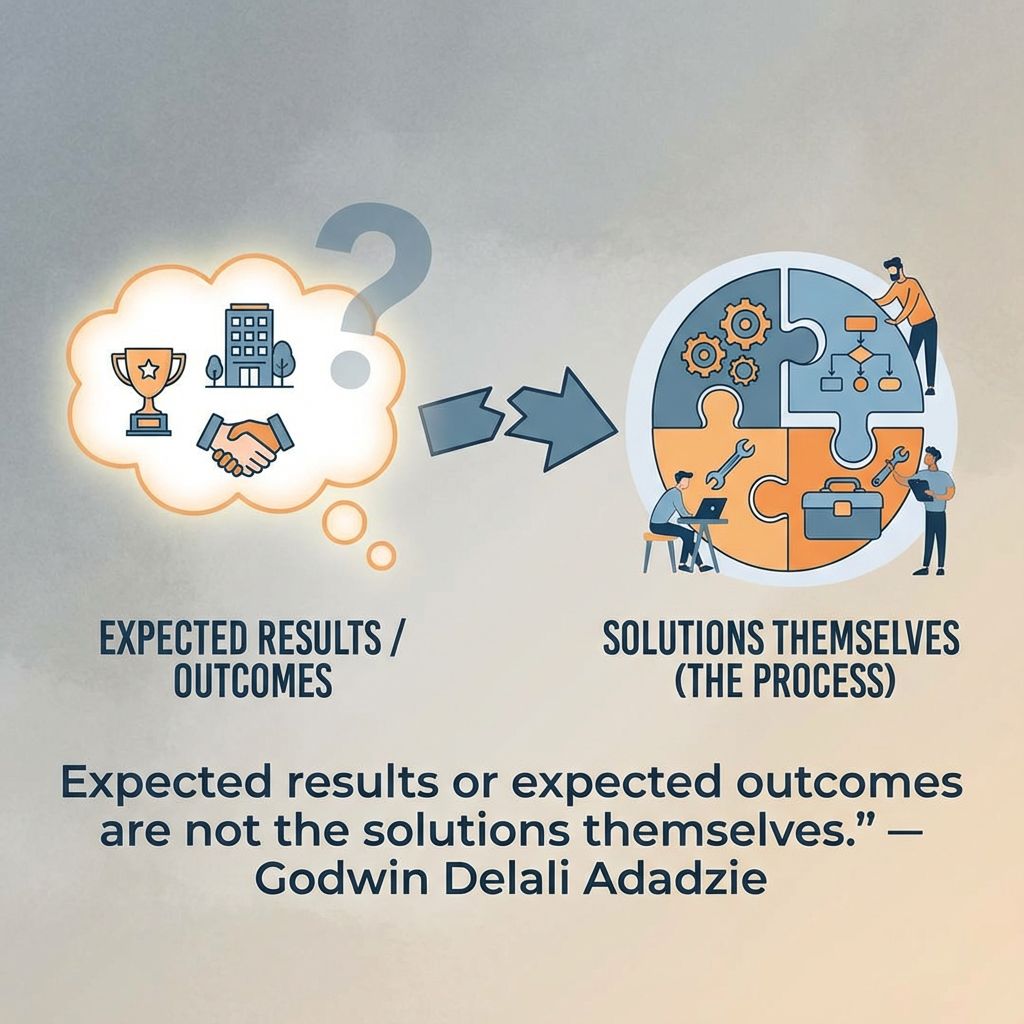
This reflection addresses a common confusion that derails many people’s efforts to solve problems: mistaking desired outcomes for actual solutions. The observation exposes a pattern seen repeatedly in personal life, business, ministry, and relationships—people clearly identify what they want to happen but fail to identify how to make it happen, then wonder why nothing changes. Someone says “I want to lose weight” as if stating the desired result is the solution. A business declares “we need to increase revenue” without identifying concrete actions that will produce that increase. A church announces “we want more people” without implementing strategies that actually draw people. A person says “I need to be happier” without addressing what’s causing unhappiness or what would create happiness. The desired outcome is clear, but the path to that outcome remains undefined. This distinction matters enormously because you can want something passionately, visualize it clearly, and speak about it constantly—but without actual solutions (concrete actions, strategies, changes, or interventions), the desired outcome remains forever out of reach.
The Confusion Explained
Let’s clarify the difference:
Expected Result/Outcome: What you want to happen. The end state. The goal. The destination.
Examples:
- “I want to lose 30 pounds”
- “We need to increase sales by 20%”
- “I want a better marriage”
- “We need more church attendance”
- “I want to be debt-free”
- “I need better health”
Solution: How you make it happen. The method. The strategy. The concrete actions. The path to the destination.
Examples:
- “I will eat 1,500 calories daily and exercise 30 minutes five days per week”
- “We will implement a new marketing campaign, train sales staff better, and expand to two new territories”
- “We will schedule weekly date nights, start couples counseling, and commit to daily check-in conversations”
- “We will improve children’s ministry, start a contemporary service, and train greeters to be more welcoming”
- “I will pay $500 extra monthly toward debt and stop using credit cards”
- “I will see a doctor for the persistent pain, take prescribed medication, and sleep seven hours nightly”
The first list identifies what you want. The second identifies how to get it. Both matter, but only the second produces actual change.
Why People Confuse Results with Solutions
Several factors create this confusion:
Positive Thinking Culture: Self-help teachings emphasize visualization, affirmations, and declaring desired outcomes. While these have some value, they’ve created the impression that clearly stating what you want is the same as creating a plan to get it.
Magical Thinking: Some believe that wanting something badly enough or speaking it into existence will make it happen without concrete action.
Avoidance of Hard Work: Identifying desired results is easy and feels productive. Actually developing and implementing solutions requires thought, effort, and sacrifice.
Lack of Knowledge: Some people genuinely don’t know how to solve their problems. They know what they want but don’t know how to get there.
Emotional Satisfaction: Talking about desired outcomes feels good. It provides temporary emotional satisfaction without the difficulty of actual change.
Accountability Avoidance: When you only identify desired outcomes, you can’t really fail because you never committed to specific actions. Solutions create accountability.
Biblical Distinction Between Desire and Action
Scripture consistently distinguishes between wanting something and doing what’s necessary to achieve it:
Faith Without Works (James 2:14-17): “What good is it, my brothers and sisters, if someone claims to have faith but has no deeds? Can such faith save them? Suppose a brother or a sister is without clothes and daily food. If one of you says to them, ‘Go in peace; keep warm and well fed,’ but does nothing about their physical needs, what good is it? In the same way, faith by itself, if it is not accompanied by action, is dead.”
Saying “be warm and fed” is identifying desired outcome. Giving clothes and food is the solution. Only the latter helps.
Hearing and Doing (James 1:22-25): “Do not merely listen to the word, and so deceive yourselves. Do what it says.”
Knowing what you should do (outcome: be obedient) isn’t the same as actually doing it (solution: specific obedience).
Building on Rock vs. Sand (Matthew 7:24-27): Both builders heard Jesus’ words. Both presumably wanted stable houses (same desired outcome). The difference? One implemented the solution (building on rock), one didn’t (built on sand).
Same desired result, different solutions, different outcomes.
The Rich Young Ruler (Mark 10:17-22): He wanted eternal life (desired outcome). Jesus gave him the solution: sell everything and follow Him. The young man wanted the outcome but refused the solution.
Parable of the Talents (Matthew 25:14-30): All three servants had the same opportunity and presumably the same desired outcome (please the master). Two implemented solutions (invested the talents). One didn’t (buried it). Results differed.
Jesus in Gethsemane (Matthew 26:39): Jesus wanted a different outcome (“if it is possible, may this cup be taken from me”) but submitted to the solution that actually accomplished salvation (“yet not as I will, but as you will”).
Why This Distinction Matters
Understanding the difference between outcomes and solutions is critical:
Outcomes Without Solutions Produce Frustration: When you clearly want something but don’t know how to get it, you feel stuck and frustrated.
Solutions Without Clear Outcomes Waste Effort: Conversely, taking action without clear goals means you might work hard but accomplish nothing meaningful.
Both Are Necessary: You need both—clear outcomes to aim at AND concrete solutions to get there.
Only Solutions Produce Change: No amount of desiring, visualizing, or declaring produces change by itself. Action is required.
Solutions Are Where Work Happens: Identifying outcomes is relatively easy. Developing and implementing solutions is where the actual difficulty lies.
Solutions Create Accountability: Vague desires can’t be measured. Specific solutions can. Did you do what you said you’d do?
Moving from Outcomes to Solutions
How do you bridge the gap?
Start with Clear Outcomes: First, identify specifically what you want. Vague wishes don’t work. “I want to be better” isn’t clear. “I want to lose 30 pounds by December” is clear.
Ask “How?”: Once you know what you want, ask “How will I achieve this?” Then answer specifically.
“I want to save $5,000.” How? “I’ll save $200 per paycheck, cut my entertainment budget by $100 monthly, and sell items I don’t use.”
Break It Down: Big outcomes require multiple solutions. Break the desired result into components and identify solutions for each.
Want a better marriage? That’s broad. Break it down:
- Better communication (solution: 15-minute daily check-ins)
- More romance (solution: weekly date nights)
- Resolved conflicts (solution: couples counseling)
- Spiritual connection (solution: pray together daily)
Make Solutions Specific and Measurable: “Try harder” isn’t a solution. “Spend 30 minutes daily on this task” is.
“Be healthier” isn’t a solution. “Walk 10,000 steps daily, eat vegetables with every meal, sleep by 10pm” is.
Identify Resources Needed: What do your solutions require? Time? Money? Knowledge? Help? Identify and secure these resources.
Anticipate Obstacles: What will make implementing solutions difficult? Identify barriers in advance and plan how to overcome them.
Create Accountability: Share your solutions with someone who will ask if you’re actually doing them.
Adjust Based on Results: If solutions aren’t producing desired outcomes, adjust. Don’t just keep hoping—change your approach.
Common Examples
Let’s look at specific situations:
Financial Problems
Desired Outcome: “I want to be debt-free.”
Not Solutions (Just Restating Desire):
- “I need to get out of debt”
- “Debt is bad”
- “I wish I didn’t have this debt”
Actual Solutions:
- Pay $500 extra monthly on smallest debt until eliminated
- Stop using credit cards entirely
- Sell car and buy cheaper one, apply difference to debt
- Take second job for 6 months, dedicate all income to debt
- Cut cable, eating out, and subscriptions—redirect savings to debt
Relational Problems
Desired Outcome: “I want my kids to respect me.”
Not Solutions:
- “They should respect me”
- “Kids these days are disrespectful”
- “I want them to listen”
Actual Solutions:
- Establish clear, consistent consequences for disrespect
- Follow through every time without exception
- Treat them with respect consistently
- Spend quality time with each child individually
- Address underlying issues through family counseling if needed
Health Problems
Desired Outcome: “I want to lose weight.”
Not Solutions:
- “I need to lose weight”
- “I hate being overweight”
- “Tomorrow I’ll start eating better”
Actual Solutions:
- Track all food intake, stay under 1,600 calories daily
- Exercise 45 minutes, 5 days per week
- Meal prep on Sundays for the week
- Weigh daily and chart progress
- Join accountability group or hire coach
Spiritual Problems
Desired Outcome: “I want to be closer to God.”
Not Solutions:
- “I should pray more”
- “I need to be more spiritual”
- “I wish I felt God’s presence”
Actual Solutions:
- Set alarm for 6am daily prayer time
- Read one chapter of Scripture before breakfast
- Join a weekly Bible study group
- Fast one day per week
- Eliminate one distraction (social media, TV) to create space for God
Business Problems
Desired Outcome: “We need to increase revenue.”
Not Solutions:
- “We need more sales”
- “Business is slow”
- “We have to do better”
Actual Solutions:
- Launch email campaign to past customers
- Implement referral incentive program
- Expand to evening hours
- Train staff on upselling techniques
- Develop three new product offerings
When People Resist Moving to Solutions
Sometimes people actively avoid developing actual solutions:
Solutions Require Honesty: To create real solutions, you must honestly assess what needs to change. This can be uncomfortable.
Solutions Create Responsibility: Once you identify concrete solutions, you’re responsible for implementing them. Some people prefer the ambiguity of vague desires.
Solutions Reveal Priorities: When solutions require sacrifice, they expose what you truly prioritize. Do you actually want the outcome enough to do what’s necessary?
Solutions Can Fail: Attempting real solutions means risking failure. Just wishing for outcomes protects you from that risk.
Solutions Challenge Identity: Sometimes implementing solutions means admitting you’ve been wrong, changing long-held patterns, or becoming someone different.
The Role of Prayer
Where does prayer fit in this outcomes vs. solutions framework?
Prayer Identifies Outcomes: Prayer helps clarify what you truly want and need. God reveals desires He’s placed in your heart.
Prayer Reveals Solutions: God gives wisdom for how to achieve right outcomes. James 1:5 promises wisdom to those who ask.
Prayer Empowers Implementation: You need God’s strength to implement difficult solutions. Prayer connects you to that power.
Prayer Aligns Desires: Sometimes what you think you want isn’t what you actually need. Prayer aligns your desires with God’s purposes.
Prayer Is Sometimes the Solution: For spiritual problems especially, prayer isn’t just preparation for solutions—it’s often the primary solution itself.
Prayer Doesn’t Replace Action: But prayer alone rarely solves problems that require practical action. God typically works through the solutions you implement, not in spite of your inaction.
When Nehemiah heard Jerusalem’s wall was broken, he prayed—then asked the king for resources and organized reconstruction (Nehemiah 1-2). Prayer plus action.
Biblical Examples of Outcomes and Solutions
Nehemiah:
- Outcome: Rebuild Jerusalem’s wall
- Solutions: Got king’s permission, gathered materials, organized workers, defended against opposition, worked 52 days straight
- Result: Wall rebuilt
Esther:
- Outcome: Save her people from genocide
- Solutions: Fasted, approached king strategically, exposed Haman’s plot, requested specific legal remedy
- Result: People saved
Woman with Issue of Blood:
- Outcome: Be healed
- Solution: Push through crowd, touch Jesus’ garment
- Result: Healed
Zacchaeus:
- Outcome: See Jesus
- Solution: Run ahead, climb tree despite dignity concerns
- Result: Jesus called him down, ate at his house
Each had clear desired outcomes AND took specific actions to achieve them.
Reflection Questions
- What desired outcomes have you been declaring without developing actual solutions?
- Where are you stuck wishing for different results without changing your actions?
- What solutions do you already know you need to implement but have been avoiding?
- Are you confusing positive thinking or prayer with actual problem-solving action?
- What specific, measurable solutions could you implement this week toward one desired outcome?
- What’s stopping you from moving from outcome to solution—fear, laziness, lack of knowledge, or something else?
Related Quotes
- “Solutions are the right answer to problems.”
- “When you find the solution, it always works, regardless of whether you like it or not, regardless of whether you believe it or not.”
- “Something no matter how small is better than nothing.”
Want to become more action-oriented in achieving your goals? Explore my books on faith and practical wisdom, discover more quotes and reflections, or read more articles on turning goals into reality.
Disclaimer: Adadzie.com is the personal website of Godwin Delali Adadzie. Content represents personal views and does not constitute official Catholic teaching, pastoral counseling, or professional advice. Quotes and reflections are shared for inspiration and reflection. For personal guidance, consult appropriate professionals. Questions? Email delali@adadzie.com | Read Full Disclaimer