
The Quote
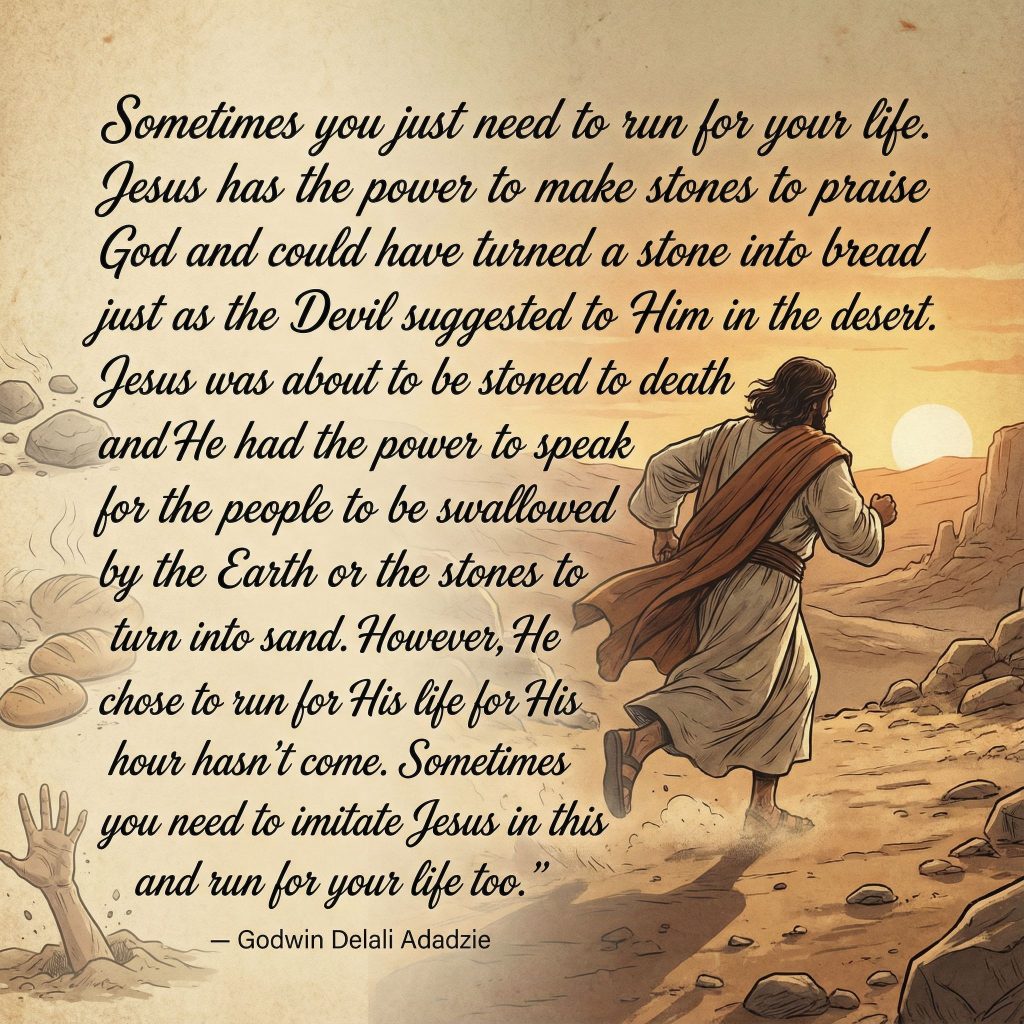
“Sometimes you just need to run for your life. Jesus has the power to make stones to praise God and could have turned a stone into bread just as the Devil suggested to Him in the desert. Jesus was about to be stoned to death and He had the power to speak for the people to be swallowed by the Earth or the stones to turn into sand. However, He chose to run for His life for His hour hasn’t come. Sometimes you need to imitate Jesus in this and run for your life too.”
— Godwin Delali Adadzie
Context and Inspiration
This reflection addresses a misunderstanding many Christians hold about courage and faith: the belief that standing your ground in every situation is always the right choice, and that withdrawing or fleeing represents cowardice or lack of faith. The observation points to a profound example—Jesus Himself, who possessed unlimited power and could have destroyed His enemies with a word, chose instead to withdraw and escape when His life was threatened. This wasn’t weakness, cowardice, or lack of faith. It was wisdom. He understood timing, recognized that His hour for sacrifice hadn’t yet come, and chose strategic withdrawal over premature confrontation. Many believers have died unnecessarily, destroyed their ministries, or suffered needlessly because they believed standing firm was always required, even when God was providing an escape route. Understanding that sometimes the most faithful response is to run, hide, or withdraw saves lives, preserves ministries, and allows people to live to fight another day. Courage doesn’t mean never retreating—it means knowing when to stand and when to strategically withdraw.
Biblical Examples of Jesus Withdrawing
Jesus, though all-powerful, repeatedly chose withdrawal over confrontation:
John 10:39-40: “Again they tried to seize him, but he escaped their grasp. Then Jesus went back across the Jordan to the place where John had been baptizing in the early days. There he stayed.”
They tried to seize Him. He escaped. He withdrew to safe location. This wasn’t accident or weakness—it was choice.
John 8:59: “At this, they picked up stones to stone him, but Jesus hid himself, slipping away from the temple grounds.”
Facing imminent stoning, Jesus didn’t call down fire from heaven or turn stones to sand. He hid and slipped away.
Luke 4:28-30: After speaking in His hometown synagogue, “All the people in the synagogue were furious when they heard this. They got up, drove him out of the town, and took him to the brow of the hill on which the town was built, in order to throw him off the cliff. But he walked right through the crowd and went on his way.”
They intended to kill Him. He simply walked through and left. Not confrontation—withdrawal.
Matthew 12:14-15: “But the Pharisees went out and plotted how they might kill Jesus. Aware of this, Jesus withdrew from that place.”
When He learned of death plots, He withdrew. He didn’t stay to confront them or prove He couldn’t be killed.
Matthew 14:13: After John the Baptist’s execution, “When Jesus heard what had happened, he withdrew by boat privately to a solitary place.”
Grief, danger, or need for rest—all legitimate reasons to withdraw.
In every case, Jesus had power to confront and destroy enemies. But He chose strategic withdrawal instead. Why? Because His time hadn’t come. Unnecessary confrontation would have ended His ministry prematurely.
The Key Phrase: “His Hour Hadn’t Come”
Throughout John’s Gospel, Jesus’ actions are governed by awareness of His “hour”:
John 2:4: At the wedding in Cana, Jesus told Mary, “My hour has not yet come.”
John 7:30: “At this they tried to seize him, but no one laid a hand on him, because his hour had not yet come.”
John 8:20: “Yet no one seized him, because his hour had not yet come.”
John 12:23: “Jesus replied, ‘The hour has come for the Son of Man to be glorified.'”
John 13:1: “Jesus knew that the hour had come for him to leave this world and go to the Father.”
Jesus understood that He had a specific time for specific things. Until that time came, He preserved His life through strategic withdrawal. When the time came, He willingly laid down His life.
This teaches crucial wisdom: There’s a time to stand and a time to withdraw. Discerning which is which requires wisdom, prayer, and Spirit’s guidance.
Other Biblical Examples of Strategic Withdrawal
Jesus wasn’t alone in this pattern:
David Fleeing Saul (1 Samuel 19-27): David was anointed king. Saul tried repeatedly to kill him. David had opportunities to kill Saul but didn’t. Instead, he fled, hid in caves, lived among enemies, constantly moved.
Was David a coward? No. He was preserving his life until God’s timing for kingship.
Elijah After Jezebel’s Threat (1 Kings 19:1-3): After defeating Baal’s prophets, Elijah ran from Jezebel’s death threat. “Elijah was afraid and ran for his life.”
Great prophet, fresh from powerful victory, ran from a threat. God didn’t rebuke this—He provided for Elijah during withdrawal.
Moses Fleeing Egypt (Exodus 2:11-15): After killing the Egyptian, Moses fled to Midian and stayed 40 years. This wasn’t cowardice—it was preservation until God’s timing.
Paul’s Escapes: Paul was lowered in a basket through a window in the city wall to escape those trying to kill him (Acts 9:23-25). He withdrew from various cities when threats arose (Acts 14:5-6, 17:10, 17:14).
The great apostle didn’t stay to be martyred every time danger arose. He withdrew to continue ministry elsewhere.
Early Church After Stephen’s Death (Acts 8:1): “On that day a great persecution broke out against the church in Jerusalem, and all except the apostles were scattered throughout Judea and Samaria.”
The believers fled persecution. This wasn’t failure—it spread the Gospel to new regions.
Joseph, Mary, and Jesus Fleeing to Egypt (Matthew 2:13-14): When Herod sought to kill infant Jesus, God told Joseph, “Get up, take the child and his mother and escape to Egypt.”
Even as a baby, Jesus’ life was preserved through strategic withdrawal.
When to Stand and When to Withdraw
How do you know which response is appropriate?
Consider God’s Purpose: Is this the time and place God has called you to this confrontation? Or is there greater purpose that requires preserving your life/ministry?
Assess Actual Danger: Is this a threat to comfort or threat to life? Threats to comfort might require standing firm. Threats to life might require withdrawal.
Check Your Timing: Just because you’ll eventually face something doesn’t mean you face it now. Jesus knew He’d die—but not before His time.
Evaluate Effectiveness: Will standing accomplish anything Kingdom-oriented? Or will it just result in your unnecessary death/harm while achieving nothing?
Listen to the Spirit: God may clearly direct you to stand or to withdraw. Obey His leading.
Consider Others’ Needs: Do people depend on you? Unnecessary martyrdom leaves them without shepherd, provider, or leader.
Remember the Mission: Your mission isn’t to die courageously—it’s to fulfill God’s calling. Sometimes that requires living through danger.
Distinguish Courage from Foolishness: Standing firm when God says stand is courage. Standing firm when God says flee is foolishness.
Proverbs 22:3 says: “The prudent see danger and take refuge, but the simple keep going and pay the penalty.”
False Teaching About Never Withdrawing
Some Christian teaching creates dangerous expectations:
“Real Faith Never Retreats”: This teaching says that true faith always stands firm, never withdraws, never flees. But Jesus retreated. David fled. Paul escaped. Were they lacking faith?
“God Always Protects”: Some teach that if you’re in God’s will, you’re invincible. But Stephen was stoned despite being full of faith. James was executed. John the Baptist was beheaded.
God doesn’t guarantee physical safety in this life. Sometimes He calls you to stand and face death. Sometimes He provides escape. Both require faith.
“Withdrawal Is Cowardice”: This equates every strategic withdrawal with cowardice or fear. But wisdom recognizes when withdrawal is prudent, not cowardly.
“Stand Your Ground Always”: This teaching ignores that Jesus Himself didn’t always stand His ground. He withdrew when appropriate.
“Dying for Faith Is Always God’s Will”: Martyrdom is real and sometimes God’s will. But not every threat is meant to be your martyrdom. Jesus withdrew from death threats repeatedly until His appointed time.
These teachings, though well-intentioned, have led believers into unnecessary danger, imprisonment, and death when God was providing escape routes they refused to take.
The Difference Between Cowardice and Wisdom
How do you distinguish cowardly retreat from wise withdrawal?
Cowardice:
- Abandoning God’s clear calling because it’s difficult
- Denying Christ to save yourself when directly confronted about faith
- Refusing to do what God clearly commands because of fear
- Running from every challenge or difficulty
- Prioritizing comfort over obedience
Wise Withdrawal:
- Preserving your life when not yet God’s time for your death
- Escaping unnecessary danger that doesn’t serve Kingdom purposes
- Protecting others who depend on you
- Living to fulfill calling another day
- Following God’s directive to withdraw (like Joseph fleeing to Egypt)
Peter’s denial of Jesus was cowardice—Jesus hadn’t told him to deny. David’s fleeing from Saul was wisdom—staying would have been presumption, not faith.
Practical Applications
How does this apply today?
Persecution Situations: In countries with severe persecution, Christians must discern when to openly witness (potentially facing death) and when to practice faith quietly or relocate.
Some are called to stay and face martyrdom. Others are called to flee and continue ministry elsewhere. Both can be obedience.
Abusive Relationships: When facing domestic violence, leaving isn’t lack of faith—it’s wisdom and self-preservation. God doesn’t require you to stay and be harmed.
Dangerous Confrontations: When encountering someone threatening violence, sometimes wisdom means de-escalating and leaving, not standing your ground to prove courage.
Ministry Opposition: When facing intense opposition in ministry, sometimes wisdom is withdrawing to let situation cool before returning. Sometimes it’s moving to different field entirely.
Employment Situations: If workplace becomes toxic or dangerous, seeking different employment isn’t lack of faith—it might be wisdom.
Church Conflicts: When church conflict becomes destructive, sometimes wise response is leaving for different church, not staying to fight.
Mental/Emotional Health: When situation threatens your mental or emotional wellbeing severely, withdrawing isn’t weakness—it’s self-care that preserves you for future service.
When God Calls You to Stand
While this article emphasizes wisdom of withdrawal, sometimes God clearly calls you to stand:
When Denying Christ Is Required for Safety: If safety requires denying Jesus, stand firm and confess Him regardless of cost.
Jesus said: “Whoever disowns me before others, I will disown before my Father in heaven” (Matthew 10:33).
When God Explicitly Commands You to Stay: If God has clearly said “stay and face this,” obey even if dangerous.
When Your Appointed Time Has Come: Like Jesus knowing His hour had come, if God shows you this is your time to give your life, embrace it with faith.
When Standing Serves Kingdom Purpose: If your stand will significantly advance Gospel or serve God’s people, and God has called you to it, stand firm.
When Fleeing Would Harm Others: If your withdrawal would devastate those depending on you and God hasn’t released you, stay.
The key is discerning God’s leading, not following formula.
Trusting God in Withdrawal
Some feel guilty when withdrawing:
God Provides Escape Routes: “No temptation has overtaken you except what is common to mankind. And God is faithful; he will not let you be tempted beyond what you can bear. But when you are tempted, he will also provide a way out so that you can endure it” (1 Corinthians 10:13).
If God provides escape, taking it isn’t lack of faith—it’s recognizing His provision.
Preservation Serves Purpose: Your life has purpose beyond proving courage in one moment. Preserving life allows you to fulfill broader calling.
Jesus’ Example Legitimizes Withdrawal: If Jesus—who had ultimate power and perfect faith—withdrew from danger, your withdrawal when wise is legitimate.
Wisdom Is Praised: Scripture repeatedly praises prudence, wisdom, and discernment. These qualities include knowing when to withdraw.
God’s Timing Matters: Dying before God’s time accomplishes nothing Kingdom-oriented. Living until God’s timing fulfills purpose.
Reflection Questions
- Have you confused standing firm with refusing to use escape routes God provides?
- Are you in a situation where wisdom calls for withdrawal but false guilt keeps you there?
- Can you distinguish between cowardice and strategic withdrawal in your circumstances?
- Have you judged others for withdrawing when they were actually being wise?
- Are you listening for God’s leading about whether to stand or withdraw?
- Do you need to imitate Jesus and “run for your life” in some current situation?
Related Quotes
- “Be wise in this wicked, selfish, ungrateful and forgetful world of humans.”
- “Anyone God can use, the devil can equally use, regardless of who they are. Be careful. Be alert.”
- “Once you are in this world, challenges will always come. Whether you are ready or not.”
Want to grow in wisdom about when to stand and when to withdraw? Explore my books on faith and discernment, discover more quotes and reflections, or read more articles on living wisely.
Disclaimer: Adadzie.com is the personal website of Godwin Delali Adadzie. Content represents personal views and does not constitute official Catholic teaching, pastoral counseling, or professional advice. Quotes and reflections are shared for inspiration and reflection. For personal guidance, consult appropriate professionals. Questions? Email delali@adadzie.com | Read Full Disclaimer