
The Quote
“Anyone God can use, the devil can equally use, regardless of who they are. Be careful. Be alert.”
— Godwin Delali Adadzie
Context and Inspiration
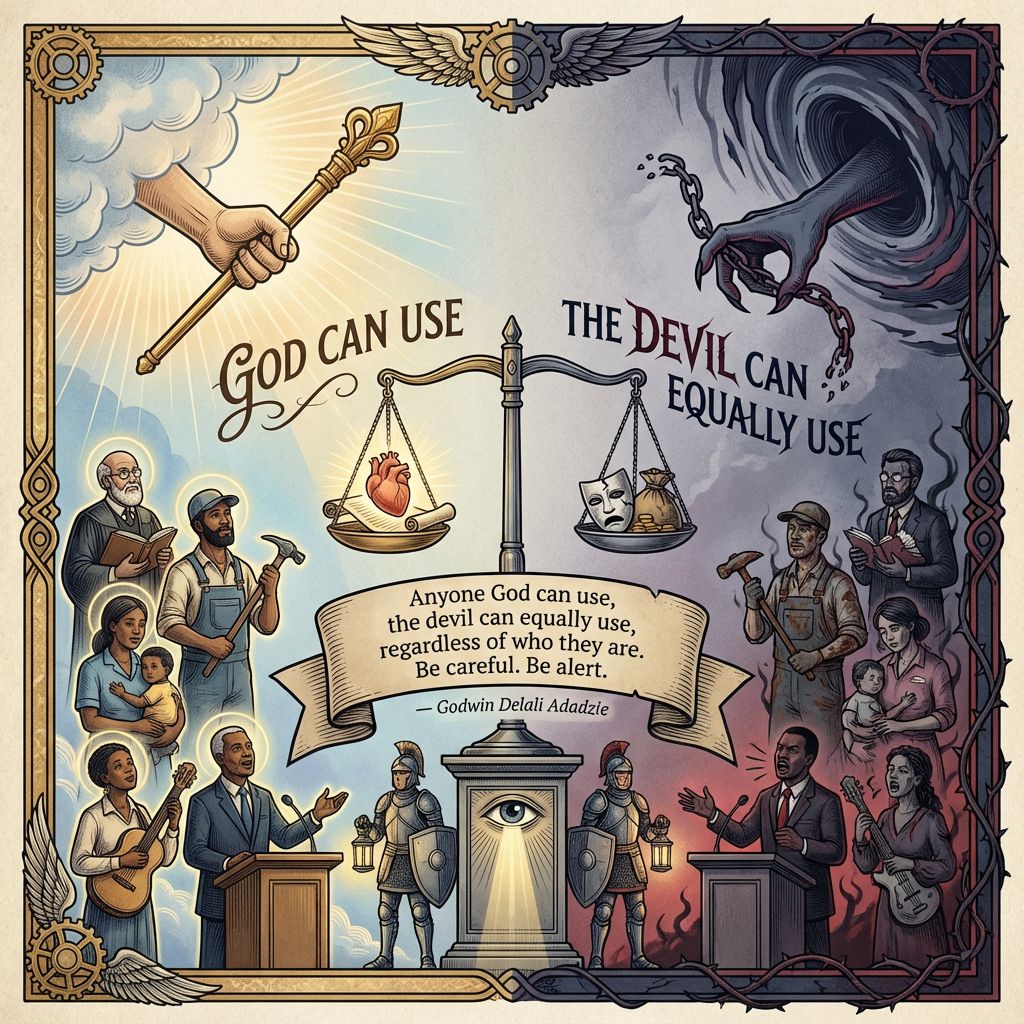
This reflection addresses a dangerous assumption many believers make: that certain people are immune to falling into sin or being used by the enemy. The observation challenges the common belief that spiritual maturity, ministry success, or deep knowledge of Scripture automatically protects someone from temptation and deception. History shows repeatedly that gifted preachers fall into immorality, influential leaders embrace heresy, faithful servants become bitter and destructive, and people who accomplished great things for God end their lives in disgrace. The principle here is sobering: the very gifts, influence, platform, or abilities that make someone useful for God’s kingdom also make them a valuable target for the enemy. There are no exceptions. No one reaches a level of spiritual achievement that makes vigilance unnecessary. This truth calls for constant alertness, humble recognition of personal vulnerability, and ongoing dependence on God’s grace rather than confidence in one’s own strength.
The Biblical Pattern
Scripture demonstrates this pattern repeatedly—people God used significantly were also vulnerable to being used by the enemy:
David: God called him “a man after my own heart” (Acts 13:22). David wrote psalms, defeated Goliath, united Israel, and established the kingdom. Yet he committed adultery with Bathsheba and arranged Uriah’s murder (2 Samuel 11).
The same passionate heart that pursued God also lusted after a woman. The same strategic mind that won battles also plotted murder. The gifts that made him useful to God also made him dangerous when misdirected.
Solomon: The wisest man who ever lived (1 Kings 4:29-34). God appeared to him twice. He built the temple. He wrote Scripture. Yet his many foreign wives turned his heart away from God to idols (1 Kings 11:1-13).
The same wisdom that judged nations failed to protect his own heart. The same diplomatic skills that brought peace also led him into compromising alliances.
Peter: The rock on whom Christ would build His church (Matthew 16:18). Bold, courageous, devoted. Yet he denied Jesus three times when tested (Matthew 26:69-75). Later, his hypocrisy regarding Jewish-Gentile relations had to be confronted by Paul (Galatians 2:11-14).
The same boldness that led him to walk on water also led him to rashly declare loyalty he couldn’t maintain. The same leadership gifts that built the early church also made his compromises more damaging.
Samson: Blessed with supernatural strength for God’s purposes (Judges 13-16). Yet he repeatedly pursued forbidden relationships and eventually revealed his secret to Delilah, losing his strength and his eyes.
The physical power God gave him didn’t come with corresponding moral strength. The gift that made him a judge of Israel also made him vulnerable when combined with lust.
Judas: Chosen as one of the twelve apostles. He witnessed miracles, heard Jesus teach, and was trusted with the money bag. Yet he betrayed Jesus for thirty pieces of silver (Matthew 26:14-16, 47-50).
His proximity to Jesus didn’t protect him. His position of trust made his betrayal more devastating.
Why Anyone Can Be Used by the Enemy
Several factors make every person vulnerable, regardless of their spiritual standing:
We All Have Flesh: As long as we live in these bodies, we battle sinful desires. Paul wrote: “For the flesh desires what is contrary to the Spirit, and the Spirit what is contrary to the flesh. They are in conflict with each other” (Galatians 5:17).
Spiritual maturity doesn’t eliminate the flesh—it means learning to not gratify its desires. But the temptation remains.
Pride Grows with Success: Often the people most vulnerable to falling are those who’ve experienced significant spiritual success. Success can breed pride, and “pride goes before destruction, a haughty spirit before a fall” (Proverbs 16:18).
When you’ve preached powerful sermons, led people to Christ, or experienced God’s anointing, you can subtly begin to trust your own wisdom, strength, or spirituality. That’s when you’re most vulnerable.
The Enemy Studies Your Weaknesses: Satan isn’t random in his attacks. He studies you, identifies your particular vulnerabilities, and crafts temptations specifically designed for you.
He tempted Jesus with things relevant to His situation—hunger, safety, power (Matthew 4:1-11). He’ll do the same with you, exploiting whatever weaknesses exist.
Spiritual Gifts Don’t Equal Spiritual Maturity: Someone can have powerful gifts—prophecy, healing, teaching, leadership—without corresponding character development.
God’s gifts are “irrevocable” (Romans 11:29). He doesn’t withdraw them based on behavior. This means someone can continue operating in gifts while living in sin. The gifts don’t validate the person’s character.
Isolation Increases Vulnerability: Leaders especially can become isolated—surrounded by people but without genuine accountability. When no one can speak truth to you, challenge you, or hold you accountable, you’re dangerously exposed.
Weariness Opens Doors: Elijah performed one of Scripture’s greatest miracles on Mount Carmel, then immediately ran in fear from Jezebel’s threat (1 Kings 19:1-4). Spiritual, physical, and emotional exhaustion made him vulnerable.
When you’re tired, depleted, or burned out, your defenses weaken.
Prosperity Can Corrupt: Moses warned Israel: “When you eat and are satisfied… be careful that you do not forget the Lord” (Deuteronomy 8:10-14). Blessing can breed complacency and self-sufficiency.
How the Devil Uses People
The enemy doesn’t just tempt people to sin—he actively works to use them for his purposes:
Spreading False Teaching: People who were once sound in doctrine can drift into heresy, leading others astray. Paul warned: “Even from your own number men will arise and distort the truth in order to draw away disciples after them” (Acts 20:30).
Causing Division: The enemy loves to use believers to divide the church. Someone with legitimate concerns can become a tool for destruction if they handle them poorly.
Discouraging Others: A bitter believer can poison an entire community. Someone who falls publicly can cause many to stumble. The enemy uses these falls strategically.
Validating Hypocrisy Accusations: When high-profile Christians fall into major sin, the enemy uses it to validate the world’s accusations of Christian hypocrisy.
Wasting Kingdom Resources: When a gifted person is sidelined by sin, all the time, resources, and investment in developing them becomes wasted (at least temporarily). The enemy loves this.
Corrupting Truth with Error: Sometimes the most dangerous false teaching comes from people who still use biblical language but twist the meaning. They sound right but lead people wrong.
Warning Signs You’re Being Targeted
How do you know when the enemy is actively working to use you?
Increasing Temptation in Specific Areas: If you notice intensifying temptation around a particular weakness, that’s often strategic enemy activity.
Unusual Opportunities That Require Compromise: When an amazing opportunity requires you to compromise integrity, violate conscience, or shade the truth—that’s bait.
Isolation from Accountability: If you find yourself pulling away from people who might challenge you, avoiding accountability, or surrounding yourself only with yes-people—danger.
Rationalization of Questionable Behavior: When you start making sophisticated arguments for why something you know is wrong might actually be okay—watch out.
Increasing Pride or Self-Sufficiency: If you’re thinking “I’ve got this” or “I’m past that struggle” or “That could never happen to me”—you’re vulnerable.
Spiritual Dryness Combined with Continuing Activity: If your personal relationship with God is withering but you’re still performing ministry—that’s dangerous ground.
Justified Anger Becoming Bitterness: Righteous anger over injustice is legitimate. But when it hardens into bitterness, resentment, or desire for revenge—the enemy is at work.
Biblical Commands for Vigilance
Scripture repeatedly commands watchfulness:
“Be alert and of sober mind. Your enemy the devil prowls around like a roaring lion looking for someone to devour” (1 Peter 5:8). The enemy is actively hunting. Alertness isn’t optional—it’s survival.
“Watch and pray so that you will not fall into temptation” (Matthew 26:41). Prayer and vigilance go together. We can’t protect ourselves through willpower alone.
“Examine yourselves to see whether you are in the faith” (2 Corinthians 13:5). Regular self-examination helps catch drift before it becomes a fall.
“If you think you are standing firm, be careful that you don’t fall!” (1 Corinthians 10:12). Confidence in your own strength is dangerous.
“Keep watch over yourselves” (Acts 20:28). Leaders especially must guard their own souls, not just serve others.
“Be on your guard; stand firm in the faith” (1 Corinthians 16:13). Vigilance is active, not passive. It requires intentional effort.
Practical Steps for Staying Alert
How do you actually maintain vigilance?
Maintain Genuine Accountability: Have people in your life who can ask hard questions, challenge you, and tell you uncomfortable truths. Not just people you supervise or who admire you—peers or mentors who can speak freely.
Make yourself truly accountable for your time, money, relationships, and private life.
Stay in Scripture Daily: Personal Bible reading and study aren’t optional for spiritual safety. When you drift from the Word, you lose your compass.
“How can a young person stay on the path of purity? By living according to your word” (Psalm 119:9).
Maintain Active Prayer Life: Not just professional prayers or praying for others—personal communion with God. When that relationship weakens, everything else becomes vulnerable.
Be Honest About Struggles: Don’t maintain an image of having it all together. When you’re struggling with something, tell someone safe. Secrets give the enemy power.
James 5:16 says: “Therefore confess your sins to each other and pray for each other so that you may be healed.”
Flee Temptation: Don’t linger around things you know are dangerous for you. 1 Corinthians 6:18 says: “Flee from sexual immorality.” Not manage it, not get close to the line—flee.
Joseph literally ran when Potiphar’s wife tempted him (Genesis 39:12). Sometimes the wise response is to get out fast.
Monitor Your Heart: Pay attention to your thoughts, attitudes, and desires. Sin starts in the heart before it shows in behavior.
Jesus said: “For out of the heart come evil thoughts—murder, adultery, sexual immorality, theft, false testimony, slander” (Matthew 15:19).
Rest Properly: Don’t let yourself become so depleted that your defenses weaken. Sabbath isn’t optional—it’s protective.
Stay Humble: Remember that you’re capable of any sin. Peter thought he could never deny Jesus. He was wrong.
Paul wrote: “By the grace of God I am what I am” (1 Corinthians 15:10). Everything good in you is grace, not achievement.
Watch Your Success: Paradoxically, seasons of great success are often seasons of great danger. When God is using you powerfully, the enemy is more interested in taking you down.
Protect Your Marriage: If you’re married, prioritize your marriage. Many ministry leaders have shipwrecked their calling through affairs.
Guard Your Mind: Be careful what you watch, read, listen to, and think about. “Whatever is true, whatever is noble, whatever is right, whatever is pure, whatever is lovely, whatever is admirable—if anything is excellent or praiseworthy—think about such things” (Philippians 4:8).
When Others Fall
The quote applies not just personally but in how we view others. When a spiritual leader or mature believer falls:
Don’t Be Shocked: The principle tells us anyone can fall. Don’t be naive about human vulnerability.
But Also Don’t Become Cynical: Just because anyone can fall doesn’t mean everyone will. Don’t lose faith in all leaders because one failed.
Learn from Their Fall: Ask what warning signs were there? What could have prevented this? What do I need to guard against in my own life?
Extend Grace While Maintaining Boundaries: Fallen leaders need restoration, not just condemnation. But restoration doesn’t mean immediate return to the same position. Trust must be rebuilt.
Protect Others: If someone’s fall has hurt people, prioritize protecting the victims over rehabilitating the offender’s reputation.
Remember the Wider Impact: Falls don’t just affect the individual—they impact families, churches, and the witness of the gospel. This reality should motivate vigilance.
The Role of the Holy Spirit
Vigilance isn’t just human effort—it requires the Holy Spirit’s help:
He Convicts: The Spirit alerts you to danger, convicts of sin, and warns when you’re drifting (John 16:8).
He Empowers: You can’t overcome temptation in your own strength. “Live by the Spirit, and you will not gratify the desires of the flesh” (Galatians 5:16).
He Guides: The Spirit leads you away from danger and toward safety (Romans 8:14).
He Prays: When you don’t know how to pray, the Spirit intercedes (Romans 8:26).
He Produces Fruit: The character qualities that protect against falling—love, joy, peace, patience, kindness, goodness, faithfulness, gentleness, self-control—are fruit of the Spirit (Galatians 5:22-23).
Your job is to stay surrendered to the Spirit’s control. His job is to protect and guide you.
The Hope
This teaching could sound discouraging—no one is safe, everyone is vulnerable, constant vigilance is required. But there’s hope:
God Is Faithful: “No temptation has overtaken you except what is common to mankind. And God is faithful; he will not let you be tempted beyond what you can bear. But when you are tempted, he will also provide a way out so that you can endure it” (1 Corinthians 10:13).
Grace Is Sufficient: Paul’s thorn in the flesh taught him: “My grace is sufficient for you, for my power is made perfect in weakness” (2 Corinthians 12:9). Your weakness plus God’s grace equals strength.
He Who Began a Good Work Will Complete It: Philippians 1:6 promises that God will complete what He started in you. Your perseverance isn’t based on your strength but His faithfulness.
Nothing Can Separate You from His Love: Romans 8:38-39 assures that nothing can separate you from God’s love. You can fail, stumble, and struggle—but His love remains.
Restoration Is Possible: When you do fall, God specializes in restoration. Peter denied Jesus but was restored. David sinned grievously but was forgiven. God’s mercy is bigger than your failure.
The goal isn’t anxious paranoia but humble dependence. Recognize your vulnerability while trusting God’s protection. Stay alert while resting in His grace.
Reflection Questions
- Are there areas where you’ve become overconfident, thinking “that could never happen to me”?
- Do you have genuine accountability in your life, or just people who admire you?
- What are your particular vulnerabilities that the enemy knows and might exploit?
- Are you maintaining your personal relationship with God, or just performing ministry?
- When was the last time you honestly examined your heart and confessed struggles to someone safe?
- Are you more alert during spiritual highs or lows? Why?
Related Quotes
- “Be wise in this wicked, selfish, ungrateful and forgetful world of humans.”
- “The enemy is not your friend but your friend can be the enemy.”
- “If you can’t swim never attempt saving a drowning person. Also, if you can swim never attempt saving someone who is thrice your weight.”
Want to grow in spiritual vigilance and discernment? Explore my books on faith and spiritual warfare, discover more quotes and reflections, or read more articles on staying spiritually alert.
Disclaimer: Adadzie.com is the personal website of Godwin Delali Adadzie. Content represents personal views and does not constitute official Catholic teaching, pastoral counseling, or professional advice. Quotes and reflections are shared for inspiration and reflection. For personal guidance, consult appropriate professionals. Questions? Email delali@adadzie.com | Read Full Disclaimer