
The Quote
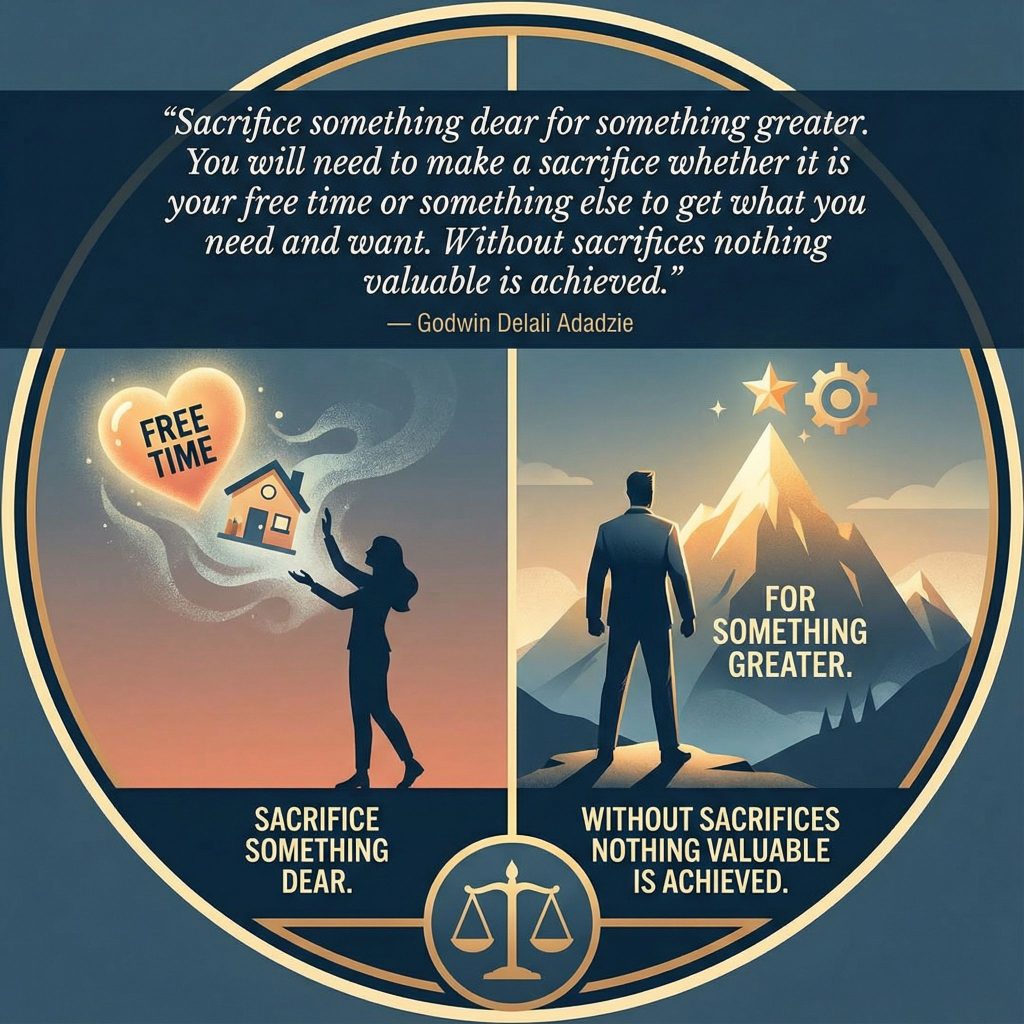
“Sacrifice something dear for something greater. You will need to make a sacrifice whether it is your free time or something else to get what you need and want. Without sacrifices nothing valuable is achieved.”
— Godwin Delali Adadzie
Context and Inspiration
This reflection addresses a fundamental principle that modern culture often tries to deny: valuable things cost something. The observation challenges the increasingly common belief that you can have everything you want without giving up anything, that achievement should come easily, or that desire alone should produce results. Reality works differently. Every significant achievement, relationship, skill, or possession requires sacrifice—giving up something you value to gain something you value more. Time, comfort, money, pleasure, other opportunities—something must be surrendered to gain what you truly want. People who refuse to sacrifice remain stuck wanting things they never achieve, envying others’ success without recognizing the sacrifices that made it possible. Understanding this principle doesn’t make sacrifice pleasant, but it makes it purposeful. When you know that sacrifice is the price of value, you can choose your sacrifices wisely rather than drifting through life unwilling to pay for anything worthwhile.
The Biblical Foundation of Sacrifice
Scripture consistently teaches that value requires sacrifice:
Jesus’ Teaching (Luke 14:28-30): “Suppose one of you wants to build a tower. Won’t you first sit down and estimate the cost to see if you have enough money to complete it? For if you lay the foundation and are not able to finish it, everyone who sees it will ridicule you, saying, ‘This person began to build and wasn’t able to finish.'”
Count the cost. Understand what you must sacrifice before beginning. Those unwilling to pay the price shouldn’t start.
Pearl of Great Price (Matthew 13:45-46): “Again, the kingdom of heaven is like a merchant looking for fine pearls. When he found one of great value, he went away and sold everything he had and bought it.”
The merchant sacrificed everything—all other pearls, all possessions—to gain the one pearl of greatest value. That’s wisdom, not foolishness.
Paul’s Sacrifice (Philippians 3:7-8): “But whatever were gains to me I now consider loss for the sake of Christ. What is more, I consider everything a loss because of the surpassing worth of knowing Christ Jesus my Lord, for whose sake I have lost all things. I consider them garbage, that I may gain Christ.”
Paul sacrificed status, comfort, safety, reputation—everything—to gain Christ. He judged the trade infinitely worthwhile.
The Cross Itself: God sacrificed His Son. Jesus sacrificed His life. The entire Gospel centers on sacrifice that produced infinite value—salvation.
Abraham and Isaac (Genesis 22): God tested Abraham’s willingness to sacrifice what was most dear—his promised son. Abraham’s willingness (though God provided a substitute) demonstrated that he valued God above everything.
Disciples Leaving Everything (Matthew 19:27-29): Peter said, “We have left everything to follow you!” Jesus responded that anyone who sacrifices family, property, or possessions for Him will receive a hundred times as much and eternal life.
Following Christ requires sacrifice. But the return dwarfs the cost.
Why Sacrifice Is Necessary
Several realities make sacrifice unavoidable for achievement:
Limited Resources: You have limited time, energy, and money. Investing in one thing means not investing in others. Choice itself is sacrifice—choosing one path means sacrificing other paths.
Competing Goods: Often you must choose between multiple good things. Career or family time? This opportunity or that one? Sleep or productivity? Comfort or growth?
You can’t have everything. Choosing requires sacrificing.
Growth Requires Discomfort: Comfort and growth rarely coexist. Growing means sacrificing comfort. Staying comfortable means sacrificing growth.
Excellence Demands Focus: To become excellent at anything requires sacrificing mediocrity in many things. The person excellent at one thing sacrificed being decent at ten things.
Future Requires Present: Building future success requires present sacrifice. Save now or spend later. Study now or remain ignorant. Exercise now or suffer poor health later.
Kingdom Economics: In God’s economy, you gain by losing, live by dying, lead by serving. “Whoever wants to save their life will lose it, but whoever loses their life for me will find it” (Matthew 16:25).
What People Must Sacrifice
Different goals require different sacrifices:
For Career Success
Time: Late nights, early mornings, weekends working while others rest. Career advancement costs time.
Leisure: While friends vacation or enjoy hobbies, you’re building skills, networking, or working on projects.
Other Opportunities: Saying yes to one career path means saying no to others. The surgeon sacrificed being an artist. The entrepreneur sacrificed job security.
For Education
Money: Tuition, books, living expenses. Education costs significant money that could have been spent on immediate comfort.
Years: The years spent in school are years not spent earning full income or pursuing other paths.
Social Life: Studying while friends party. Reading when others relax. The disciplined student sacrifices social approval for future opportunity.
For Physical Health
Comfort: Exercise is uncomfortable. Discipline in eating sacrifices immediate pleasure of junk food for long-term health.
Time: Working out, meal prepping, adequate sleep—all require sacrificing time you could spend on other things.
Convenience: Fast food is easier than cooking healthy meals. Taking the elevator is easier than stairs. Health requires sacrificing convenience.
For Strong Relationships
Independence: Deep relationships require vulnerability, compromise, and considering others’ needs—sacrificing complete independence.
Time: Quality relationships require invested time. You sacrifice time alone or time on other activities.
Pride: Maintaining relationships requires apologizing, forgiving, and sometimes being wrong. This sacrifices pride.
For Financial Security
Present Consumption: Saving for the future means not spending on present wants. Investing means delaying gratification.
Debt-Funded Lifestyle: Financial security requires sacrificing the lifestyle that debt enables. Living below your means when you could borrow to live above it.
Risky Ventures: Sometimes financial security means sacrificing potentially lucrative but risky opportunities.
For Spiritual Growth
Sin: Following Jesus means sacrificing sinful pleasures, however enjoyable they are temporarily.
Time: Prayer, Bible study, worship, service—all require sacrificing time spent on other things.
Popularity: Living by biblical values often costs social acceptance. “Everyone who wants to live a godly life in Christ Jesus will be persecuted” (2 Timothy 3:12).
Control: Submitting to God means sacrificing control over your life, plans, and decisions.
The Lie of “Having It All”
Modern culture sells the lie that you can have everything without sacrificing anything:
“Follow Your Dreams!” (No Mention of Cost): Motivational speakers emphasize dreams without discussing sacrifice required. This sets people up for disappointment.
“Work-Life Balance” (Implying You Can Maximize Both): The phrase suggests you can excel at work and have unlimited personal time. Reality: excellence in anything requires imbalance—more time there means less time here.
“Do What You Love and You’ll Never Work a Day”: This ignores that even doing what you love requires sacrifice—discipline on hard days, delayed gratification, consistent effort.
“You Deserve It All”: Consumer culture says you deserve comfort, pleasure, convenience, and achievement—all without sacrifice. This produces entitled people unprepared for reality.
Social Media Highlights: People show achievements without showing sacrifices that produced them. You see the graduation photo, not the sleepless nights studying. You see the fit body, not the disciplined workouts and meal prep.
This creates false expectations. People think others achieved without sacrifice because they don’t see the cost paid.
Biblical Examples of Sacrifice Producing Value
Moses: Sacrificed life as Egyptian royalty to lead Israel. “He chose to be mistreated along with the people of God rather than to enjoy the fleeting pleasures of sin. He regarded disgrace for the sake of Christ as of greater value than the treasures of Egypt” (Hebrews 11:25-26).
Short-term: he lost everything. Long-term: he gained purpose, led God’s people, and entered biblical history.
Ruth: Sacrificed her home, people, and chance of remarriage in her homeland to stay with Naomi and embrace Israel’s God (Ruth 1:16-17).
The sacrifice led to becoming great-grandmother of David and ancestor of Jesus.
Esther: Sacrificed safety by approaching the king uninvited, risking death to save her people (Esther 4:16).
The risk succeeded. Her people were saved.
The Apostles: Sacrificed comfortable lives for missionary journeys, persecution, and eventually martyrdom for most.
They gained the joy of spreading the Gospel and eternal reward.
Mary: Her “yes” to bearing Jesus sacrificed reputation, safety, and normal life.
She gained the honor of being mother of the Messiah and place in salvation history.
In every case, they sacrificed something dear for something greater. And the return exceeded the cost.
Choosing Your Sacrifices Wisely
Since sacrifice is unavoidable, wisdom means choosing what to sacrifice:
Sacrifice Lesser for Greater: Don’t sacrifice marriage for career. Don’t sacrifice health for money. Don’t sacrifice eternity for temporary pleasure.
Some things matter more than others. Sacrifice accordingly.
Sacrifice Present for Future (When Appropriate): Present comfort for future security. Present pleasure for future health. Present ease for future skill.
But don’t sacrifice all present for future that may not come. Balance matters.
Sacrifice Good for Best: Often you must choose between multiple good options. The wise person sacrifices good for best.
Count the Cost: Before committing, understand what sacrifice is required. Can you and will you pay it?
Make Conscious Choices: Many people sacrifice important things unconsciously through default choices. Intentionally decide what you’ll sacrifice for what.
Reassess Regularly: What you should sacrifice changes as life circumstances change. Periodically evaluate whether current sacrifices still align with priorities.
When People Won’t Sacrifice
What happens when people want valuable things but won’t sacrifice for them?
Resentment: They resent others who achieved what they wanted, not recognizing those people paid the price they refused to pay.
Stagnation: Without sacrifice, nothing changes. They remain stuck wanting things they never pursue.
Excuse-Making: Unable to admit unwillingness to sacrifice, they create excuses—”I don’t have time” (really: “I won’t sacrifice time from other things”), “I can’t afford it” (really: “I won’t sacrifice money spent elsewhere”).
Victim Mentality: They blame circumstances, other people, or “the system” for not having what they want, rather than acknowledging they won’t pay the price.
Shallow Living: Life without sacrifice is shallow. Depth requires digging—sacrificing surface-level comfort for deeper meaning.
Missed Opportunities: Every opportunity not pursued because of unwillingness to sacrifice is a door closed forever.
Proverbs 13:4 captures this: “A sluggard’s appetite is never filled, but the desires of the diligent are fully satisfied.” Want without sacrifice produces emptiness. Want with sacrifice produces fulfillment.
The Joy of Sacrifice
Here’s a paradox: sacrifice, though difficult, produces joy:
Purpose: Sacrificing for something you value gives life meaning. You’re building toward something that matters.
Achievement: Accomplishing something through sacrifice feels better than receiving something free. Earned victory tastes sweeter than gifted participation trophies.
Character Development: Sacrifice develops character—discipline, perseverance, delayed gratification, priorities alignment.
Deeper Appreciation: You value what cost you something more than what came free. Free things are taken for granted. Sacrificed-for things are treasured.
Legacy: Sacrifices today create inheritance for tomorrow—for your children, your community, the Kingdom.
Eternal Perspective: “For our light and momentary troubles are achieving for us an eternal glory that far outweighs them all” (2 Corinthians 4:17).
Present sacrifices produce eternal rewards beyond comparison.
Teaching Others to Sacrifice
Parents, leaders, and mentors must teach sacrifice:
Model It: Let people see your sacrifices. Don’t hide the cost of your achievements.
Don’t Rescue Unnecessarily: Letting children or followers experience natural consequences of avoiding sacrifice teaches the principle.
Celebrate Sacrifice, Not Just Achievement: Praise the effort, the discipline, the choice to sacrifice—not just the outcome.
Tell True Stories: Share stories of real people whose sacrifices produced value. Counter the “easy success” narrative.
Create Opportunities: Put people in situations requiring sacrifice for things they want. Sports, music, academics—these teach sacrifice when done seriously.
Don’t Over-Provide: Children who get everything without sacrifice don’t learn the principle. Require contribution, work, and earned rewards.
The Ultimate Sacrifice and Value
The Gospel demonstrates the sacrifice principle perfectly:
God Sacrificed His Son: “For God so loved the world that he gave his one and only Son” (John 3:16). Ultimate sacrifice.
Jesus Sacrificed Everything: Divinity’s privileges, comfort, safety, His very life—all sacrificed.
We’re Called to Sacrifice: “Therefore, I urge you, brothers and sisters, in view of God’s mercy, to offer your bodies as a living sacrifice, holy and pleasing to God—this is your true and proper worship” (Romans 12:1).
The Return Is Infinite: Salvation, eternal life, relationship with God, purpose, hope, transformation—these infinitely exceed the sacrifice.
The cross proves that the greatest value comes through the greatest sacrifice.
Reflection Questions
- What valuable things do you want but have been unwilling to sacrifice for?
- What are you currently sacrificing? Is it producing value aligned with your priorities?
- Where are you expecting achievement without sacrifice?
- What lesser things should you sacrifice for greater things?
- Are you teaching your children the principle of sacrifice, or protecting them from all discomfort?
- What sacrifice might God be calling you to make for Kingdom purposes?
Related Quotes
- “Everything is expensive. You just pay for it now or later.”
- “Something no matter how small is better than nothing.”
- “Solutions are the right answer to problems.”
Want to learn to sacrifice wisely for what truly matters? Explore my books on faith and purpose, discover more quotes and reflections, or read more articles on living intentionally.
Disclaimer: Adadzie.com is the personal website of Godwin Delali Adadzie. Content represents personal views and does not constitute official Catholic teaching, pastoral counseling, or professional advice. Quotes and reflections are shared for inspiration and reflection. For personal guidance, consult appropriate professionals. Questions? Email delali@adadzie.com | Read Full Disclaimer