

The Quote
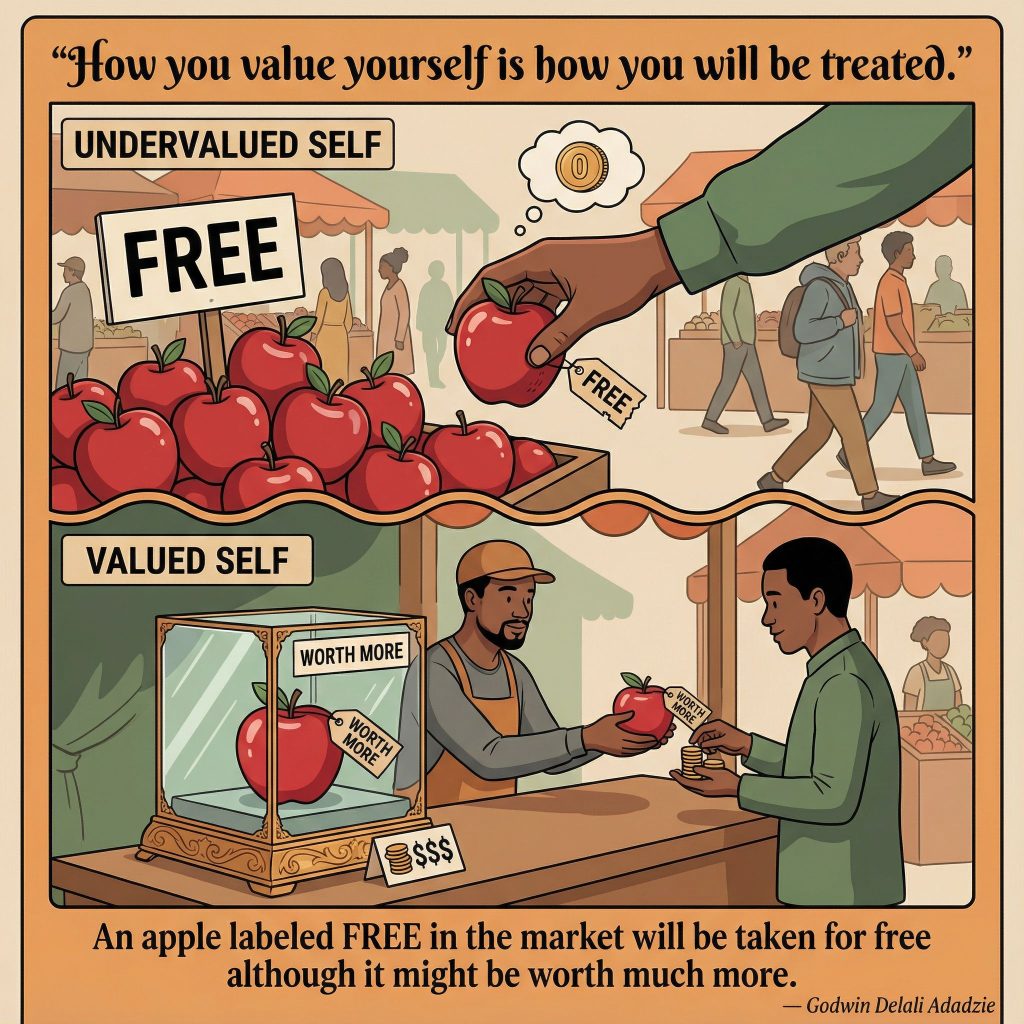
“How you value yourself is how you will be treated. An apple labeled FREE in the market will be taken for free although it might be worth much more.”
— Godwin Delali Adadzie
Context and Inspiration
This reflection addresses a painful pattern many people experience: being treated with disrespect, being taken advantage of, or being undervalued by others. The observation reveals that while others’ mistreatment is their responsibility, how you value yourself significantly influences how others treat you. The metaphor of the free apple is powerful—the apple hasn’t changed in quality or worth, but the label changes everything. People take what’s marked “free” regardless of its actual value because the label signals it has no cost. Similarly, when you present yourself as having no worth, requiring no respect, accepting any treatment, people respond to that presentation. This isn’t about blaming victims of mistreatment or suggesting abuse is ever the victim’s fault. Rather, it’s recognizing that appropriate self-valuation creates boundaries that communicate to others how you should be treated. People who don’t value themselves become easy targets for those who exploit, manipulate, or disrespect. Learning to value yourself biblically—not too high (pride) or too low (false humility)—helps establish healthy patterns where you’re treated with the respect and dignity that every image-bearer of God deserves.
The Pattern: Self-Worth and Treatment
The connection between self-valuation and treatment plays out predictably:
Low Self-Worth Invites Poor Treatment: When you treat yourself as worthless, others often follow suit. Not always—good people treat others well regardless—but many people take cues from how you present yourself.
Boundaries Communicate Worth: People who set and maintain boundaries communicate that they have worth. Those without boundaries signal that any treatment is acceptable.
Desperation Attracts Exploitation: Desperate people—for relationship, approval, acceptance—become targets for those who exploit desperation.
Self-Respect Commands Respect: People who demonstrate self-respect generally receive more respect from others.
This isn’t universal—some people disrespect everyone regardless. But it’s a common pattern.
Biblical Foundation for Proper Self-Worth
Scripture provides foundation for healthy self-valuation:
Created in God’s Image (Genesis 1:27): “So God created mankind in his own image, in the image of God he created them; male and female he created them.”
Every person bears God’s image. This gives inherent worth and dignity.
Bought at a Price (1 Corinthians 6:19-20): “You are not your own; you were bought at a price.”
Christ’s blood is your purchase price. If you’re worth Jesus’ life, you have immense value.
Fearfully and Wonderfully Made (Psalm 139:14): “I praise you because I am fearfully and wonderfully made; your works are wonderful, I know that full well.”
God made you intentionally, carefully, wonderfully. This creates worth.
Loved by God (John 3:16): “For God so loved the world that he gave his one and only Son.”
God’s love for you demonstrates your value to Him.
Called His Children (1 John 3:1): “See what great love the Father has lavished on us, that we should be called children of God! And that is what we are!”
You’re God’s child. This identity gives worth.
Your worth isn’t based on accomplishments, appearance, others’ opinions, or circumstances. It’s based on being God’s image-bearer, loved and redeemed by Christ.
The Danger of Undervaluing Yourself
When you don’t recognize your worth, problems follow:
Tolerating Abuse: People who don’t value themselves tolerate treatment they should never accept—emotional abuse, manipulation, disrespect, exploitation.
Desperate Choices: Low self-worth creates desperation. Desperate people make poor choices—wrong relationships, compromising situations, selling themselves short.
People-Pleasing: Without internal sense of worth, you seek worth through others’ approval. This creates exhausting people-pleasing that never satisfies.
No Boundaries: Boundaries require believing you deserve protection. Without self-worth, you have no boundaries.
Attraction to Wrong People: Healthy people generally avoid those with no self-worth. Unhealthy people seek them out because they’re easy to manipulate.
Self-Fulfilling Prophecy: If you believe you deserve poor treatment, you’ll accept it, confirming your belief, creating cycle.
Wasted Potential: God-given gifts, talents, and calling go unused because you don’t believe you’re worth investing in or capable of significance.
Proverbs 29:25 warns: “Fear of man will prove to be a snare, but whoever trusts in the Lord is kept safe.” Fear of what others think—rooted in low self-worth—traps you.
The Danger of Overvaluing Yourself
The opposite extreme is equally problematic:
Pride and Arrogance: Thinking you’re better than others, deserving of special treatment, above rules or consequences.
Proverbs 16:18 warns: “Pride goes before destruction, a haughty spirit before a fall.”
Demanding What You Haven’t Earned: Inflated self-worth demands rewards, recognition, or treatment not yet earned.
Inability to Receive Correction: Those who overvalue themselves reject correction, feedback, or accountability.
Alienating Others: Arrogance pushes people away. Even those who should be allies distance themselves.
Spiritual Danger: Pride is sin God specifically opposes. “God opposes the proud but shows favor to the humble” (James 4:6).
Biblical self-worth is neither self-hatred nor arrogance. It’s recognizing you’re valuable because God made and loves you, while remaining humble about your limitations and need for God.
How Self-Worth Affects Relationships
Self-valuation profoundly impacts relationship patterns:
Romantic Relationships: People with healthy self-worth choose partners who treat them well. They don’t settle for mistreatment because they believe they deserve better.
People with low self-worth often choose partners who reinforce their negative self-view or accept treatment they should never tolerate.
Friendships: Healthy self-worth leads to mutual friendships where both parties give and receive. Low self-worth creates one-sided friendships where you give everything and receive little.
Workplace: Employees who value themselves appropriately negotiate fair compensation, set boundaries about work hours, and don’t accept harassment.
Those who don’t value themselves accept underpayment, overwork, and mistreatment.
Church/Ministry: Christians with healthy self-worth serve from abundance, not desperation. They can say no to requests that aren’t their calling.
Those with low self-worth can’t say no, leading to burnout and resentment.
Family: Healthy self-worth allows you to have appropriate boundaries even with family while still loving them.
Low self-worth leads to accepting unhealthy family dynamics that damage you.
The “Free Apple” Phenomenon
The quote’s metaphor reveals how presentation affects treatment:
Labels Matter: A $5 apple marked “FREE” will be treated as free, regardless of actual value. Your presentation—how you carry yourself, what you tolerate, boundaries you set—labels you.
People Respond to Signals: Most people take cues from how you present yourself. If you signal “I have no worth,” many will treat you accordingly.
Market Dynamics Apply: In marketplace, free items are grabbed without thought. Items with price tags are considered more carefully.
Similarly, people who require nothing from others are taken for granted. Those who have standards are treated with more consideration.
Value Must Be Communicated: The apple’s inherent quality doesn’t matter if it’s labeled wrong. Your inherent worth (as God’s image-bearer) matters, but must be recognized and communicated through how you carry yourself.
Not About Pride: This isn’t about prideful demands or acting superior. It’s about healthy self-respect that communicates you deserve basic dignity.
Biblical Examples of Proper Self-Worth
Esther: She approached the king uninvited, risking death, because she valued her calling and her people enough to take that risk (Esther 4:16).
She didn’t grovel or demean herself. She presented herself with dignity befitting a queen.
Daniel: In Babylon, Daniel refused to compromise his values despite pressure (Daniel 1:8). He valued his integrity and relationship with God above comfort or advancement.
His self-respect earned others’ respect, even from pagan kings.
Paul: Paul knew his worth came from Christ, not accomplishments. This freed him to serve humbly while also standing firm when necessary.
He could say “I am the least of the apostles” (1 Corinthians 15:9) and also “I consider my life worth nothing to me” (Acts 20:24) while still setting boundaries and demanding proper treatment when needed (Acts 16:37, 22:25).
Jesus: Jesus demonstrated perfect balance—ultimate humility (washing disciples’ feet) combined with appropriate assertion of worth (clearing temple, confronting religious leaders).
He didn’t grovel before authorities but spoke truth with dignity.
The Bleeding Woman (Luke 8:43-48): Despite her condition and society’s treatment of her as unclean, she believed she deserved healing. Her faith-filled action demonstrated she valued herself enough to pursue wholeness.
Building Healthy Self-Worth
How do you develop appropriate self-valuation?
Ground Worth in God: Your worth comes from being God’s image-bearer and Christ’s redeemed one, not from accomplishments, appearance, or others’ opinions.
Reject False Labels: Society, past abuse, or negative voices may have labeled you “worthless.” Reject those labels. God’s label is “beloved child.”
Set Boundaries: Practice saying no to mistreatment, unreasonable demands, or situations that compromise your values.
Boundaries aren’t selfish—they’re healthy.
Surround Yourself with Healthy People: Relationships with people who treat you well reinforce healthy self-worth. Distance from those who constantly tear you down.
Address Past Wounds: Abuse, trauma, or rejection can create deep wounds affecting self-worth. Professional counseling can help heal these.
Develop Competence: Growing in skills and abilities naturally builds confidence and appropriate self-valuation.
Serve from Strength: Serve others from position of strength and wholeness, not desperation for approval.
Practice Self-Care: Taking care of your physical, emotional, and spiritual health communicates to yourself and others that you’re worth caring for.
Celebrate Your Gifts: God gave you specific gifts and talents. Recognizing and using them reinforces your worth.
Setting Your Price
The quote’s metaphor suggests you “set your price” through how you value yourself:
You Teach People How to Treat You: Through what you tolerate, what you accept, and what you reject, you train others in how to treat you.
If you accept disrespect repeatedly, you’re teaching that disrespect is acceptable.
Standards Matter: Having standards—for how you’re spoken to, what treatment you accept, what relationships you enter—communicates worth.
Consistency Reinforces: Occasionally standing up for yourself but usually accepting mistreatment sends mixed signals. Consistent boundaries are clearer.
It’s Not Manipulation: This isn’t manipulating others into treating you well. It’s communicating your value honestly and letting their response reveal their character.
Some Will Leave: When you start valuing yourself, some people will leave because they benefited from your low self-worth. Let them go.
Right People Will Appreciate: People of character appreciate and respect appropriate self-worth. They’re relieved to relate to someone with healthy boundaries.
When Others Don’t Respond to Your Worth
Sometimes you value yourself appropriately but others still mistreat you:
Their Problem, Not Yours: Some people mistreat everyone regardless. Their behavior reflects their character, not your worth.
Don’t Return to Old Patterns: Continuing mistreatment despite your healthy boundaries doesn’t mean you should lower your standards. It means that relationship might need to end.
Victim-Blaming Is Wrong: This teaching isn’t about blaming abuse victims. Abusers are responsible for abuse, period.
But recognizing your worth can help you leave abusive situations and avoid future ones.
Persecution Is Different: Christians face persecution for faith. This isn’t result of low self-worth—it’s hostility to Christ.
Jesus warned: “If the world hates you, keep in mind that it hated me first” (John 15:18).
Keep Healthy Perspective: Your worth isn’t determined by others’ response. God’s view of you matters most.
The Balance: Humility and Worth
How do you balance biblical humility with healthy self-worth?
Humility Isn’t Self-Hatred: Humility is accurate self-assessment, not thinking you’re worthless.
You Can Be Humble and Valuable: Moses was “more humble than anyone else” (Numbers 12:3) yet God used him powerfully. Humility and worth coexist.
Serve from Strength: Jesus washed disciples’ feet from position of secure identity: “Jesus knew that the Father had put all things under his power… so he got up from the meal, took off his outer clothing, and wrapped a towel around his waist” (John 13:3-4).
He served from security, not insecurity.
Don’t Confuse Humility with Doormat: Humility doesn’t mean accepting all mistreatment. Jesus was humble but confronted wrong.
Pride Is the Danger: Overvaluing yourself is pride. Proper self-worth based on God’s view of you is healthy.
Reflection Questions
- How do you currently value yourself? Too high, too low, or appropriately?
- What patterns of poor treatment do you tolerate that reflect low self-worth?
- Have you confused humility with allowing mistreatment?
- What boundaries do you need to set that you’ve avoided setting?
- Are you seeking worth from others’ approval rather than God’s truth?
- How might your life change if you truly believed God’s assessment of your worth?
Related Quotes
- “Human beings are naturally foolish, dishonest and afraid.”
- “Be wise in this wicked, selfish, ungrateful and forgetful world of humans.”
- “Truth is a bitter medicine. That’s why many can’t take it.”
Want to develop healthy biblical self-worth and establish appropriate boundaries? Explore my books on faith and identity, discover more quotes and reflections, or read more articles on living with dignity.
Disclaimer: Adadzie.com is the personal website of Godwin Delali Adadzie. Content represents personal views and does not constitute official Catholic teaching, pastoral counseling, or professional advice. Quotes and reflections are shared for inspiration and reflection. For personal guidance, consult appropriate professionals. Questions? Email delali@adadzie.com | Read Full Disclaimer