
The Quote
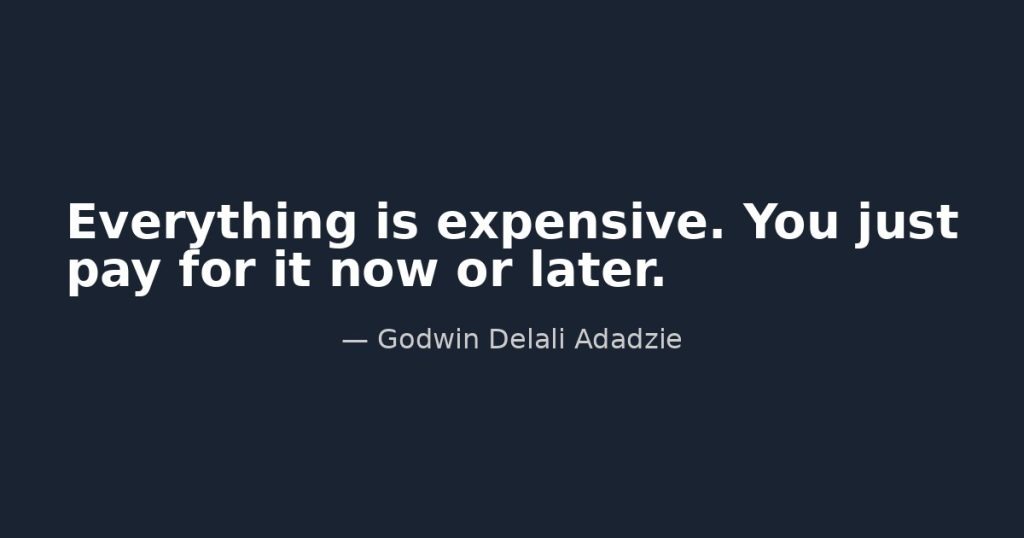
“Everything is expensive. You just pay for it now or later.”
— Godwin Delali Adadzie
Context and Inspiration
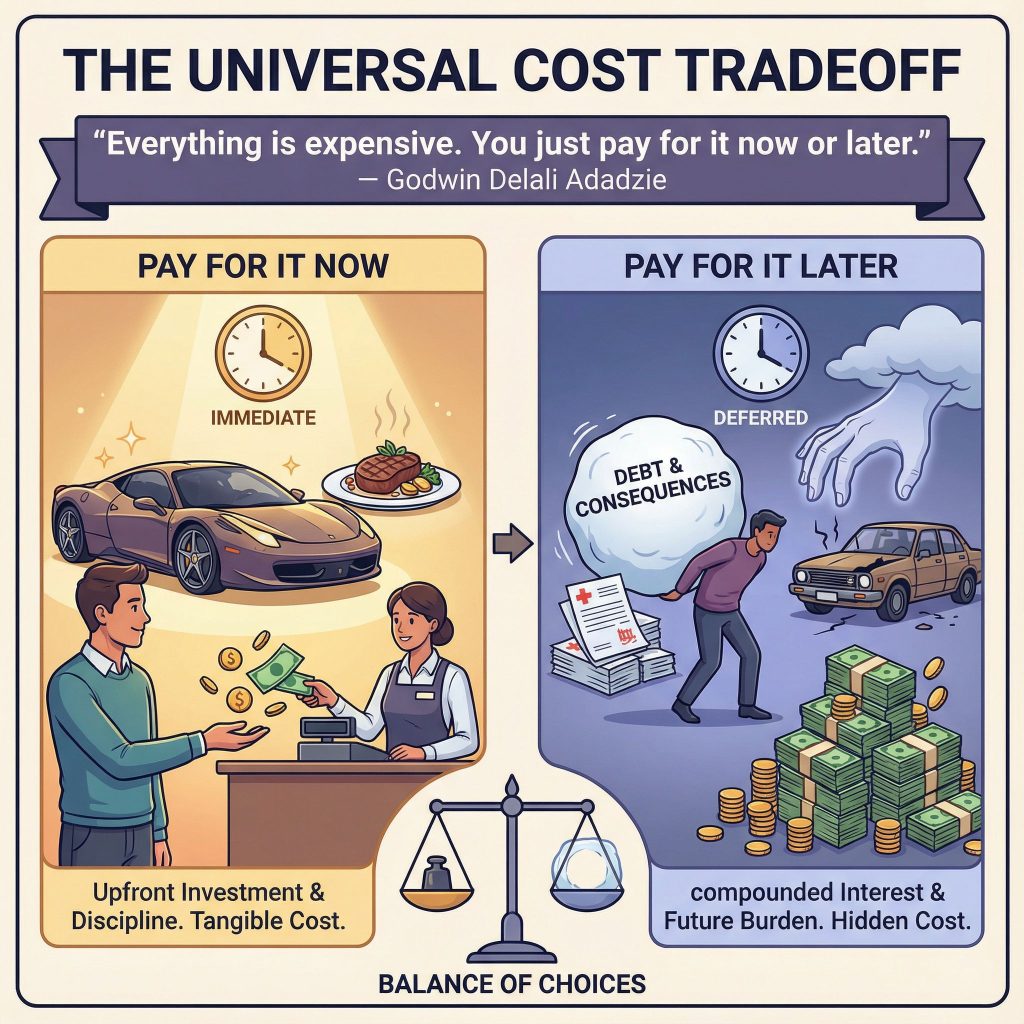
This reflection addresses a fundamental truth about life that many people resist: nothing comes without cost. The observation applies across multiple areas—physical health, relationships, education, spiritual growth, financial decisions, and moral choices. Some people assume they’ve found shortcuts or free rides, only to discover years later that the bill always comes due. The distinction between paying now versus paying later reveals an important principle about wisdom and consequences. Often, what seems cheap or easy in the moment carries a much higher price tag down the road, while what requires significant investment upfront saves enormous cost later. This truth challenges our natural preference for immediate comfort and delayed consequences, inviting us to think more carefully about the real cost of our choices.
The Immediate Cost vs. The Delayed Cost
Every choice, habit, and path in life has a price. The question is not whether you’ll pay, but when and how much.
Paying Now: This involves immediate sacrifice, effort, discomfort, or investment. It’s choosing the harder path in the present for the sake of future benefit.
Examples include:
- Exercising regularly instead of staying comfortable on the couch
- Studying instead of playing
- Saving money instead of spending it
- Having difficult conversations instead of avoiding conflict
- Practicing self-control instead of giving in to every desire
- Investing time in relationships instead of taking them for granted
Paying Later: This involves choosing immediate comfort, pleasure, or ease while deferring the consequences. It’s the path of least resistance in the moment, but it accumulates interest.
Examples include:
- Eating poorly and living without exercise (paying later with health problems)
- Avoiding education or skill development (paying later with limited opportunities)
- Spending everything you earn (paying later with financial stress)
- Ignoring relationship problems (paying later with broken connections)
- Giving in to every temptation (paying later with damaged character and consequences)
- Neglecting spiritual life (paying later with emptiness and lack of foundation)
The Bible recognizes this pattern clearly: “Do not be deceived: God cannot be mocked. A man reaps what he sows” (Galatians 6:7). The harvest always comes, whether we plant good seeds or bad ones.
The Hidden Cost of “Free” Things
Nothing is truly free. Even things that appear to cost nothing carry hidden price tags.
“Free” Entertainment: Scrolling social media is free, right? Not really. You pay with your attention, your time, your mental health, your productivity, and your privacy. Companies make billions from what you give them “for free.”
The cost might not be in dollars, but it’s real. Hours that could have been invested in growth, relationships, or meaningful work are spent on content designed to keep you hooked.
“Free” Pleasure: Sin often markets itself as free pleasure. A moment of indulgence, a shortcut through dishonesty, a compromise of values—these seem to cost nothing in the moment.
But Proverbs 14:12 warns: “There is a way that appears to be right, but in the end it leads to death.” The bill for “free” sin comes later, often with massive interest: broken trust, damaged reputation, ruined relationships, guilt, shame, and spiritual distance from God.
“Free” Shortcuts: Cutting corners to get ahead faster seems smart until the foundation crumbles. The student who cheats their way through school pays later when they lack the knowledge their degree claims they have. The business that builds on deception pays later when the truth comes out.
Jesus asked the crucial question: “What good is it for someone to gain the whole world, yet forfeit their soul?” (Mark 8:36). Some costs are too high, even if you get what you wanted.
“Free” Neglect: Not investing in something feels free because you’re not actively doing anything. But neglect has enormous costs.
Neglecting your health is free today—it costs you in medical bills, pain, and shortened life later. Neglecting your marriage is free today—it costs you in divorce, loneliness, and broken family later. Neglecting your relationship with God is free today—it costs you in spiritual emptiness, lack of foundation during trials, and eternal consequences.
Examples from Scripture
The Bible is filled with examples of people who learned this principle the hard way:
Esau’s Birthright (Genesis 25:29-34): Esau was hungry. He wanted immediate satisfaction. So he sold his birthright—his inheritance, his position, his future—for a single meal.
It seemed like a good deal in the moment. But later, when he realized what he’d given up, “he could find no chance to repent, though he sought it with tears” (Hebrews 12:17). He paid a massive price later for choosing immediate comfort over long-term value.
David and Bathsheba (2 Samuel 11-12): David saw Bathsheba and wanted her. Rather than paying the cost of self-control in that moment, he took what he wanted. Then he covered it up with murder.
The immediate pleasure seemed free. But the cost came later: a dead child, family dysfunction and violence, rebellion from his own son, and lifelong consequences that scarred his family for generations. He paid far more later than self-control would have cost him in the moment.
The Rich Fool (Luke 12:16-21): A rich man had great harvests. Rather than using his abundance to honor God and help others, he built bigger barns and planned to “eat, drink, and be merry.”
It seemed like he’d gotten everything for free—good fortune, wealth, security. But that very night, God said: “You fool! This very night your life will be demanded from you.” He gained everything and lost his soul. The cost came due when he least expected it.
The Prodigal Son (Luke 15:11-32): The younger son wanted his inheritance immediately. He took it and spent it all on wild living. For a while, it seemed free—pleasure, excitement, freedom.
Then the money ran out. The famine came. He ended up feeding pigs and starving. What seemed like free pleasure early on cost him his dignity, his wealth, his comfort, and nearly his relationship with his father.
Judas (Matthew 26:14-16, 27:3-5): Judas got thirty pieces of silver for betraying Jesus. It seemed like easy money. But the cost came later—overwhelming guilt, despair, and ultimately suicide.
He got paid immediately for his betrayal, then paid an infinitely higher price later.
The Cost in Different Areas of Life
This principle plays out across every area of human experience:
Physical Health
Pay Now: Exercise regularly, eat well, get enough sleep, avoid harmful substances, manage stress. All of this requires discipline, time, effort, and sometimes discomfort.
Pay Later: Skip the discipline and pay with obesity, diabetes, heart disease, chronic pain, limited mobility, shortened lifespan, and massive medical bills.
The cost of maintaining health is high. The cost of neglecting it is much higher.
Education and Skill Development
Pay Now: Study hard, practice consistently, invest time in learning, accept correction, work through difficulty. It’s mentally taxing and requires delayed gratification.
Pay Later: Skip the learning and pay with limited job opportunities, lower income, inability to adapt to changing markets, dependence on others, and regret.
The cost of education is real. The cost of ignorance is greater.
Financial Wisdom
Pay Now: Live below your means, save consistently, avoid debt, invest for the future, make sacrifices to build financial stability. It requires saying no to things you want today.
Pay Later: Spend everything, accumulate debt, live for the moment. Later you’ll pay with financial stress, inability to handle emergencies, debt bondage, and anxiety about the future.
Proverbs 21:5 says it clearly: “The plans of the diligent lead to profit as surely as haste leads to poverty.”
Relationships
Pay Now: Invest time, have difficult conversations, forgive when it’s hard, be vulnerable, prioritize people over comfort, show up even when you don’t feel like it.
Pay Later: Take relationships for granted, avoid conflict, withhold forgiveness, choose convenience over connection. Eventually you’ll pay with loneliness, broken families, lost friendships, and regret.
Relationships require constant investment. Neglect costs far more than maintenance.
Character and Integrity
Pay Now: Tell the truth even when lying would be easier. Keep your word even when it’s inconvenient. Do the right thing even when no one’s watching. Resist temptation even when it’s strong.
Pay Later: Choose shortcuts, compromise your values, lie for convenience, give in to temptation. You’ll pay with damaged reputation, lost trust, guilt, shame, and a character that crumbles under pressure.
Proverbs 11:3 says: “The integrity of the upright guides them, but the unfaithful are destroyed by their duplicity.”
Spiritual Life
Pay Now: Pray regularly, read Scripture, attend church, confess sin, serve others, practice spiritual disciplines, deny yourself, take up your cross. All of this requires time, humility, and effort.
Pay Later: Neglect your relationship with God, skip spiritual practices, drift away from community, feed your flesh instead of your spirit. You’ll pay with spiritual emptiness, lack of foundation during trials, distance from God, and eternal consequences.
Jesus said: “Whoever wants to be my disciple must deny themselves and take up their cross daily and follow me” (Luke 9:23). Discipleship costs. But the cost of not following Jesus is infinitely higher.
Why We Choose to Pay Later
If paying later is more expensive, why do so many people choose that path?
Immediate Gratification Feels Better: Our brains are wired to prefer immediate rewards over delayed ones. Eating the cake now feels better than the abstract concept of being healthy later.
This is called temporal discounting—we discount the value of future benefits compared to immediate ones.
Future Consequences Seem Uncertain: “Maybe I won’t get diabetes.” “Maybe the relationship will be fine without effort.” “Maybe I can coast on talent without developing discipline.”
Future costs feel hypothetical. Present costs feel real. So we gamble on avoiding the later cost rather than paying the certain cost now.
Paying Now Is Visible; Paying Later Is Hidden: Everyone can see you’re sacrificing if you skip dessert, study instead of partying, or save instead of buying what you want.
But future costs are hidden until they arrive. It’s easy to pretend they won’t come.
Cultural Messages Encourage It: Modern culture constantly sells the message that you can have everything now without consequences. Credit cards, instant entertainment, quick fixes, shortcuts to success—the whole system encourages paying later.
We Lack Wisdom or Foresight: Young people especially struggle to see far enough ahead to value future benefits over present pleasures. Experience teaches us that the bill always comes, but often only after we’ve paid it the hard way.
The Wisdom of Paying Now
Those who learn to pay the cost upfront rather than deferring it gain enormous advantages:
Compound Interest Works in Your Favor: Just as financial debt compounds against you, investment compounds for you. Small consistent investments early pay massive dividends later.
The person who starts exercising at 20 rather than waiting until health problems force them at 50 has gained 30 years of compounding health benefits.
You Choose the Terms: When you pay now, you control how and when. When you pay later, circumstances often control the terms.
It’s better to choose to study hard on your schedule than to be forced to scramble when you’re failing. It’s better to choose healthy eating than to be forced into it by a heart attack.
The Cost Is Usually Lower: Maintenance is cheaper than repair. Prevention is cheaper than cure. Investment is cheaper than emergency response.
It costs less to brush your teeth than to get them all pulled and replaced. It costs less to maintain your car than to replace it. It costs less to address relationship problems early than to heal from divorce.
You Avoid the Interest: Delayed costs don’t just stay the same—they grow. Sin doesn’t just cost what it cost initially; it compounds with additional consequences.
A lie told today requires more lies tomorrow to maintain it. A health habit neglected today creates bigger problems tomorrow. Debt ignored today grows with interest.
You Build Character: Choosing to pay now builds discipline, wisdom, self-control, and maturity. These character qualities then make future decisions easier and better.
The person who’s practiced saying no to immediate gratification has developed the muscle to keep saying no. The person who’s only indulged has no such strength.
Learning to Count the Cost
Jesus taught about counting the cost before making commitments:
“Suppose one of you wants to build a tower. Won’t you first sit down and estimate the cost to see if you have enough money to complete it? For if you lay the foundation and are not able to finish it, everyone who sees it will ridicule you, saying, ‘This person began to build and wasn’t able to finish'” (Luke 14:28-30).
Wisdom requires thinking ahead about what things actually cost—not just the immediate price tag, but the total cost over time.
Ask Better Questions:
- “What will this cost me a year from now?”
- “What am I giving up by choosing this?”
- “What will future-me wish present-me had done?”
- “What’s the full price, not just the down payment?”
Consider Opportunity Cost: Every choice costs not just what you pay directly, but what you give up by not choosing differently.
The hour spent scrolling costs not just that hour, but whatever else you could have done with it. The money spent on impulse purchases costs not just those dollars, but the future value those dollars could have grown into.
Look at Others Who’ve Gone Ahead: Want to know the real cost of a particular path? Look at people 10, 20, 30 years ahead of you who made similar choices.
The person who never invested in their health—what’s their quality of life now? The person who built their life on work and neglected family—how did that turn out? The person who pursued God faithfully—what fruit has that borne?
Seek Wisdom from Scripture and Wise Counselors: You don’t have to learn every lesson through personal experience. Scripture and wise people can help you see costs you’d miss on your own.
Proverbs 15:22 says: “Plans fail for lack of counsel, but with many advisers they succeed.”
The Only Thing Worth Its Full Price
Here’s the paradox: While everything costs something, following Jesus is the one thing that’s worth whatever it costs.
Jesus told a parable about a merchant who found a pearl of great value. He sold everything he had to buy it (Matthew 13:45-46). The cost was total—everything. But the pearl was worth it.
Discipleship costs. It costs your comfort, your control, your right to live for yourself. It costs your pride, your selfish ambitions, your claim to your own life.
But what you gain is infinitely greater: forgiveness, relationship with God, eternal life, purpose, peace, transformation, community, and ultimately God Himself.
Paul, who gave up everything to follow Christ, wrote: “I consider everything a loss because of the surpassing worth of knowing Christ Jesus my Lord, for whose sake I have lost all things. I consider them garbage, that I may gain Christ” (Philippians 3:8).
He paid. But he didn’t consider it a loss—because what he gained was worth infinitely more.
Making Peace with the Cost
Once we accept that everything costs something, we can stop looking for free rides and start making wise choices about when and how we’ll pay.
Accept that discomfort isn’t the enemy. Growth requires discomfort. Character development requires challenge. Anything worthwhile requires sacrifice.
Stop trying to avoid all difficulty and start choosing which difficulties are worth bearing.
Choose your hard. It’s hard to exercise; it’s also hard to be unhealthy. It’s hard to save; it’s also hard to be broke. It’s hard to have difficult conversations; it’s also hard to live with broken relationships.
You’re going to experience hard either way. Choose which hard leads somewhere better.
Invest in your future self. Make choices today that future-you will thank you for. Every time you’re tempted to defer the cost, ask: “Do I want to make future-me deal with this, plus interest?”
Trust God’s economy. In God’s kingdom, costs and rewards don’t always work like we expect. Losing your life leads to finding it (Matthew 16:25). Giving leads to receiving (Luke 6:38). The last become first (Matthew 20:16).
God sees what you sacrifice for righteousness, and He rewards it—if not in this life, certainly in the next.
Reflection Questions
- Where in your life are you choosing to “pay later” rather than paying now? What’s that likely to cost you down the road?
- What “free” things are you consuming that actually have significant hidden costs?
- Looking back, what are some times you paid upfront and are grateful for it now? What are some times you deferred the cost and regretted it later?
- In what areas do you need to start investing now to avoid much higher costs later?
- What helps you choose delayed gratification over immediate pleasure? What makes it harder?
- How does understanding that “everything is expensive” change how you make decisions?
Related Quotes
- “Sacrifice something dear for something greater. You will need to make a sacrifice whether it is your free time or something else to get what you need and want. Without sacrifices nothing valuable is achieved.”
- “God is not a genie. Prayer is not a magic lamp.”
- “No matter how microscopic your progress is, it is still progress.”
Want to grow in wisdom about choices and their consequences? Explore my books on faith and practical wisdom, discover more quotes and reflections, or read more articles on living wisely.
Disclaimer: Adadzie.com is the personal website of Godwin Delali Adadzie. Content represents personal views and does not constitute official Catholic teaching, pastoral counseling, or professional advice. Quotes and reflections are shared for inspiration and reflection. For personal guidance, consult appropriate professionals. Questions? Email delali@adadzie.com | Read Full Disclaimer