The Quote
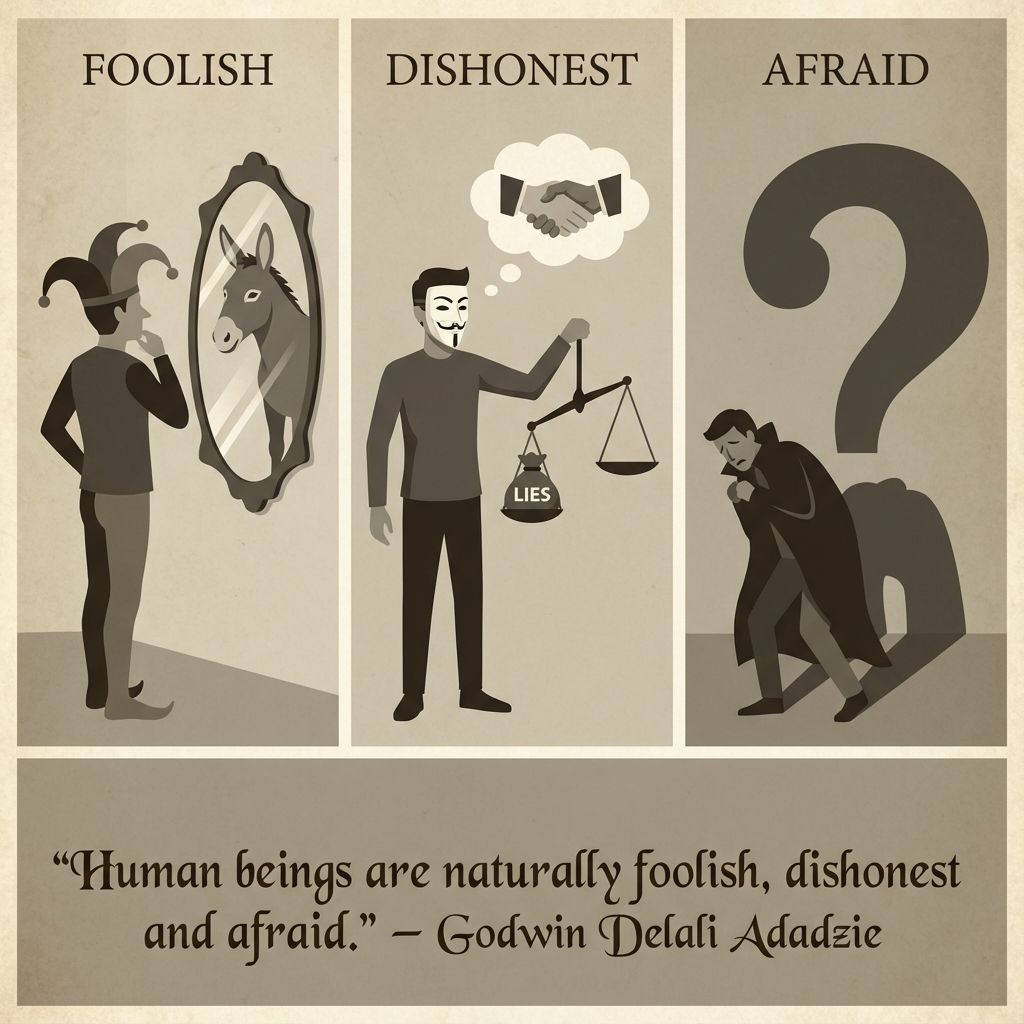
“Human beings are naturally foolish, dishonest and afraid.”
— Godwin Delali Adadzie
Context and Inspiration
This reflection addresses an uncomfortable truth about human nature that modern culture often denies or minimizes: we are not born good, noble, or naturally inclined toward virtue. The observation captures three core defects that mark humanity in its fallen state—foolishness that rejects wisdom and truth, dishonesty that distorts reality for personal advantage, and fear that controls and paralyzes. Many contemporary philosophies insist that humans are fundamentally good and that evil is merely learned behavior or the result of bad environments. But honest examination of human history, careful observation of human behavior from earliest childhood, and biblical revelation all point to a darker reality: these negative traits are natural to us, not exceptions. Children don’t need to be taught selfishness, lying, or fear—these emerge naturally and must be trained out through discipline and moral formation. Understanding this truth isn’t pessimistic despair but realistic assessment that leads to proper solutions: we need transformation, not just education; redemption, not just improvement; God’s grace, not just human effort.
Naturally Foolish
Scripture consistently describes humanity’s natural foolishness:
Psalm 14:1: “The fool says in his heart, ‘There is no God.’ They are corrupt, their deeds are vile; there is no one who does good.”
Natural human thinking rejects God and embraces corruption. This is foolishness.
Proverbs 1:7: “The fear of the Lord is the beginning of knowledge, but fools despise wisdom and instruction.”
The natural human response to wisdom and instruction is despising it, not embracing it.
Romans 1:21-22: “For although they knew God, they neither glorified him as God nor gave thanks to him, but their thinking became futile and their foolish hearts were darkened. Although they claimed to be wise, they became fools.”
Human wisdom apart from God is foolishness. We think we’re being wise while actually being foolish.
1 Corinthians 1:18: “For the message of the cross is foolishness to those who are perishing, but to us who are being saved it is the power of God.”
Natural human thinking finds God’s actual wisdom (the cross) to be foolish. This shows how backwards our natural thinking is.
1 Corinthians 2:14: “The person without the Spirit does not accept the things that come from the Spirit of God but considers them foolishness, and cannot understand them because they are discerned only through the Spirit.”
Natural human thinking cannot understand spiritual truth. It lacks the capacity.
What does this foolishness look like practically?
Rejecting Consequences: Foolish people ignore obvious cause-and-effect relationships. They believe they can sin without suffering consequences.
Short-term Thinking: Fools prioritize immediate gratification over long-term wellbeing. They eat the seed corn, spend tomorrow’s money today, trade permanent for temporary.
Pride: The fool trusts his own understanding rather than seeking wisdom from God or others. “The way of fools seems right to them, but the wise listen to advice” (Proverbs 12:15).
Moral Confusion: Natural human thinking calls evil good and good evil. Isaiah 5:20 condemns this: “Woe to those who call evil good and good evil, who put darkness for light and light for darkness.”
Self-Sufficiency: Fools believe they don’t need God. They think human wisdom is sufficient.
Repeating Mistakes: Proverbs 26:11 says: “As a dog returns to its vomit, so fools repeat their folly.” Natural foolishness keeps making the same errors.
Naturally Dishonest
Humans don’t need to learn how to lie—lying comes naturally:
Psalm 58:3: “Even from birth the wicked go astray; from the womb they are wayward, speaking lies.”
Lying isn’t learned behavior corrupting naturally honest children. Children naturally lie.
Jeremiah 17:9: “The heart is deceitful above all things and beyond cure. Who can understand it?”
The human heart naturally deceives—both others and itself.
Romans 3:13: “Their throats are open graves; their tongues practice deceit.”
Human speech naturally tends toward deception, not truth.
John 8:44: Jesus told some listeners, “You belong to your father, the devil, and you want to carry out your father’s desires. He was a murderer from the beginning, not holding to the truth, for there is no truth in him. When he lies, he speaks his native language, for he is a liar and the father of lies.”
Lying is the devil’s native language. Unredeemed humanity shares that language naturally.
What does natural dishonesty look like?
Self-Deception: We lie to ourselves first, believing we’re better than we are, making excuses for our failures, rationalizing our sins.
Manipulation: We shade truth to get what we want. We tell partial truths that mislead. We omit facts that hurt our case.
Reputation Management: We present false versions of ourselves to look better—on social media, to friends, even in church.
Blame-Shifting: When caught in wrongdoing, we deflect, excuse, minimize, or blame others. Adam and Eve started this immediately after sinning (Genesis 3:12-13).
Exaggeration: We inflate our achievements and minimize our failures. We make ourselves sound better than reality.
Flattery: We say things we don’t mean to manipulate people or gain advantage.
Small Lies: We lie about “small things” constantly—why we’re late, what we’re doing, what we think, whether we’ve done something.
Most people lie multiple times daily without considering it significant. This naturalness of dishonesty proves it’s built into fallen human nature.
Naturally Afraid
Fear is the third natural human characteristic:
Genesis 3:10: After sinning, Adam said to God: “I heard you in the garden, and I was afraid because I was naked; so I hid.”
Fear entered immediately with sin. It’s part of the fallen condition.
Job 15:20-21: “All his days the wicked man suffers torment, the ruthless man through all the years stored up for him. Terrifying sounds fill his ears; when all seems well, marauders attack him.”
The guilty live in fear. Wickedness produces fear.
Proverbs 28:1: “The wicked flee though no one pursues, but the righteous are as bold as a lion.”
Guilt creates fear even when there’s no threat. Wickedness and fear connect.
Romans 8:15: “The Spirit you received does not make you slaves, so that you live in fear again; rather, the Spirit you received brought about your adoption to sonship.”
Paul assumes natural human state is living in fear. The Spirit frees from that fear.
2 Timothy 1:7: “For the Spirit God gave us does not make us timid, but gives us power, love and self-discipline.”
Again, the assumption is that natural human state is timid (fearful). God’s Spirit changes this.
What do we naturally fear?
Death: Hebrews 2:15 speaks of “those who all their lives were held in slavery by their fear of death.” Natural humans fear death constantly.
Judgment: We fear consequences of our actions, being found out, facing accountability.
Other People: We fear rejection, disapproval, being laughed at, what others think. This fear controls countless decisions.
Loss: We fear losing what we have—possessions, relationships, status, comfort, security.
Pain and Suffering: We fear physical and emotional pain. This fear drives us to avoid anything uncomfortable.
The Unknown: We fear what we can’t predict or control. Uncertainty paralyzes us.
Insignificance: We fear being forgotten, meaningless, unimportant.
God: Apart from Christ, humans naturally fear God’s judgment because they know they’re guilty.
Fear isn’t just an emotion—it’s a master. “Fear has torment” (1 John 4:18). Natural humans live enslaved to fear.
Why These Three?
Why does the quote identify these specific characteristics—foolishness, dishonesty, and fear?
They’re Universal: Every culture, every time period, every demographic shows these traits. They transcend circumstances.
They’re Early: Children display all three before anyone teaches them. This proves they’re natural, not learned.
They’re Connected: These three feed each other. Foolishness leads to choices that require dishonesty to hide and create fear of consequences. Fear drives dishonest attempts to protect ourselves. Dishonesty prevents wisdom that would reduce fear.
They’re Destructive: All three destroy—relationships, societies, individuals, spiritual life.
They Reveal Our Need: These three prove we need external help. We can’t fix ourselves when foolishness, dishonesty, and fear are built into our nature.
The Biblical Diagnosis: Sin Nature
Scripture explains this pattern through the doctrine of sin nature:
Original Sin: Through Adam, sin entered humanity and death through sin (Romans 5:12). We inherited a fallen nature.
Born in Sin: “Surely I was sinful at birth, sinful from the time my mother conceived me” (Psalm 51:5). We’re not born neutral—we’re born with sin nature.
Total Depravity: Every part of human nature is affected by sin—mind, will, emotions, desires. Not that we’re as evil as possible, but that no part is untouched.
Inability to Save Ourselves: “All of us have become like one who is unclean, and all our righteous acts are like filthy rags” (Isaiah 64:6). Our best efforts can’t fix our nature.
Need for Rebirth: “Flesh gives birth to flesh, but the Spirit gives birth to spirit” (John 3:6). We need new nature, not just improved old nature.
This is why Jesus said you must be born again (John 3:3). Education, environment, effort—none of these change human nature. We need transformation.
How This Manifests in Life
These natural traits show up everywhere:
In Children: Watch small children. No one teaches them to lie, take toys from others, disobey, or throw tantrums. These emerge naturally.
In Relationships: Marriages fail because partners are naturally selfish, dishonest about feelings, and afraid of vulnerability.
In Business: Corporations cut corners, mislead customers, hide information, and fear accountability—all natural human traits scaled up.
In Politics: Leaders naturally seek power, mislead voters, hide failures, and fear losing position.
In Church: Even believers struggle with foolish decisions, dishonest presentation of themselves, and fear of others’ opinions.
In Personal Life: We make foolish financial decisions, lie to ourselves about habits, and live controlled by fear of rejection.
These patterns repeat because they’re built into unredeemed human nature.
The Hope: Transformation
The quote identifies the problem. The Gospel provides the solution:
New Nature (2 Corinthians 5:17): “Therefore, if anyone is in Christ, the new creation has come: The old has gone, the new is here!”
God doesn’t just improve old nature—He gives new nature.
Wisdom from God (James 1:5): “If any of you lacks wisdom, you should ask God, who gives generously to all without finding fault, and it will be given to you.”
God replaces natural foolishness with His wisdom.
Truth Sets Free (John 8:32): “Then you will know the truth, and the truth will set you free.”
Following Jesus—who is the truth—delivers from dishonesty.
Perfect Love Casts Out Fear (1 John 4:18): “There is no fear in love. But perfect love drives out fear, because fear has to do with punishment. The one who fears is not made perfect in love.”
God’s love delivered us from fear of judgment and increasingly frees us from all fear.
The Holy Spirit (Galatians 5:22-23): The Spirit produces fruit that directly counters natural traits—love instead of fear, faithfulness instead of dishonesty, self-control instead of foolishness.
Practical Applications
Understanding natural human foolishness, dishonesty, and fear changes how we live:
Don’t Trust Your Natural Thinking: Your first instinct is likely foolish. Seek wisdom from God and others.
Check Your Honesty: Assume you’re deceiving yourself in some area and examine your life honestly.
Identify Your Fears: What controls you? What drives decisions? Name your fears and bring them to God.
Don’t Be Surprised by Others: When people act foolishly, dishonestly, or fearfully, remember—that’s natural human behavior. This doesn’t excuse it, but it explains it.
Extend Grace: Since you struggle with these same issues, extend grace to others who display them.
Pursue Transformation: Don’t just try harder—pursue relationship with God that transforms nature.
Practice Disciplines: Prayer, Scripture reading, community, confession—these are means through which God transforms us.
Walk by the Spirit: Daily dependence on the Holy Spirit to overcome natural tendencies.
When Christians Display These Traits
Believers still struggle with these natural tendencies:
Old Nature Remains: We have new nature, but old nature’s patterns persist until glorification.
Daily Choice: We must choose to walk by the Spirit rather than gratify flesh (Galatians 5:16).
Growth Is Process: Sanctification takes time. We’re being transformed, but not instantly.
Confession and Repentance: When we display foolishness, dishonesty, or fear, we confess and repent rather than excuse.
Community Helps: Other believers help us see our blind spots and grow.
The difference isn’t that Christians no longer struggle with these traits—it’s that we have power through the Spirit to increasingly overcome them.
Reflection Questions
- Where do you see natural foolishness in your thinking or decisions?
- In what areas are you being dishonest—with yourself or others?
- What fears control your choices and paralyze your obedience?
- Are you relying on self-improvement or seeking God’s transformation?
- How does understanding natural human fallenness change how you view yourself? Others?
- What specific step toward transformation could you take today?
Related Quotes
- “Every time I realize that all these criminals, liars, thieves, charlatans, murderers, cheaters, etc. were once babies and little children, it keeps me wondering on a deeper level.”
- “Be wise in this wicked, selfish, ungrateful and forgetful world of humans.”
- “Anyone God can use, the devil can equally use, regardless of who they are. Be careful. Be alert.”
Want to understand human nature and God’s transforming power? Explore my books on faith and transformation, discover more quotes and reflections, or read more articles on redemption and change.
Disclaimer: Adadzie.com is the personal website of Godwin Delali Adadzie. Content represents personal views and does not constitute official Catholic teaching, pastoral counseling, or professional advice. Quotes and reflections are shared for inspiration and reflection. For personal guidance, consult appropriate professionals. Questions? Email delali@adadzie.com | Read Full Disclaimer