
The Quote
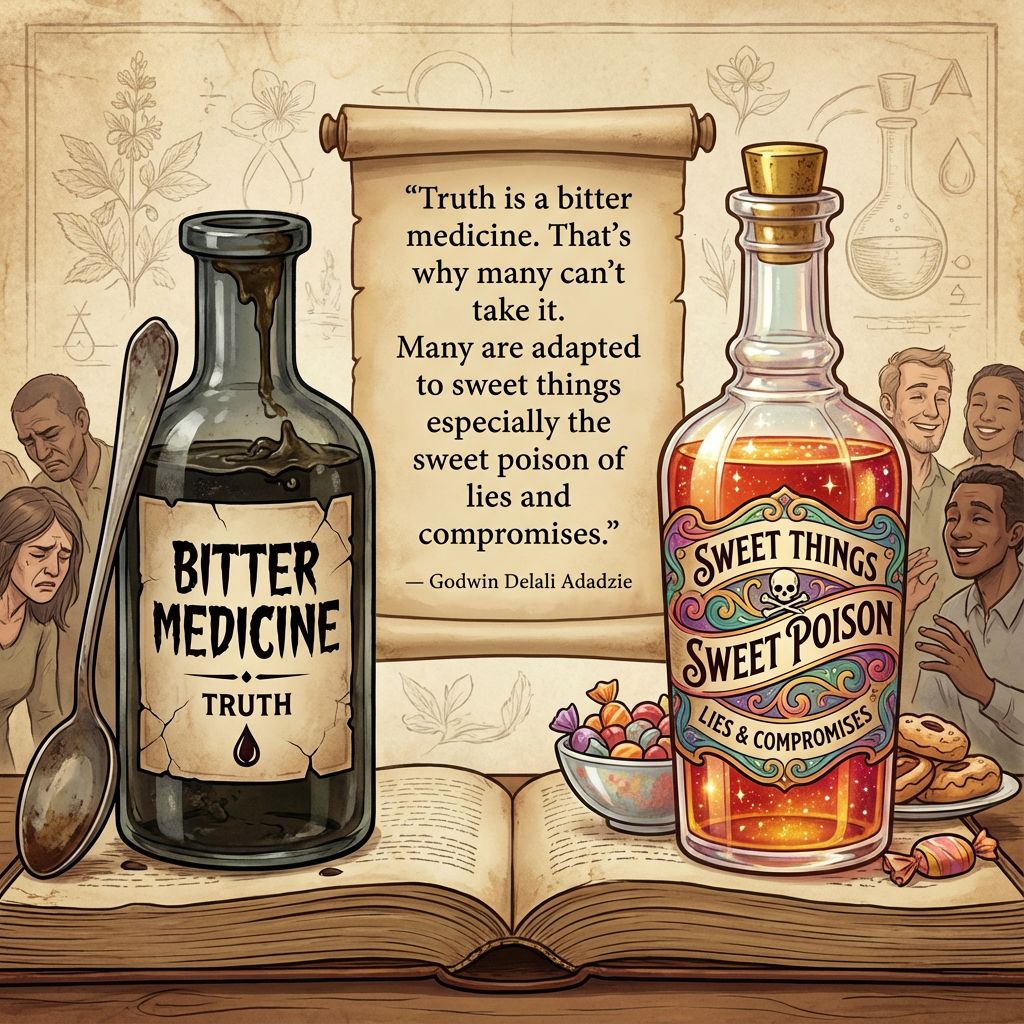
“Truth is a bitter medicine. That’s why many can’t take it. Many are adapted to sweet things especially the sweet poison of lies and compromises.”
— Godwin Delali Adadzie
Context and Inspiration
This reflection addresses a painful reality about human nature and truth: people often prefer comforting lies to uncomfortable truths. The observation uses a powerful metaphor comparing truth to bitter medicine—unpleasant to take but necessary for healing—while lies are sweet poison that tastes good while destroying from within. Many people have become so used to sweet things—flattery, false comfort, easy answers, convenient compromises—that they’ve lost the ability to receive truth when it challenges them, convicts them, or requires them to change. A doctor prescribing bitter medicine isn’t being mean; they’re trying to heal. But patients often refuse the medicine because it tastes bad, preferring sweet remedies that make them feel better temporarily while leaving the underlying disease untreated. Similarly, truth-tellers who speak hard truths are often rejected, attacked, or silenced, not because they’re wrong but because their message is bitter. Meanwhile, people who tell comforting lies are celebrated and followed, even as their sweet poison slowly kills those who consume it.
Why Truth Is Bitter
Truth often tastes bitter because it challenges, convicts, and demands change:
Truth Exposes Sin: When truth reveals your sin, it hurts. Nobody likes having their failures, selfishness, or wrongdoing exposed.
John 3:19-20 explains: “This is the verdict: Light has come into the world, but people loved darkness instead of light because their deeds were evil. Everyone who does evil hates the light, and will not come into the light for fear that their deeds will be exposed.”
Truth is light. Light exposes what darkness hides. People avoid truth to avoid exposure.
Truth Destroys Illusions: Many people build their lives on comforting illusions—about themselves, their relationships, their future, their righteousness.
Truth shatters these illusions. This feels like attack, even when it’s rescue.
Truth Requires Repentance: When truth shows you’re wrong, genuine response requires repentance—admitting error, changing direction, making amends.
Pride hates this. It’s easier to reject truth than to repent.
Truth Demands Action: Truth about problems requires action to solve them. Truth about sin requires confession. Truth about injustice requires standing up. Truth about your situation requires difficult choices.
Many prefer ignorance because it requires nothing of them.
Truth Disrupts Comfort: Truth often means letting go of comfortable patterns, relationships, or beliefs that aren’t true or right.
People cling to comfortable lies rather than embrace disruptive truth.
Truth Isolates: Speaking truth can cost you relationships, acceptance, approval. Sometimes truth-tellers stand alone.
Jesus warned: “Brother will betray brother to death, and a father his child. Children will rebel against their parents and have them put to death. You will be hated by everyone because of me” (Matthew 10:21-22).
Biblical Examples of Bitter Truth
Scripture is full of bitter truths that people resisted:
Nathan Confronts David (2 Samuel 12:1-14): After David committed adultery and murder, Nathan told him the truth through a parable. When David reacted with anger at the injustice in the story, Nathan declared: “You are the man!”
Bitter truth. David could have killed Nathan. Instead, David repented. But many kings would have rejected the truth and executed the messenger.
Jeremiah’s Message (Jeremiah 38:1-6): Jeremiah prophesied that Jerusalem would fall to Babylon and people should surrender. Leaders threw him in a cistern to die, calling his message treasonous.
The truth was bitter—we’re losing, resistance is futile, God is judging us. They preferred sweet lies: “We’ll win! God is with us! Victory is coming!”
Jerusalem fell exactly as Jeremiah said. Truth was bitter but accurate. Lies were sweet but deadly.
Jesus and the Rich Young Ruler (Mark 10:17-22): The man wanted eternal life. Jesus told him the truth: “Sell everything you have and give to the poor, and you will have treasure in heaven. Then come, follow me.”
Bitter truth. The man went away sad because he loved wealth more than truth. Many teachers would have offered a sweeter message to keep him engaged.
Paul Confronts Peter (Galatians 2:11-14): Peter was compromising the Gospel by refusing to eat with Gentile believers when Jewish believers were present. Paul confronted him publicly.
Bitter truth that must have been humiliating for Peter. But Paul valued truth over Peter’s comfort or their relationship.
Jesus to the Pharisees (Matthew 23:1-36): Jesus called the religious leaders hypocrites, blind guides, whitewashed tombs full of dead bones—seven “woes” of harsh truth.
The Pharisees presented themselves as righteous. Jesus told the bitter truth: they were pretenders leading people astray.
This wasn’t mean—it was truthful. And it cost Jesus His life. The Pharisees rejected the bitter medicine and killed the physician.
The Sweetness of Lies
Why are lies sweet? What makes them appealing?
Lies Flatter: “You’re fine just as you are.” “You don’t need to change.” “That sin isn’t really that bad.”
These lies feel good but prevent growth and healing.
Lies Require Nothing: Truth demands response. Lies let you stay comfortable, unchanged, inactive.
Lies Protect Pride: Lies let you believe you’re right when you’re wrong, justified when you’re guilty, innocent when you’re not.
Lies Offer Easy Answers: Complex problems have complex solutions. Lies offer simple answers that don’t work but sound good.
Lies Promise Without Cost: “You can have it all!” “Follow your heart!” “You deserve this!” Lies promise benefits without sacrifice.
Lies Confirm Biases: We love hearing what we already believe. Lies tell us we’re right. Truth challenges us to reconsider.
Lies Draw Crowds: Tell people what they want to hear and crowds gather. Tell hard truths and crowds disperse.
This is why prosperity gospel preachers fill stadiums while prophets calling for repentance face persecution.
Sweet Poison of Lies
The quote calls lies “sweet poison”—they taste good going down but kill:
Spiritual Poison: False teaching that sounds good but leads away from God destroys souls.
2 Timothy 4:3-4 warns: “For the time will come when people will not put up with sound doctrine. Instead, to suit their own desires, they will gather around them a great number of teachers to say what their itching ears want to hear. They will turn their ears away from the truth and turn aside to myths.”
People seek teachers who tell sweet lies rather than bitter truth. This poison kills spiritually.
Relational Poison: Relationships built on flattery and avoiding truth are shallow and unstable. When crisis comes, they collapse.
Proverbs 27:6 says: “Wounds from a friend can be trusted, but an enemy multiplies kisses.”
Sweet kisses from those who tell you what you want to hear are more dangerous than wounds from friends who tell hard truth.
Personal Poison: When you believe lies about yourself—”I’m fine,” “I don’t have a problem,” “I can handle this”—you avoid addressing issues that destroy you.
Societal Poison: Societies that embrace comfortable lies rather than uncomfortable truths decay from within. Economic lies, political lies, cultural lies—all poison the society.
The poison is sweet, so people keep drinking it even as it kills them.
Compromises: The Middle Poison
The quote specifically mentions compromises as part of the sweet poison:
Compromise Sounds Reasonable: “Let’s meet in the middle.” “Can’t we find common ground?” “Both sides have valid points.”
Sometimes compromise is wisdom. But often it’s poison disguised as reasonableness.
Compromise on Truth Is Betrayal: Some things can’t be compromised. You can’t compromise between truth and lies. You can’t find middle ground between right and wrong.
Jesus didn’t compromise: “I am the way and the truth and the life. No one comes to the Father except through me” (John 14:6). That’s not a negotiable starting position—it’s truth.
Compromise Feels Sophisticated: Standing firm on truth sounds simplistic, rigid, dogmatic. Compromising sounds mature, nuanced, sophisticated.
But sophistication that betrays truth is just educated foolishness.
Compromise Avoids Conflict: Truth creates conflict with lies. Compromise avoids that conflict by blending truth with lies.
But this “peace” is false. True peace requires truth, not compromise with lies.
Compromise Corrupts Gradually: Major corruptions usually start with small compromises. “Just this once.” “Just a little.” “It’s not that important.”
Small compromises become habits. Habits become character. Character becomes destiny.
Elijah confronted Israel: “How long will you waver between two opinions? If the Lord is God, follow him; but if Baal is God, follow him” (1 Kings 18:21).
Choose. Don’t compromise between truth and lies.
Adapted to Sweetness
The quote observes that many are “adapted to sweet things”—they’ve lost the ability to receive bitter truth:
Tolerance for Truth Atrophies: Like taste buds accustomed to sugar can’t enjoy subtle flavors, minds accustomed to flattery can’t receive correction.
Emotional Fragility Increases: People raised on constant affirmation can’t handle criticism, even constructive feedback.
Discernment Disappears: When you consume mostly lies, you lose ability to recognize truth. Everything becomes subjective.
Dependency Develops: Like addiction, dependence on flattery and comfort grows. People need increasingly sweet lies to feel good.
Reality Becomes Enemy: When you’re adapted to lies, truth feels like attack. Reality itself becomes offensive.
This adaptation is dangerous because it makes healing impossible. The medicine that could cure you tastes so bitter you refuse it.
Speaking Bitter Truth
For those called to speak truth, several realities apply:
Expect Resistance: People will reject you, attack you, or dismiss you. Don’t be surprised.
Jesus warned: “If the world hates you, keep in mind that it hated me first” (John 15:18).
Speak Truth in Love: Bitter truth should be delivered with love, not harshness for its own sake.
Ephesians 4:15 instructs: “Instead, speaking the truth in love, we will grow to become in every respect the mature body of him who is the head, that is, Christ.”
Truth without love is harsh. Love without truth is useless. Both together are powerful.
Don’t Soften Truth: Some try to make truth more palatable by softening it. This corrupts the medicine.
Speak truth clearly, even when bitter. Let God handle the results.
Accept the Cost: Truth-telling often costs relationships, positions, comfort, reputation.
Count the cost and pay it. Truth is worth it.
Stay Humble: Truth-tellers aren’t superior. You’re just a messenger. You struggle with pride, lies, and compromise too.
Speak truth about yourself as readily as about others.
Trust God: You’re not responsible for making people receive truth. That’s the Holy Spirit’s work. You’re responsible for speaking it.
Receiving Bitter Truth
For those who need to receive hard truth:
Recognize the Gift: When someone tells you hard truth, they’re risking your rejection to help you. That’s a gift.
Proverbs 9:8 says: “Do not rebuke mockers or they will hate you; rebuke the wise and they will love you.”
Wise people value truth more than comfort.
Examine Your Reaction: When truth makes you angry or defensive, that’s often because it’s hitting something real.
Don’t dismiss truth just because it hurts. Medicine that doesn’t hurt might not be working.
Separate Message from Messenger: Sometimes truth comes from imperfect messengers. Don’t reject truth just because you don’t like who’s speaking it.
Pray for Humility: Ask God to make you receptive to truth, even bitter truth.
Act on Truth: Once you recognize truth, act on it. Don’t just acknowledge it—change based on it.
Thank Truth-Tellers: Let people know you appreciate honest feedback, even when it’s hard to hear.
The Sweetest Truth
Here’s the irony: while truth often tastes bitter initially, it leads to the sweetest outcomes:
Freedom (John 8:32): “Then you will know the truth, and the truth will set you free.”
Truth frees. Lies enslave. The bitter medicine of truth produces sweet freedom.
Healing: Facing truth about your sin, problems, or situation is painful. But it’s the path to healing. Denying truth keeps you sick.
Growth: You can’t grow by believing lies about yourself. Truth—even uncomfortable truth—enables genuine growth.
Peace: Living in truth produces deep peace. Living in lies produces constant anxiety that you’ll be exposed.
Better Relationships: Relationships built on truth are strong. Those built on flattery and avoidance are fragile.
Wisdom: Truth is foundation of wisdom. Lies produce foolishness, even educated foolishness.
The Gospel itself demonstrates this: the truth about our sin is bitter. But the truth about God’s grace is sweet beyond measure.
Reflection Questions
- What truths are you avoiding because they’re too bitter to face?
- Where have you been consuming sweet lies instead of bitter truth?
- What compromises have you made that corrupt truth?
- Are you adapted to sweetness—unable to receive correction or hard truth?
- When someone speaks hard truth to you, is your first reaction defensive or receptive?
- Where might God be calling you to speak bitter truth in love?
Related Quotes
- “Human beings are naturally foolish, dishonest and afraid.”
- “When you find the solution, it always works, regardless of whether you like it or not, regardless of whether you believe it or not.”
- “Be wise in this wicked, selfish, ungrateful and forgetful world of humans.”
Want to grow in truth-seeking and truth-telling? Explore my books on faith and truth, discover more quotes and reflections, or read more articles on living in reality.
Disclaimer: Adadzie.com is the personal website of Godwin Delali Adadzie. Content represents personal views and does not constitute official Catholic teaching, pastoral counseling, or professional advice. Quotes and reflections are shared for inspiration and reflection. For personal guidance, consult appropriate professionals. Questions? Email delali@adadzie.com | Read Full Disclaimer