
The Quote
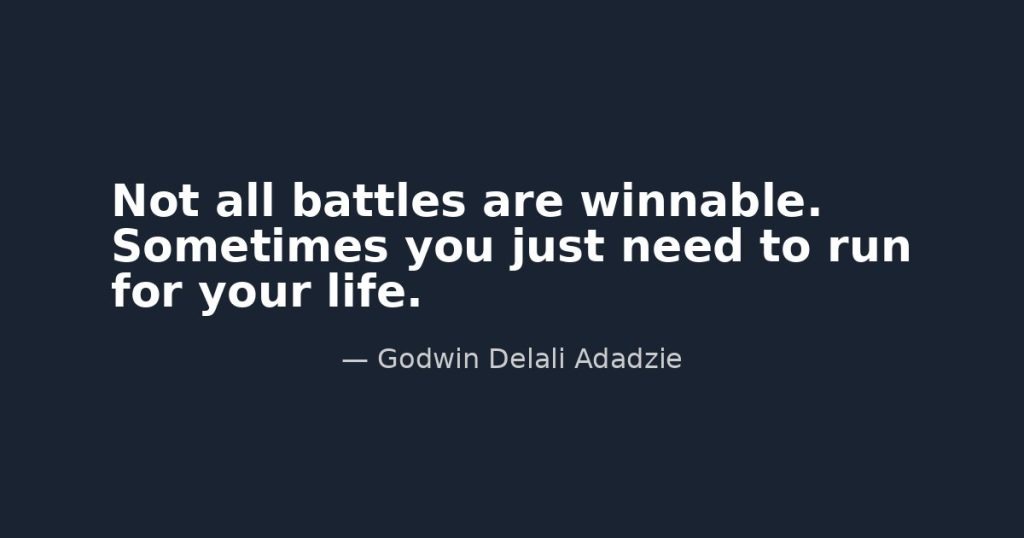
“Not all battles are winnable. Sometimes you just need to run for your life.”
— Godwin Delali Adadzie
Context and Inspiration
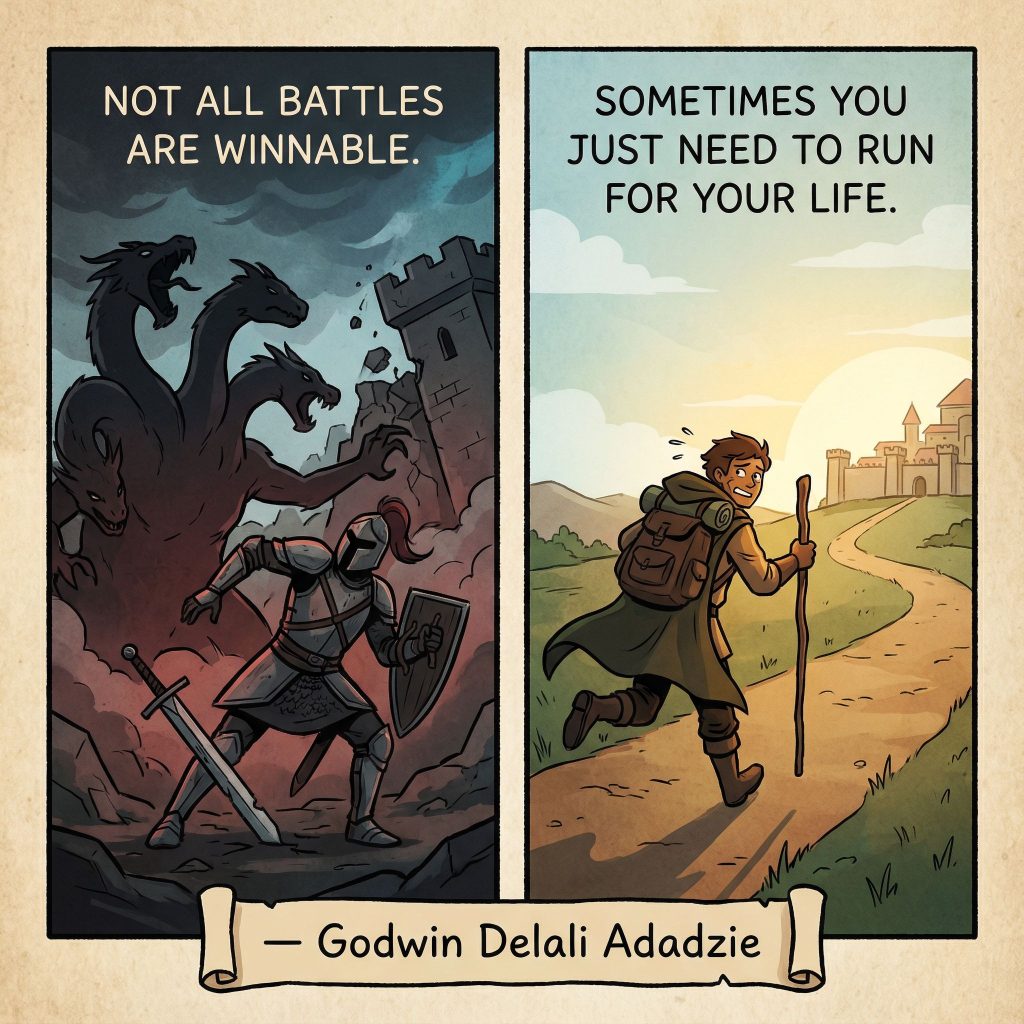
This reflection addresses a painful reality that many people struggle to accept: some battles simply cannot be won, and the wise response is to disengage rather than fight to the bitter end. The observation challenges the cultural narrative that says “never give up,” “winners never quit,” or “you can overcome anything with enough determination.” While persistence and perseverance are valuable qualities, wisdom requires recognizing when you’re fighting an unwinnable battle that will only destroy you if you continue. Some relationships cannot be saved no matter how much you try. Some business ventures will fail regardless of additional investment. Some conflicts have no resolution accessible to you. Some enemies are too powerful to defeat. Some situations are beyond your control or capacity to change. Continuing to fight these unwinnable battles doesn’t demonstrate courage or faith—it demonstrates foolishness and pride. True wisdom knows when to fight and when to withdraw, when to persist and when to cut losses, when standing firm serves purpose and when it only ensures your destruction.
Biblical Recognition of Unwinnable Battles
Scripture acknowledges that some battles cannot or should not be fought:
Ecclesiastes 3:1, 7-8: “There is a time for everything, and a season for every activity under the heavens… a time to tear and a time to mend, a time to be silent and a time to speak, a time to love and a time to hate, a time for war and a time for peace.”
Some times are not your time to fight. Some battles belong to other seasons or other people.
Matthew 10:14: Jesus instructed His disciples: “If anyone will not welcome you or listen to your words, leave that home or town and shake the dust off your feet.”
Don’t keep fighting for those who reject you. Move on.
Proverbs 26:4: “Do not answer a fool according to his folly, or you yourself will be just like him.”
Some arguments cannot be won and shouldn’t be engaged. The battle itself corrupts you.
2 Timothy 2:23: “Don’t have anything to do with foolish and stupid arguments, because you know they produce quarrels.”
Some battles are inherently unproductive. Avoid them entirely.
Romans 12:18: “If it is possible, as far as it depends on you, live at peace with everyone.”
Note: “if it is possible” and “as far as it depends on you.” Paul acknowledges some peace is impossible and some things don’t depend on you.
Luke 13:31-33: When warned that Herod wanted to kill Him, Jesus didn’t stay to confront Herod. He said, “Go tell that fox, ‘I will keep on driving out demons and healing people today and tomorrow, and on the third day I will reach my goal.'”
He acknowledged the threat but didn’t fight it directly. He kept His mission and moved on.
Types of Unwinnable Battles
Various battles fall into the “unwinnable” category:
Battles Against God’s Will: If God has determined something, fighting against it is futile.
When Jonah fled from God’s call, he couldn’t win that battle. Eventually he submitted.
Battles Requiring What You Don’t Have: Some battles require resources, authority, power, or capacity you simply don’t possess and cannot obtain.
David didn’t fight Goliath until God had prepared him. Fighting earlier would have been suicide.
Battles Against Hard Hearts: You cannot force someone to love you, change, repent, or accept truth if they’ve hardened their heart.
Jesus didn’t keep arguing with Pharisees who were determined to reject Him. At some point, He moved on.
Battles Against Overwhelming Force: Sometimes the enemy is simply too powerful for you to defeat.
David fled from Saul rather than fight him directly, even though David was anointed king.
Battles That Destroy You in Fighting: Some battles cost more than any possible victory is worth. Winning would leave you destroyed.
Pyrrhic victories are real—victories so costly that they’re actually defeats.
Battles Against Time and Nature: You cannot stop aging, prevent all illness, or make time stand still.
Battles to Control Others: You cannot control other people’s choices, feelings, or actions. Trying creates endless losing battle.
Battles That Aren’t Yours: Some battles belong to others, not you. Fighting them is presumption.
Signs a Battle Is Unwinnable
How do you recognize when to disengage?
No Progress Despite Sustained Effort: You’ve tried everything, invested heavily, persisted long-term, yet nothing changes. This often signals unwinnable battle.
Victory Would Require What You Cannot Provide: If winning requires resources, authority, or power you don’t have and can’t obtain, the battle is unwinnable for you.
The Cost Exceeds Any Possible Benefit: Even if you could win, the cost—emotional, financial, relational, spiritual—is greater than any victory’s value.
God’s Clear Direction to Disengage: If God has clearly told you to withdraw, continuing is fighting against God, not just the visible enemy.
You’re Fighting Alone Against Many: If no one supports you, everyone opposes you, and you have no allies, consider whether this is your battle.
The Battle Is Destroying You: If fighting is destroying your health, relationships, faith, or sanity, and there’s no end in sight, reassess.
Others Have Failed at Same Battle: If many capable people have tried and failed at this exact battle, maybe it’s unwinnable, at least for now.
You’re Fighting the Tide: Some situations are part of larger forces you can’t control. Fighting them is like fighting ocean tides.
Biblical Examples of Walking Away from Unwinnable Battles
Abraham and Lot (Genesis 13:5-12): When conflict arose over land, Abraham didn’t fight for his rights. He let Lot choose the better land and took what remained.
Abraham could have fought—he was the elder, the one with promise. But he chose peace over winning that battle.
Jacob Fleeing Esau (Genesis 27:41-45): After deceiving Esau, Jacob fled rather than face his brother’s wrath. He wasn’t ready for that confrontation.
Years later, prepared by God, he could face Esau. But initially, fleeing was wisdom.
David and Saul (1 Samuel 19-31): David fled from Saul for years rather than fight him. He had opportunities to kill Saul but refused.
That battle—overthrowing the current king—wasn’t his to fight at that time.
Jeremiah and the People (Jeremiah 42-44): After Jerusalem’s fall, the remnant asked Jeremiah for God’s word, promising to obey. God told them to stay in Judah.
They rejected the message and fled to Egypt. Jeremiah went with them but stopped trying to change their minds. That battle was lost.
Paul Leaving Cities (Acts 14:5-6, 17:10, 17:14): Multiple times, Paul left cities when opposition became too intense. He didn’t stay to win every battle.
He moved to where hearts were open rather than beating his head against closed doors.
Jesus and His Hometown (Luke 4:28-30): After His hometown tried to kill Him, Jesus didn’t stay to convince them. He went elsewhere where people would receive Him.
The Danger of Fighting Unwinnable Battles
What happens when you refuse to recognize and disengage from unwinnable battles?
Destruction: Continuing unwinnable battles destroys you—financially, emotionally, physically, spiritually.
Wasted Resources: Time, money, energy spent on unwinnable battles cannot be invested in winnable ones.
Missed Opportunities: While fighting unwinnable battles, you miss opportunities where you could actually make a difference.
Bitterness: Repeatedly losing unwinnable battles breeds bitterness, cynicism, and despair.
Damaged Relationships: Fighting battles that should be released damages relationships with those trying to help you disengage.
Pride: Often, continuing unwinnable battles is pride—”I can’t admit defeat,” “I can’t let them win,” “I must prove myself.”
Proverbs 16:18 warns: “Pride goes before destruction, a haughty spirit before a fall.”
Missing God’s Actual Plan: God may have different battle for you, but you’re too busy fighting unwinnable one to notice.
The Difference Between Unwinnable Battles and Hard Battles
Not every difficult battle is unwinnable. How do you distinguish?
Hard Battles:
- Progress exists, even if slow
- God has clearly called you to this specific fight
- Resources exist or are being provided
- You’re being strengthened through the battle
- Victory is possible with persistence
- The cause is worthy and within your calling
- Others confirm you should continue
Unwinnable Battles:
- No progress despite sustained effort
- God hasn’t called you to this fight
- Required resources don’t exist and won’t come
- The battle is destroying rather than strengthening you
- Victory is impossible given actual circumstances
- Continuing serves only pride or stubbornness
- Wise counsel urges withdrawal
Paul’s “thorn in the flesh” was hard battle he couldn’t win. He asked God three times to remove it. God said no. Paul accepted it and learned to live with it (2 Corinthians 12:7-10).
Sometimes God calls you to hard battles. But He also sometimes calls you to accept that certain battles aren’t yours to win.
The Courage to Withdraw
Withdrawing from unwinnable battles requires courage:
Courage to Admit Limits: It takes courage to say “I can’t win this” or “I was wrong about my ability to change this.”
Courage to Disappoint Others: People may expect you to keep fighting. Withdrawing disappoints them.
Courage to Face Shame: Culture often shames those who withdraw, calling them quitters, cowards, or failures.
Courage to Change Course: Having invested heavily, changing course feels like admitting waste. But it’s actually preventing further waste.
Courage to Trust God with Results: Withdrawing means releasing control of outcomes. This requires faith that God will handle what you cannot.
Courage to Ignore Critics: Those not in the battle will criticize your withdrawal. Their opinions don’t matter.
True courage isn’t always fighting—sometimes it’s knowing when to stop fighting.
Practical Applications
How does this apply in real situations?
Toxic Relationships: If you’ve tried everything to save a relationship but the other person refuses to engage, continuing to fight that battle only destroys you.
Sometimes love means releasing people to their choices and protecting yourself from continued harm.
Failing Businesses: If you’ve exhausted options and the business cannot survive, closing it before it destroys you financially and emotionally is wisdom, not failure.
Church Conflicts: When church conflict becomes destructive and you’ve exhausted biblical reconciliation attempts, leaving for another church can be wisdom.
Family Members’ Choices: You cannot force adult children, parents, or siblings to make right choices. Continuing to fight for control of their lives is unwinnable battle.
Career Paths: If despite best efforts, a career path isn’t working, recognizing this and changing direction is wisdom.
Health Battles: Some health conditions cannot be cured. Accepting this and focusing on quality of life rather than futile search for cure is sometimes wisest choice.
Addictions of Others: You cannot make an addict get sober. They must choose it. Fighting their battle for them is unwinnable.
Crusades Against Systemic Issues: Sometimes individuals cannot single-handedly change massive systemic problems. Recognizing limits allows you to contribute in realistic ways rather than destroying yourself.
What to Do After Withdrawing
Once you’ve recognized and disengaged from unwinnable battle:
Grieve the Loss: It’s okay to grieve what you couldn’t win, save, or change. This is healthy processing.
Release to God: “Cast all your anxiety on him because he cares for you” (1 Peter 5:7). Give God what you cannot fix.
Learn Lessons: What did this teach you? How can you recognize unwinnable battles sooner next time?
Heal: Battle wounds—emotional, spiritual, sometimes physical—need healing. Take time to recover.
Redirect Energy: Energy previously spent on unwinnable battle can now go toward productive purposes.
Find Winnable Battles: There are battles you can win. Find them and invest there.
Practice Self-Compassion: Don’t beat yourself up for not winning unwinnable battle. That’s like condemning yourself for not being able to fly.
Help Others: Your experience with unwinnable battles can help others recognize theirs and disengage before unnecessary destruction.
When God Wins the Unwinnable
Sometimes battles unwinnable for you are winnable for God:
God’s Power Where You Have None: What you cannot do, God can. “With man this is impossible, but with God all things are possible” (Matthew 19:26).
God’s Timing: Battles unwinnable now might be winnable later when circumstances change. Your withdrawal isn’t permanent surrender—it’s waiting for God’s timing.
God’s Methods: You might try to win through force while God wants to win through prayer, waiting, or indirect approach.
God’s Glory: Sometimes God lets you reach the end of your capacity so His power is clearly seen when breakthrough comes.
Paul learned: “My grace is sufficient for you, for my power is made perfect in weakness” (2 Corinthians 12:9).
Withdrawing from unwinnable battle isn’t lack of faith. It can be faith that God will do what you cannot.
Reflection Questions
- What unwinnable battles are you currently fighting?
- What keeps you from withdrawing—pride, fear of shame, others’ expectations?
- Have you confused perseverance in God-given battles with stubbornness in self-chosen ones?
- What could you accomplish if you redirected energy from unwinnable to winnable battles?
- Are you making your life about proving you can win unwinnable battles, or about fulfilling actual calling?
- What would change if you released to God what you cannot fix?
Related Quotes
- “Sometimes you just need to run for your life.”
- “Be wise in this wicked, selfish, ungrateful and forgetful world of humans.”
- “Once you are in this world, challenges will always come. Whether you are ready or not.”
Want to grow in wisdom about which battles to fight and which to release? Explore my books on faith and discernment, discover more quotes and reflections, or read more articles on living wisely.
Disclaimer: Adadzie.com is the personal website of Godwin Delali Adadzie. Content represents personal views and does not constitute official Catholic teaching, pastoral counseling, or professional advice. Quotes and reflections are shared for inspiration and reflection. For personal guidance, consult appropriate professionals. Questions? Email delali@adadzie.com | Read Full Disclaimer