
The Quote
“The Law used to be blind (meaning impartial); now the Law is no longer blind. It can see, and that is sad. Really sad.”
— Godwin Delali Adadzie
Context and Inspiration
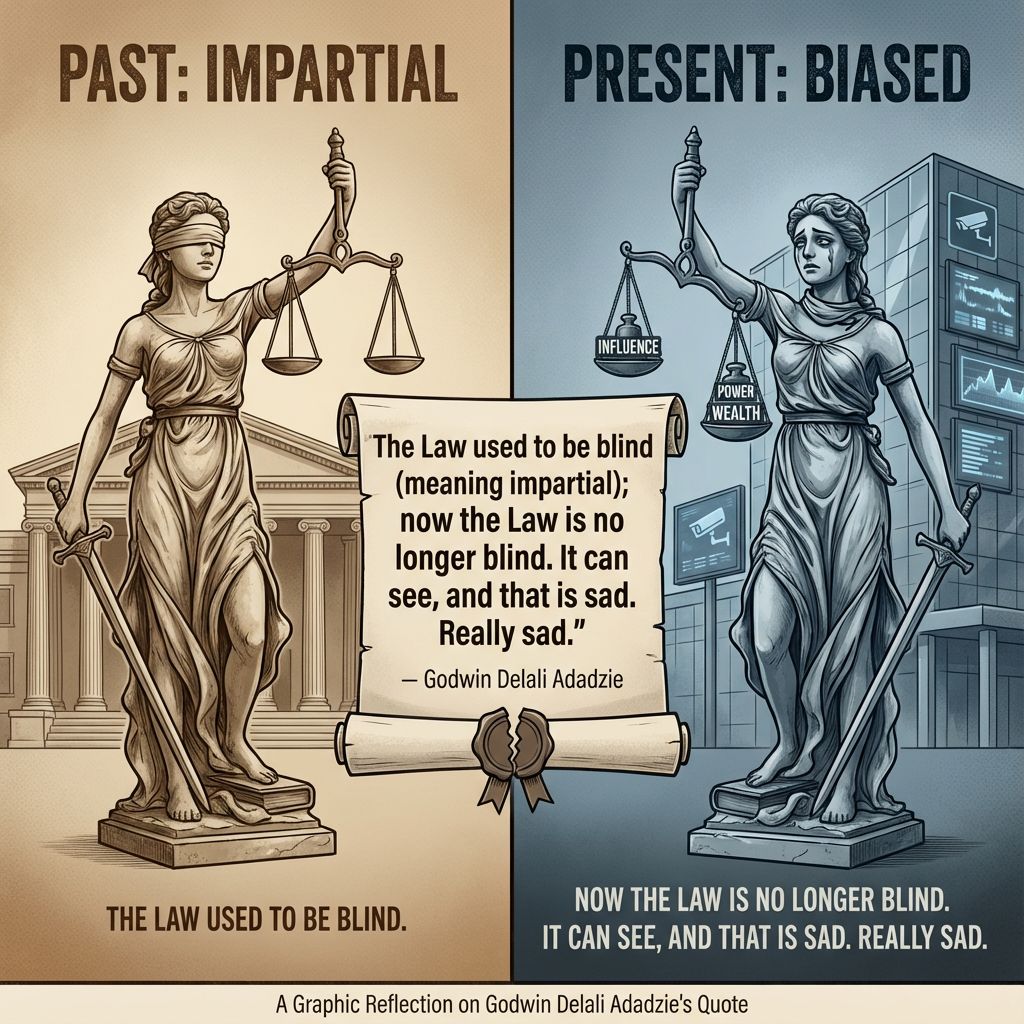
This reflection addresses a disturbing shift observed in legal systems worldwide: the movement from impartial justice to justice that favors certain people based on wealth, power, connections, or other factors unrelated to guilt or innocence. The observation references the traditional symbol of justice—Lady Justice wearing a blindfold to represent impartiality. The blindfold means justice treats everyone equally, judging only facts and evidence without regard to who stands before the court. But when “the Law can see,” it notices who has money, who has influence, who has the right connections, who belongs to the right group. This seeing corrupts justice completely because outcomes then depend not on what someone did but on who they are. The poor receive harsh sentences while the wealthy get warnings. The connected walk free while the powerless face maximum penalties. The well-represented receive justice while those with inadequate counsel receive injustice. This corruption destroys the foundation of any just society and betrays the very purpose of law.
The Symbol of Blind Justice
Lady Justice—the traditional symbol of legal systems—carries three things:
Scales: Weighing evidence and arguments fairly, measuring guilt and innocence.
Sword: Enforcing the law’s judgment, executing justice without hesitation.
Blindfold: The most important element—she cannot see who stands before her. She judges only the case, not the person.
The blindfold means:
- Rich and poor are judged by the same standard
- Powerful and weak receive equal treatment
- Famous and unknown face identical legal processes
- Connected and isolated encounter the same justice
- The judge sees only evidence, not identity
This ideal has never been perfectly realized anywhere. But it represents what justice should be—impartial, fair, blind to everything except truth and law.
When the Law removes the blindfold and starts seeing who stands before it, justice dies.
Biblical Foundation for Impartial Justice
Scripture consistently demands impartial justice:
Leviticus 19:15: “Do not pervert justice; do not show partiality to the poor or favoritism to the great, but judge your neighbor fairly.”
Notice this commands impartiality in both directions—don’t favor the rich, but also don’t favor the poor just because they’re poor. Judge fairly based on facts.
Deuteronomy 1:17: “Do not show partiality in judging; hear both small and great alike. Do not be afraid of anyone, for judgment belongs to God.”
The judge represents God’s justice. God shows no partiality. Neither should human judges.
Deuteronomy 16:19-20: “Do not pervert justice or show partiality. Do not accept a bribe, for a bribe blinds the eyes of the wise and twists the words of the innocent. Follow justice and justice alone.”
Bribes cause justice to “see” who’s paying. This corrupts everything.
Proverbs 18:5: “It is not good to be partial to the wicked and so deprive the innocent of justice.”
When justice favors the guilty because of who they are, innocence is robbed.
Proverbs 24:23: “These also are sayings of the wise: To show partiality in judging is not good.”
Partial justice isn’t just imperfect—it’s not good. It’s evil.
James 2:1-4: “My brothers and sisters, believers in our glorious Lord Jesus Christ must not show favoritism. Suppose a man comes into your meeting wearing a gold ring and fine clothes, and a poor man in filthy old clothes also comes in. If you show special attention to the man wearing fine clothes and say, ‘Here’s a good seat for you,’ but say to the poor man, ‘You stand there’ or ‘Sit on the floor by my feet,’ have you not discriminated among yourselves and become judges with evil thoughts?”
Even in church, showing favoritism based on wealth or appearance is condemned. How much more in legal justice?
When the Law “Sees”
What does it mean when the Law can see? It means justice depends on factors other than evidence:
Wealth Matters: Rich defendants hire expensive lawyers, expert witnesses, and private investigators. They post bail easily. They can drag cases out. They get plea deals.
Poor defendants get overworked public defenders, can’t afford bail, pressure to plead guilty quickly, and harsher sentences.
Same crime, different wealth, different justice. The Law sees bank accounts.
Power Matters: Powerful people have connections, political influence, and the ability to pressure prosecutors, judges, and witnesses. They receive kid-glove treatment.
Powerless people have no protection, no influence, no ability to push back. They get the full weight of the law.
Same crime, different power, different justice. The Law sees position.
Fame Matters: Celebrities and public figures often receive lenient treatment. Their trials become spectacles. Juries are star-struck. Sentences are light.
Unknown people receive standard or harsh treatment. No one cares. No media attention. Maximum sentences.
Same crime, different fame, different justice. The Law sees name recognition.
Race and Class Matter: In many systems, certain races or classes receive systematically harsher treatment—more likely to be arrested, charged, convicted, and given longer sentences for the same offenses.
Other races or classes receive systematically gentler treatment—less likely to be stopped, arrested, or given serious charges.
Same crime, different race or class, different justice. The Law sees skin color and background.
Connections Matter: Who you know changes everything. Prosecutors who know your family. Judges who attended your school. Lawyers who play golf with the right people.
People without connections navigate the system alone. No one cuts them breaks. No one makes calls on their behalf.
Same crime, different connections, different justice. The Law sees relationships.
The Consequences of Partial Justice
When justice becomes partial, everything crumbles:
Public Trust Dies: When people see that justice depends on who you are rather than what you did, they stop trusting the system.
Why follow laws if the wealthy and powerful break them with impunity while regular people suffer harsh consequences?
The Law Loses Authority: Law’s authority comes from its fairness. When fairness disappears, law becomes just another tool of oppression.
Crime Increases: If certain people can commit crimes without real consequences, they’ll continue. If others see no path to justice, they stop reporting crimes or seek their own vengeance.
Society Fractures: Partial justice divides society into those protected by the system and those victimized by it. This creates deep resentment and instability.
The Innocent Suffer: When justice is partial, innocent people are convicted while guilty people walk free—but the guilty people who walk free are those with money, power, or connections.
Cynicism Spreads: People become cynical about justice, fairness, and institutions generally. This cynicism corrodes civic life.
God Is Dishonored: Since God commands impartial justice, systems that practice partial justice dishonor Him.
Amos 5:24 cries out: “But let justice roll on like a river, righteousness like a never-failing stream!” When justice is partial, this stream is polluted.
Biblical Examples of Unjust Partiality
Ahab and Naboth’s Vineyard (1 Kings 21): Ahab wanted Naboth’s vineyard. Naboth refused to sell. Jezebel arranged for Naboth to be falsely accused, tried, and executed. Ahab took the vineyard.
The Law saw that Ahab was king and Naboth was nobody. Justice died.
The Rich Man and Lazarus (Luke 16:19-31): While not explicitly about legal justice, this parable illustrates how the rich lived in luxury while the poor suffered at their gates—a reality that included economic and legal systems favoring wealth.
Jesus’ Trial: Jesus faced an illegal trial—night proceedings, false witnesses, no proper defense, predetermined outcome. The religious authorities wanted Him dead. Justice was irrelevant.
Pilate knew Jesus was innocent but crucified Him anyway because of political pressure. Pilate saw the crowd’s reaction and chose political safety over justice.
Stephen’s Martyrdom (Acts 7): Stephen was falsely accused, given a mock trial, and stoned. The Law saw religious and political convenience, not evidence.
Paul’s Trials: Paul faced repeated legal proceedings where truth mattered less than politics, bribes, and favoritism (Acts 24:26-27). Felix kept Paul imprisoned for two years hoping for a bribe.
Modern Manifestations
Partial justice appears in many forms today:
Two-Tier Justice Systems: Some countries explicitly have different legal systems for citizens and non-citizens, wealthy and poor, military and civilian, or different ethnic groups.
Selective Prosecution: Prosecutors choose who to charge based on politics, not just evidence. Similar crimes receive wildly different treatment based on who committed them.
Bail Systems: Those with money buy freedom while awaiting trial. Those without money sit in jail for months or years before trial, even if innocent.
Legal Representation Quality: Expensive lawyers produce better outcomes than overworked public defenders, even with identical facts.
Plea Bargain Pressure: Poor defendants feel pressured to plead guilty to crimes they didn’t commit because they can’t afford to fight or risk harsher sentences if they lose at trial.
Civil Asset Forfeiture: In some systems, authorities can seize property without proving guilt, and recovering it requires expensive legal proceedings. The poor lose everything. The wealthy hire lawyers.
Corporate vs. Individual Treatment: Corporations pay fines for actions that would send individuals to prison. Wealthy executives receive white-collar crime treatment while poor thieves face harsh sentences.
International Justice: Powerful nations face no consequences for actions that would bring international sanctions against weaker nations.
What Christians Should Do
Followers of Jesus must respond to unjust systems:
Recognize the Problem: Don’t pretend justice is blind when it clearly isn’t. Acknowledge the reality.
Speak Truth: Call out injustice when you see it. Silence protects corrupt systems.
Proverbs 31:8-9 commands: “Speak up for those who cannot speak for themselves, for the rights of all who are destitute. Speak up and judge fairly; defend the rights of the poor and needy.”
Support Reform: Work for legal reforms that reduce partiality—bail reform, public defender funding, sentencing guideline reforms, body cameras, civilian oversight.
Help the Vulnerable: Provide legal aid, support public defenders, help people navigate systems, post bail for those who can’t afford it.
Practice Justice in Your Sphere: If you have any authority—employer, church leader, community member—practice impartial justice. Don’t favor the wealthy, powerful, or connected.
Pray: Pray for judges, prosecutors, defense attorneys, police, and all involved in justice systems. Pray for wisdom, courage, and integrity.
Vote: Support leaders and policies that promote impartial justice.
Support Victims: Those harmed by unjust systems need support, advocacy, and help recovering.
Teach Justice: Raise children who value fairness and resist partiality. Create cultures where impartiality is celebrated.
God’s Perfect Justice
While human justice fails repeatedly, God’s justice never fails:
God Shows No Partiality (Romans 2:11): “For God does not show favoritism.” He judges based on truth, not status.
God Sees Everything (Hebrews 4:13): “Nothing in all creation is hidden from God’s sight. Everything is uncovered and laid bare before the eyes of him to whom we must give account.”
God sees all crimes, including those human courts ignore. He sees all innocence, including those human courts condemn.
God Judges Justly (Psalm 9:7-8): “The Lord reigns forever; he has established his throne for judgment. He rules the world in righteousness and judges the peoples with equity.”
God Vindicates the Innocent (Psalm 7:8-9): “Let the Lord judge the peoples. Vindicate me, Lord, according to my righteousness, according to my integrity, O Most High. Bring to an end the violence of the wicked and make the righteous secure—you, the righteous God who probes minds and hearts.”
God Punishes the Guilty (Nahum 1:3): “The Lord is slow to anger but great in power; the Lord will not leave the guilty unpunished.”
Ultimate Justice Comes (Revelation 20:12-13): “And I saw the dead, great and small, standing before the throne, and books were opened… The dead were judged according to what they had done as recorded in the books.”
In that judgment:
- No lawyers can manipulate outcomes
- No bribes can buy freedom
- No connections can influence the Judge
- No power can intimidate justice
- No wealth can purchase innocence
God’s justice is truly blind—blind to everything except truth.
Living with Injustice
How do we live in systems where the Law can see and justice fails?
Don’t Become Cynical: Yes, systems are corrupt. But don’t let that make you bitter or give up on justice entirely.
Trust God’s Justice: When human justice fails, God’s doesn’t. “Will not the Judge of all the earth do right?” (Genesis 18:25).
Practice Personal Integrity: Even if systems are corrupt, maintain your own integrity. Don’t contribute to injustice.
Help Where You Can: Support victims, advocate for reform, speak truth. Small actions matter.
Remember the Eternal Perspective: Current injustices are temporary. God’s justice is eternal.
Romans 12:19 reminds us: “Do not take revenge, my dear friends, but leave room for God’s wrath, for it is written: ‘It is mine to avenge; I will repay,’ says the Lord.”
This doesn’t mean we stop pursuing earthly justice—we should fight for it. But it means we don’t despair when earthly justice fails. God’s justice never fails.
Hope for Change
Can corrupted justice systems be reformed? History shows it’s possible but difficult:
Reformers Must Be Persistent: Fighting entrenched injustice requires sustained effort, not quick campaigns.
Multiple Approaches Work Together: Legal reform, advocacy, education, political action, cultural change—all contribute.
Small Victories Matter: Complete justice may not come quickly, but each improvement helps real people.
Prophetic Voices Are Essential: People willing to speak uncomfortable truths push systems toward justice.
Public Pressure Works: When ordinary citizens demand justice, systems can change.
God Works Through People: When Amos, Isaiah, and other prophets condemned injustice, they moved nations toward reform.
Reflection Questions
- Have you witnessed or experienced partial justice? How did it affect your trust in legal systems?
- Where do you see the Law “seeing” things it shouldn’t—wealth, power, connections, race?
- What can you do in your sphere of influence to promote impartial justice?
- How does knowing God’s justice is perfect help you respond to human injustice?
- Are you silent about injustice to avoid controversy, or do you speak up?
- How can you support those victimized by partial justice?
Related Quotes
- “Be wise in this wicked, selfish, ungrateful and forgetful world of humans.”
- “Truth is a bitter medicine. That’s why many can’t take it.”
- “When you find the solution, it always works, regardless of whether you like it or not, regardless of whether you believe it or not.”
Want to learn more about biblical justice and righteousness? Explore my books on faith and justice, discover more quotes and reflections, or read more articles on living righteously in unjust systems.
Disclaimer: Adadzie.com is the personal website of Godwin Delali Adadzie. Content represents personal views and does not constitute official Catholic teaching, pastoral counseling, or professional advice. Quotes and reflections are shared for inspiration and reflection. For personal guidance, consult appropriate professionals. Questions? Email delali@adadzie.com | Read Full Disclaimer