
The Quote
“When the party is over, everyone leaves for their homes. This is the reality of life. You are left alone after all the merrymaking is over.”
— Godwin Delali Adadzie
Context and Inspiration
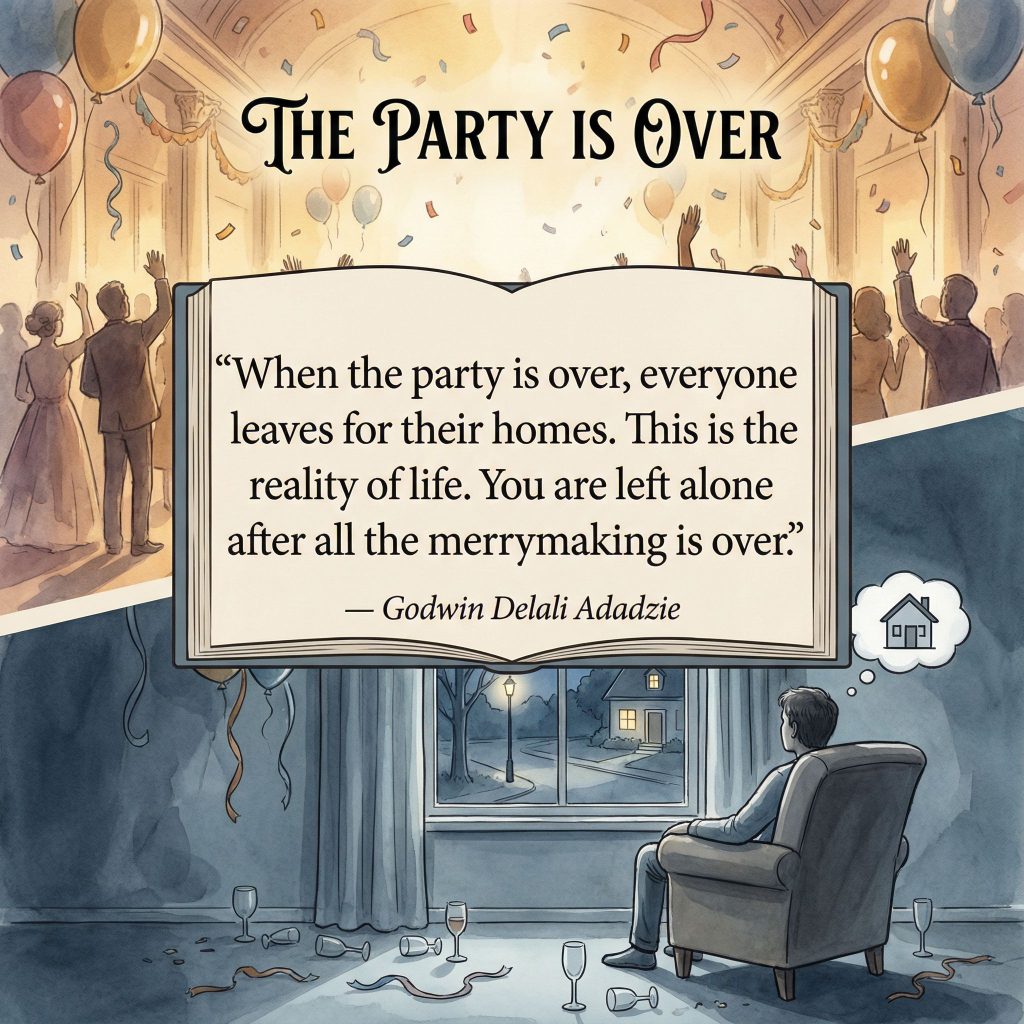
This reflection addresses a fundamental truth about human existence that many people spend their lives trying to avoid: essential aloneness. The observation uses the simple image of a party ending to capture something profound about life itself. No matter how many people surround us during the celebration, no matter how connected we feel in moments of joy and community, everyone eventually goes home. The hosts clean up empty cups and decorations in silence. The laughter fades. The crowd disperses. And we find ourselves alone with our own thoughts, our own choices, our own relationship with God. This isn’t pessimistic or depressing—it’s simply acknowledging reality. Understanding this truth actually helps us live better, love more authentically, build proper foundations, and recognize what truly matters when the noise and excitement fade away.
The Illusion of Constant Company
Modern culture works hard to help us avoid ever being truly alone. We’re surrounded by noise, entertainment, notifications, and the constant presence of others—at least digitally.
When we wake up, we immediately check our phones. Throughout the day, we’re texting, scrolling, watching, listening. We fill silence with podcasts. We fill solitude with social media. We schedule our lives so full that we’re rarely without plans, people, or distractions.
This creates an illusion: that we’re never really alone, that we’re always connected, that community is constant.
But it’s an illusion. Eventually, the phone battery dies. The party ends. The friends go home. The notifications stop. The entertainment ends. And you’re left with yourself, your thoughts, and your God.
Some people spend their entire lives running from this reality, constantly seeking the next party, the next distraction, the next way to avoid being alone with themselves.
But you can’t outrun it forever.
Biblical Recognition of Essential Aloneness
Scripture acknowledges this reality repeatedly:
We Enter Life Alone and Leave It Alone: Job said: “Naked I came from my mother’s womb, and naked I will depart” (Job 1:21). We arrive with nothing and leave with nothing. No one can walk that path for us.
We Face Judgment Individually: “For we must all appear before the judgment seat of Christ, so that each of us may receive what is due us for the things done while in the body, whether good or bad” (2 Corinthians 5:10).
You won’t face God as part of a crowd. It will be you and Him. What you did with your life. How you responded to His grace. The choices you made.
Some Spiritual Battles Are Fought Alone: Jesus in Gethsemane took Peter, James, and John with Him—His closest friends. But even they couldn’t stay awake to support Him. He faced His darkest hour essentially alone, praying: “My Father, if it is possible, may this cup be taken from me. Yet not as I will, but as you will” (Matthew 26:39).
The disciples were nearby, but they couldn’t bear the weight with Him. Some burdens you carry alone.
Elijah’s Isolation: After his great victory over the prophets of Baal, Elijah ran for his life and ended up alone in a cave, depressed and suicidal: “I have had enough, Lord… I am the only one left” (1 Kings 19:4, 10).
Even prophets of God experience profound aloneness. The crowd that cheered his victory wasn’t there in his moment of despair.
Paul’s Abandonment: Near the end of his life, Paul wrote: “At my first defense, no one came to my support, but everyone deserted me” (2 Timothy 4:16).
The great apostle, after decades of ministry and countless lives changed, faced his trial alone. The party was over. People had moved on.
Why This Reality Matters
Understanding that you’ll ultimately be alone isn’t depressing nihilism. It’s crucial wisdom that affects how you live:
It Clarifies What Actually Matters: When you know the party will end and everyone will go home, you stop living for the applause, the crowd’s approval, or the temporary excitement.
You ask deeper questions: What matters when I’m alone? What foundation am I building that remains when the entertainment stops? What am I becoming when no one’s watching?
It Reveals the Difference Between Crowds and Community: Some people confuse being surrounded by people with genuine community. But being in a crowd isn’t the same as having real relationships.
When the party ends, real friends check on you. Crowds just disappear. Understanding this helps you invest in depth rather than breadth—a few real relationships rather than hundreds of shallow connections.
It Exposes False Securities: Many people build their security on things that can’t last—popularity, success, position, being needed, being admired.
But when the party’s over, these things provide no comfort. The promotion doesn’t hold your hand. The applause doesn’t fill the emptiness. The crowd’s admiration doesn’t answer your existential questions.
It Forces You to Develop Inner Strength: If you’re constantly avoiding aloneness, you never develop the inner resources to handle it. But life will force aloneness on you—through loss, disappointment, aging, or simply quiet moments.
People who’ve learned to be alone with themselves are stronger, more stable, and less desperate than those who must constantly surround themselves with noise and people.
It Points You Toward God: When you recognize that no human relationship can fill the deepest aloneness of the human soul, you’re positioned to discover that only God can.
Augustine famously prayed: “You have made us for yourself, O Lord, and our heart is restless until it finds rest in you.” That restlessness is the ache of aloneness that only God can satisfy.
The Different Kinds of Aloneness
Not all aloneness is the same. Scripture and human experience reveal several types:
Physical Aloneness: Being literally by yourself with no one else present. This is the most obvious form and often the easiest to handle. You can be physically alone but emotionally and spiritually connected.
Jesus regularly withdrew to solitary places to pray (Luke 5:16). This wasn’t loneliness; it was intentional solitude.
Emotional Aloneness: Being surrounded by people but feeling disconnected, misunderstood, or emotionally isolated. This is often more painful than physical aloneness.
You can be in a crowd, even in a relationship, and still feel profoundly alone if no one truly knows you or connects with your inner reality.
Existential Aloneness: The deep awareness that you are ultimately a distinct individual with your own consciousness, choices, and responsibility before God. No one can live your life for you or make your choices.
This is the aloneness the quote primarily addresses. Even when you have wonderful relationships, you remain fundamentally yourself—distinct, individual, accountable.
Spiritual Aloneness: The sense of being cut off from God, either through sin or through seasons when God seems distant.
David cried out: “My God, my God, why have you forsaken me?” (Psalm 22:1). This spiritual aloneness is perhaps the most painful form.
Circumstantial Aloneness: Being forced into aloneness by life circumstances—widowhood, singleness when you desire marriage, losing friends through relocation or life changes, aging and outliving peers.
This aloneness isn’t chosen but must be navigated.
The Danger of Avoiding Aloneness
Many people spend enormous energy avoiding ever being alone. But this avoidance creates serious problems:
You Never Know Yourself: Self-knowledge requires solitude. If you’re constantly distracted by entertainment, people, or noise, you never examine your own heart, motives, fears, desires, or beliefs.
Socrates said, “The unexamined life is not worth living.” Examination requires aloneness.
You Become Dependent on External Validation: If you can’t be okay alone, you become desperate for constant validation from others. You need the party, the crowd, the applause, the attention.
This makes you manipulable and unstable. Your peace depends on external circumstances rather than internal foundation.
You Never Develop a Real Relationship with God: Relationship with God deepens in solitude. Prayer, meditation on Scripture, listening for God’s voice—these happen in quiet, not in crowds.
If you’re always avoiding aloneness, your relationship with God remains shallow.
You’re Unprepared for Unavoidable Aloneness: Life will force aloneness on you eventually—through loss, illness, aging, or circumstance. If you’ve spent your life avoiding it, you’ll be devastated when it comes.
But if you’ve learned to be alone with God and yourself, you can handle these seasons with grace.
You Miss the Gifts of Solitude: Solitude offers tremendous gifts—creativity, clarity, spiritual depth, self-knowledge, peace, and intimacy with God. People who avoid aloneness miss all of this.
The Gifts of Embracing Aloneness
Learning to be comfortable with aloneness brings unexpected blessings:
Clarity: When the noise stops, you can finally hear your own thoughts. You can discern what you truly believe versus what you’ve absorbed from others. You can identify what matters versus what’s just urgent.
Creativity: Many of history’s greatest works were created in solitude. Distraction kills creativity. Quiet enables it.
Self-Knowledge: In aloneness, you discover who you are when no one’s watching, what you value when no one’s applauding, what you believe when no one’s questioning.
Intimacy with God: God speaks in whispers, not shouts. “After the earthquake came a fire, but the Lord was not in the fire. And after the fire came a gentle whisper” (1 Kings 19:12).
You hear the whisper in quiet, not in chaos.
Strength: People who are comfortable alone are stronger than those who desperately need constant company. They can stand alone when necessary. They’re not easily swayed by crowds.
Rest: True rest requires solitude. If you’re constantly performing, entertaining, or interacting, you never fully rest. Aloneness provides space for your soul to breathe.
Freedom: When you’re okay being alone, you stop making desperate choices to avoid it. You don’t stay in unhealthy relationships because you fear being alone. You don’t compromise values to maintain approval. You’re free.
Jesus and Solitude
Jesus provides the perfect model for handling aloneness:
He Regularly Withdrew to Solitary Places: “Very early in the morning, while it was still dark, Jesus got up, left the house and went off to a solitary place, where he prayed” (Mark 1:35).
After feeding 5,000 people, after healing crowds, after teaching—Jesus withdrew alone. He didn’t let the constant needs of others prevent Him from solitude.
He Was Comfortable Being Alone: Jesus wasn’t desperately seeking crowds. Yes, He ministered to people and valued community. But He was equally comfortable alone with the Father.
He Found Strength in Solitude: Before major decisions or intense spiritual battles, Jesus went alone to pray. The solitude strengthened Him for what was ahead.
He Knew the Difference Between Crowds and Connection: Jesus had multitudes following Him, but He also had an inner circle. And even within that circle, He had moments of aloneness.
After His arrest, all His disciples abandoned Him (Mark 14:50). The crowd that had cheered Him on Palm Sunday shouted “Crucify Him!” on Friday. The party ended. Everyone went home.
But Jesus had foundation that didn’t depend on the crowd.
He Promises to End Ultimate Aloneness: Even as Jesus acknowledged reality—”You will be scattered, each to your own home. You will leave me all alone”—He also promised: “Yet I am not alone, for my Father is with me” (John 16:32).
And He extends that same promise to us: “And surely I am with you always, to the very end of the age” (Matthew 28:20).
The Only Companion Who Never Leaves
The quote’s observation is true: when the party ends, everyone goes home. You are ultimately alone.
Except you’re not.
God never leaves.
When the crowd disperses, God remains. When friends fail, God is faithful. When you face your darkest hour alone, God is present.
David knew this: “Even though I walk through the darkest valley, I will fear no evil, for you are with me” (Psalm 23:4).
This is why cultivating relationship with God matters so much. Human relationships are wonderful gifts—but they’re temporary, imperfect, and limited. Only God remains constant.
The person who knows God deeply can handle aloneness because they’re never truly alone.
The person who depends entirely on human company for their sense of connection will be devastated when that company inevitably fails or leaves.
Practical Applications
How do you live in light of this reality?
Practice Solitude Regularly: Don’t wait for aloneness to be forced on you. Choose it intentionally. Spend time alone with God regularly—praying, reading Scripture, listening, reflecting.
Start with small amounts if solitude feels uncomfortable. Gradually increase it. Learn to be comfortable in quiet.
Build Your Foundation on What Lasts: Don’t build your identity, security, or worth on things that depend on crowds—popularity, applause, being needed, social status.
Build on relationship with God, character, integrity, faith. These remain when everything else falls away.
Invest in Deep Relationships, Not Just Crowds: Have a few real friends who know you deeply, not hundreds of shallow connections. Real friends are there when the party ends, not just during it.
Prepare for Unavoidable Aloneness: Recognize that life will bring seasons of aloneness—through loss, change, or circumstance. Build the spiritual resources now that you’ll need then.
Use Aloneness Productively: When you find yourself alone, don’t immediately fill the silence with distraction. Use it for prayer, reflection, creativity, rest, or deep thinking.
Remember the Eternal Perspective: The ultimate reality isn’t aloneness but communion—eternal fellowship with God and His people. The aloneness of this life is temporary. “For now we see only a reflection as in a mirror; then we shall see face to face” (1 Corinthians 13:12).
The Danger of the Perpetual Party
Some people try to make life one continuous party—constant entertainment, constant company, constant excitement. But this creates exhaustion and emptiness.
You can’t sustain perpetual celebration. You need rhythms of gathering and solitude, noise and quiet, community and aloneness.
The person who tries to maintain the party forever eventually burns out or breaks down. You can’t run from reality indefinitely.
Better to embrace the rhythm: Enjoy the party while it lasts. Celebrate with others. But also accept when it ends. Go home at peace. Be comfortable alone. Find God in the quiet.
When Being Alone Becomes Loneliness
There’s an important distinction between solitude and loneliness:
Solitude is chosen aloneness that refreshes and strengthens. Loneliness is painful isolation that wounds and drains.
Solitude says: “I’m okay being alone because I’m never truly alone.” Loneliness says: “I’m cut off, unwanted, forgotten.”
If your aloneness has become loneliness:
Reach out to others. God designed us for community. If you’re isolated, take steps to connect—join a church, a small group, a community activity.
Deepen your relationship with God. Often loneliness is ultimately a spiritual hunger that no amount of human company fully satisfies. Draw near to God.
Serve others. Paradoxically, serving others helps with loneliness. It gets you outside yourself and creates meaningful connection.
Seek help if needed. If loneliness has become depression or despair, talk to a pastor, counselor, or trusted friend.
The quote acknowledges reality—we are ultimately alone. But that doesn’t mean we must suffer crushing loneliness. God provides both His presence and human community to sustain us.
The Ultimate Party
The Christian hope is that the current reality of aloneness is temporary. We’re heading toward an eternal party that never ends—the marriage supper of the Lamb, eternal fellowship with God and His people.
Revelation 21:3-4 promises: “Look! God’s dwelling place is now among the people, and he will dwell with them. They will be his people, and God himself will be with them and be their God. He will wipe every tear from their eyes. There will be no more death or mourning or crying or pain.”
No more aloneness. No more the party ending and everyone going home. Just eternal joy, perfect communion, complete belonging.
But until then, we live in the tension—enjoying community while accepting aloneness, celebrating together while being comfortable alone, building relationships while knowing they’re temporary.
And through it all, cultivating relationship with the One who never leaves, never fails, and promises to be with us always.
Reflection Questions
- How comfortable are you with being alone? Do you constantly fill silence and solitude with distractions?
- What are you building your life on—things that depend on crowds, or things that remain when you’re alone?
- When was the last time you experienced deep solitude with God? What keeps you from practicing this regularly?
- Are you cultivating deep relationships that last beyond the “party,” or just collecting shallow connections?
- What would change if you truly accepted that you’ll ultimately face God individually, accountable for your own choices?
- Is your aloneness restful solitude or painful loneliness? What needs to change?
Related Quotes
- “Be grateful always! Never be jealous of those better than you if you will not be jealous of those worse than you.”
- “If you don’t want to end up disappointed. Don’t get too excited too soon and don’t expect too much.”
- “Everything is expensive. You just pay for it now or later.”
Want to grow in spiritual depth and peace with solitude? Explore my books on faith and spiritual wisdom, discover more quotes and reflections, or read more articles on finding God in the quiet.
Disclaimer: Adadzie.com is the personal website of Godwin Delali Adadzie. Content represents personal views and does not constitute official Catholic teaching, pastoral counseling, or professional advice. Quotes and reflections are shared for inspiration and reflection. For personal guidance, consult appropriate professionals. Questions? Email delali@adadzie.com | Read Full Disclaimer